


Cryptocurrency Law 2026: Navigating Regulations in Calgary, Toronto, New York, and Berlin
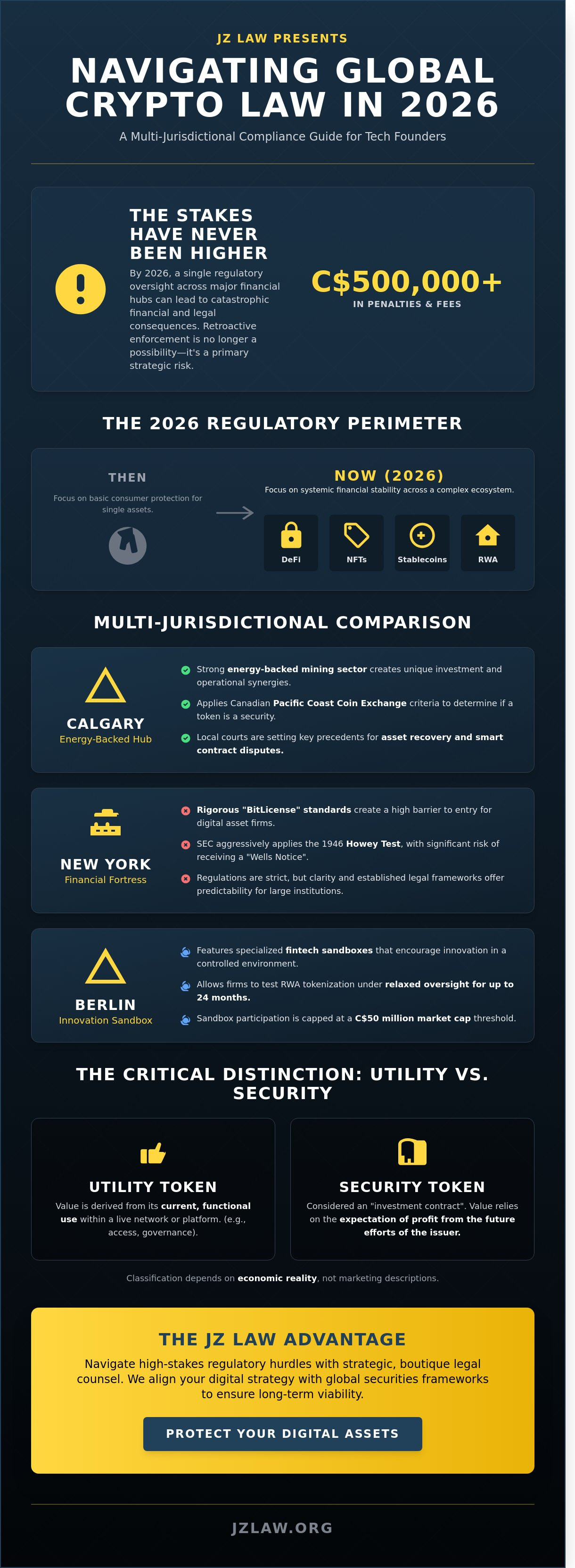
By 2026, the financial burden of a single regulatory oversight for firms operating across Calgary, Toronto, and New York could easily surpass C$500,000 in penalties and legal remediation fees. While the promise of decentralized finance remains strong, the reality of cryptocurrency law is becoming a complex web of city specific mandates and national enforcement actions. You likely feel the pressure of this fragmentation, especially when a structure that's legal in Berlin might trigger a "Wells Notice" from the SEC or a strict warning from the Canadian Securities Administrators. It's a high stakes environment where the fear of retroactive enforcement isn't just a possibility; it's a strategic risk you must manage daily.
We agree that the current lack of a unified global framework creates an exhausting administrative burden for tech founders. This article provides the comprehensive roadmap you need to achieve multi-jurisdictional compliance without sacrificing your business's agility. You'll gain clarity on the essential legal distinctions between utility tokens and securities while learning how a preventive legal partner can protect your firm's interests. We'll explore the specific regulatory climates of major financial hubs and show you how to build a corporate structure that's both legally sound and commercially viable.
Key Takeaways
Understand how the scope of cryptocurrency law has evolved by 2026 to encompass institutionalized regulations for DeFi, stablecoins, and the tokenization of real-world assets (RWA).
Navigate the complex legal distinction between utility tokens and regulated securities by applying updated Canadian equivalents to the traditional Howey Test.
Evaluate the strategic advantages of different jurisdictions, comparing Calgary’s energy-backed mining sector with the rigorous BitLicense standards of New York and Berlin.
Ensure operational continuity by implementing 2026-standard AML and KYC protocols, including mandatory FINTRAC registration for all Canadian-based digital asset firms.
Discover the competitive benefits of boutique legal counsel in managing high-stakes regulatory hurdles while aligning your digital strategy with broader securities frameworks.
Table of Contents What is Cryptocurrency Law in 2026? Defining the Regulatory Perimeter The Securities Debate: Are Your Tokens Regulated Assets? Multi-Jurisdictional Comparison: Calgary, New York, and Berlin Operational Compliance: AML, KYC, and Tax Structuring The JZ Law Advantage: Strategic Counsel for the Digital Economy
What is Cryptocurrency Law in 2026? Defining the Regulatory Perimeter
The era of the "wild west" in digital finance concluded with the comprehensive legislative overhauls finalized between 2023 and 2025. By 2026, cryptocurrency law has matured into a sophisticated pillar of corporate regulation that demands the same level of diligence as traditional securities or banking law. This legal field no longer focuses solely on the movement of Bitcoin. It now encompasses a complex web of Decentralized Finance (DeFi), Non-Fungible Tokens (NFTs), stablecoins, and the tokenization of Real World Assets (RWA).
The regulatory focus has undergone a fundamental shift. While earlier interventions prioritized basic consumer protection, the 2026 landscape is defined by the pursuit of systemic financial stability. Regulators now treat large-scale stablecoin issuers as systemically important financial institutions. This means firms must maintain liquidity ratios and capital reserves that mirror traditional banking standards to prevent market-wide contagion. Legal counsel doesn't just provide a shield against litigation anymore. We act as the essential bridge-builders, helping traditional financial institutions integrate blockchain technology while maintaining strict adherence to the global regulatory landscape for digital assets.
Modern cryptocurrency law requires a preventive mindset. Businesses shouldn't wait for a subpoena to evaluate their compliance posture. In 2026, the cost of retroactive legal restructuring often exceeds the initial investment of a properly shielded launch. Precision in documentation and a deep understanding of multi-jurisdictional requirements are the only ways to ensure long-term operational viability.
The Legal Definition of Digital Assets
In 2026, the legal classification of a token depends entirely on its functional utility and economic reality rather than its marketing description. Canadian statutes now distinguish between payment tokens, utility tokens, and security tokens with surgical precision. For regulatory purposes, the CSA and SEC in 2026 recognize a 'Crypto Asset' as a digital representation of value or contractual rights that can be transferred and stored electronically using distributed ledger technology or similar methods. Liability remains a primary differentiator between platforms. Centralized Exchanges (CEX) operate under strict fiduciary duties. In contrast, Decentralized Protocols (DEX) face "smart contract liability" if governance structures retain any form of centralized control or "admin keys" that suggest a lack of true decentralization.
Why Jurisdiction Matters: The Local Hub Effect
Geographic location is the primary determinant of a firm's regulatory burden. Local courts in Calgary and New York are currently setting precedents that influence global standards for asset recovery and smart contract disputes. Toronto and Berlin have established specialized fintech sandboxes that allow firms to test RWA tokenization under relaxed oversight for up to 24 months, provided they stay under a C$50 million market cap threshold. However, the "mind and management" rule remains the gold standard for enforcement. If your executive decisions happen in Ontario, you can't claim immunity through a shell company in a light-touch jurisdiction. Regulators look at where the control sits, not just where the server is located. This makes the choice of a corporate headquarters a high-stakes strategic decision.
The Securities Debate: Are Your Tokens Regulated Assets?
By 2026, the legal classification of digital assets has shifted from speculative theory to rigid enforcement. The United States continues to apply the Howey Test, a 1946 standard, to determine if a token constitutes an investment contract. In Canada, the Supreme Court's Pacific Coast Coin Exchange criteria serve a similar function. If your token involves an investment of money in a common enterprise with an expectation of profit from the efforts of others, it's likely a security. This distinction is critical for Calgary-based firms issuing utility tokens. If a token's primary value depends on the issuer's future development rather than current functionality, regulators will likely flag it.
Choosing between an Initial Exchange Offering (IEO) and a private placement involves significant trade-offs. Private placements under National Instrument 45-106 allow issuers to raise capital from "accredited investors" without a full prospectus. By contrast, IEOs on centralized exchanges often trigger immediate scrutiny regarding cryptocurrency law compliance. JZ Law adopts a preventive strategy; we conduct rigorous audits before any code is deployed to ensure clients avoid costly enforcement actions. For a tailored assessment of your token's regulatory status, consult our compliance team.
SEC vs. CSA: Comparing North American Approaches
In 2026, the SEC's New York and Denver offices have intensified their focus on decentralized finance (DeFi) protocols. North of the border, the Canadian Securities Administrators (CSA) have solidified rules for value-referenced crypto assets. Stablecoin issuers must now maintain 1:1 reserves in highly liquid CAD-denominated assets. A key friction point remains the "accredited investor" definition. In Toronto, an individual needs a net income exceeding C$200,000 for two consecutive years. In New York, the threshold is $200,000 USD (approximately C$275,000), creating a valuation gap that cross-border firms must reconcile.
MiCA and the European Standard
For Berlin-based firms, the Markets in Crypto-Assets regulation provides a structured path to compliance. This framework allows for "passporting," meaning a firm licensed by BaFin in Germany can legally offer services across all 27 EU member states. Navigating the MiCA regulation in Germany requires strict adherence to white paper disclosures and capital requirements. By 2026, BaFin has refined its crypto-custody license requirements, demanding robust cybersecurity protocols and segregated client accounts to prevent the commingling of assets. This clarity in cryptocurrency law gives European firms a predictable environment that North American entities often envy.
Regulatory Precision: BaFin requires a minimum capital of €125,000 (roughly C$185,000) for most crypto service providers.
Asset Segregation: Client funds must be kept separate from corporate holdings to protect against insolvency.
Transparency: Issuers must publish a detailed white paper that meets strict EU disclosure standards.
Multi-Jurisdictional Comparison: Calgary, New York, and Berlin
Strategic expansion in the digital asset space requires a preventive legal approach that anticipates regulatory shifts across borders. By 2026, the global landscape for cryptocurrency law has matured into a complex web of regional specialties. Success depends on aligning your corporate structure with the specific legal advantages of each hub. Calgary offers unmatched energy integration for miners, while New York maintains its role as the gatekeeper of institutional finance; Berlin continues to lead in decentralized governance and founder-friendly tax policies.
Canada: Calgary, Toronto, and Vancouver
Alberta's regulatory environment has become a magnet for infrastructure-heavy firms. The province's 2022 Technology Innovation and Emissions Reduction (TIER) regulation allows crypto-mining operations to integrate with oil and gas sites to utilize stranded energy. This creates a unique legal framework where mining isn't just a financial activity but an energy management service. In contrast, Ontario remains the most stringent jurisdiction for retail platforms. The Ontario Securities Commission (OSC) requires rigorous registration for any platform offering custodial services, a trend that solidified after the 2022 market volatility. British Columbia has carved out a niche by focusing on environmental, social, and governance (ESG) compliance. Digital asset firms in Vancouver must often demonstrate a net-zero carbon footprint to secure provincial grid access, making it the ideal home for "green" token projects.
USA: New York City and Denver
The New York Department of Financial Services (NYDFS) continues to set the global benchmark for stablecoin oversight. While the 2015 BitLicense was once seen as an outlier, it's now the foundation for the 2026 federal 'fit and proper' standards. Navigating U.S. Cryptocurrency Regulations requires managing the friction between New York's strict capital requirements and evolving SEC mandates. Colorado provides a starkly different atmosphere. The state's Digital Token Act provides safe harbors for tokens with a primary consumptive purpose, which has fueled a surge in Denver's utility-token ecosystem. Companies must decide if they prefer New York's institutional prestige or Colorado's innovation-friendly exemptions; choosing the wrong path can lead to federal preemption issues where state laws clash with national oversight.
Germany: Berlin, Frankfurt, and Hamburg
Germany's 2021 Electronic Securities Act (eWpG) has turned Frankfurt into the primary hub for institutional crypto-custody. It's the destination for firms seeking to issue blockchain-based bonds under the watchful eye of BaFin. Berlin remains the 'Blockchain Capital' for developers and founders. The city offers unique tax incentives for tech startups, including the ability for founders to hold assets for over one year to potentially qualify for capital gains exemptions under specific conditions. Hamburg is emerging as a leader in maritime blockchain applications. The city's legal focus on trade-finance law makes it a strategic base for companies automating global supply chains through smart contracts. To leverage the best of both worlds, many firms structure themselves with a Canadian LP for mining operations and a German GmbH for European market distribution.
Operational Compliance: AML, KYC, and Tax Structuring
By 2026, the era of "move fast and break things" in the digital asset space has ended, replaced by a rigorous cryptocurrency law framework that demands institutional-grade operational integrity. Compliance isn't merely a checkbox; it's the foundation of corporate valuation. Entities operating across Calgary, Toronto, and international hubs like Berlin must synchronize their internal protocols with evolving FATF standards and local enforcement priorities. This involves moving beyond basic identity verification to real-time transaction monitoring and sophisticated risk-scoring models that anticipate regulatory shifts before they happen.
FINTRAC and MSB Registration in Canada
Operating a crypto-related business in Calgary or Toronto requires mandatory registration with the Financial Transactions and Reports Analysis Centre of Canada (FINTRAC) as a Money Services Business (MSB). To maintain standing in 2026, firms must follow a structured compliance path:
Appoint a qualified Compliance Officer with documented expertise in blockchain forensics.
Develop comprehensive written compliance policies that are reviewed every 24 months.
Submit reports for all virtual currency transactions exceeding C$10,000 within 24 hours.
Implement the 2026 'Travel Rule' technical standards, ensuring originator and beneficiary data accompanies every cross-border transfer.
Failure to maintain these records creates significant friction during M&A activity. For a deeper look at how compliance affects firm value, see our guide on
.
Tax Implications for Digital Asset Firms
The Canada Revenue Agency (CRA) continues to refine the boundary between capital gains and business income. In 2026, the frequency of trading and the "badges of trade" test determine if your profits are taxed at the 50% capital gains inclusion rate or as 100% taxable business income. For NFT marketplaces and miners, GST/HST remains a critical focal point; specifically, the ability to claim Input Tax Credits on hardware and electricity costs. Conversely, Berlin offers a distinct advantage for long-term holders. Under current German cryptocurrency law, individual investors who hold assets for more than 12 months may qualify for a full tax exemption on gains, provided the assets aren't part of a business enterprise.
Smart Contract Audits and Legal Enforceability
In 2026, a third-party code audit is a legal necessity for mitigating director liability. Canadian and German courts have increasingly rejected the "Code is Law" defense when smart contract execution results in unforeseen losses or violates consumer protection statutes. If a protocol fails, the legal "defendant" is often the entity that deployed the code or the decentralized autonomous organization (DAO) members who exercise control. We treat code audits as a form of preventative legal due diligence, ensuring that the digital logic aligns with the underlying commercial intent and statutory requirements.
Effective compliance is a strategic shield that protects your firm from administrative penalties and reputational damage. If you need to verify your firm's standing, contact Jaszovszky Ügyvédi Iroda for a compliance audit.
The JZ Law Advantage: Strategic Counsel for the Digital Economy
Large-scale "Big Law" firms often treat cryptocurrency law as a secondary practice area, delegating complex files to junior associates who lack the specialized technical depth required for the 2026 regulatory environment. JZ Law operates on a boutique model that prioritizes direct access to senior expertise. This agility allows us to pivot faster than traditional firms when the Alberta Securities Commission or the SEC issues new guidance. We don't just react to changes; we anticipate them by maintaining a presence in the world's most influential regulatory hubs.
John Zang's methodology involves a meticulous integration of digital asset strategies with established Securities Regulation. This ensures that your tokenized assets or decentralized finance (DeFi) protocols meet the rigorous "investment contract" standards applied in both Canada and the United States. By adopting a preventive legal posture, our clients avoid the heavy-handed scrutiny that often follows rapid scaling. Data from 2025 suggests that firms with pre-emptive compliance frameworks face 60% fewer administrative penalties during routine audits. We bridge the critical gap between the energy-driven crypto mining sectors in Calgary, the financial markets of New York, and the progressive tech ecosystems of Berlin.
A Strategic Partner for Emerging Tech
We provide customized legal solutions that guide tech founders through the complexities of token launches and initial public offerings. Our firm specializes in the unique intersection of blockchain technology and Cannabis Licensing, helping businesses leverage distributed ledgers for supply chain transparency and payment processing. John Zang maintains a robust multi-jurisdictional reach that allows clients to scale seamlessly across the legal landscapes of North America and Europe. This global perspective is essential for companies looking to capture market share in multiple territories simultaneously.
Securing Your Corporate Future
JZ Law manages high-value corporate transactions where energy and technology converge, particularly in Calgary's expanding data center industry. The value of 'John Zang Services' becomes evident during high-stakes regulatory negotiations, where a single misstep can result in millions of C$ in lost revenue or frozen assets. We focus on creating airtight governance structures that satisfy both domestic and international regulators. Our commitment to professional dignity and modern business logic ensures your enterprise remains resilient against shifting political and economic tides.
The 2026 landscape demands a partner who understands the nuances of cryptocurrency law and the mechanics of global finance. Don't leave your compliance to chance in an era of heightened enforcement. Secure your 2026 compliance strategy with JZ Law and ensure your business is positioned for long-term stability and growth.
Securing Your Digital Assets in an Evolving Global Framework
The regulatory landscape for 2026 emphasizes that the perimeter of cryptocurrency law is no longer a localized concern; it's a complex, multi-jurisdictional challenge. Businesses operating across Calgary, Toronto, and international hubs like New York or Berlin must reconcile diverse securities classifications with rigorous AML and KYC protocols to avoid significant legal risks. Maintaining operational compliance requires a preventive approach where legal strategy is integrated directly into corporate structuring to ensure long-term viability.
By aligning your digital asset portfolio with current multi-jurisdictional securities standards, you protect your enterprise from the volatility of shifting legislative interpretations. John Zang provides the specialized focus necessary for high-stakes corporate transactions, drawing on a local presence in Calgary, NYC, and Berlin to deliver precise, strategic counsel. You don't have to navigate these intricate global requirements alone. Schedule a consultation with John Zang for expert crypto legal counsel to ensure your business remains resilient and fully compliant. Proactive legal planning is the most effective tool for establishing stability and growth in the digital economy.
Frequently Asked Questions
Is cryptocurrency legal in Canada in 2026?
Yes, cryptocurrency is legal in Canada in 2026, though it's strictly regulated as either a security or a derivative depending on its specific structure. The Canadian Securities Administrators (CSA) mandate that platforms operating in Ontario or Alberta must register as restricted dealers to maintain compliance. You're required to adhere to all federal anti-money laundering standards, ensuring every digital asset transaction is transparent for tax and regulatory oversight.
Do I need a license to start a crypto exchange in New York?
You must obtain a BitLicense from the New York State Department of Financial Services (NYDFS) to operate a crypto exchange in New York. This requirement, established under 23 NYCRR Part 200, applies to any entity engaging in virtual currency business activity with New York residents. The application process involves a rigorous review of your firm's capitalization and cybersecurity measures, with an initial application fee of approximately C$6,800.
How does the MiCA regulation affect my business in Berlin?
The Markets in Crypto-Assets (MiCA) regulation provides a unified licensing framework that allows your Berlin-based business to passport services across the entire European Economic Area. Under these rules, which reached full implementation in late 2024, you're required to maintain minimum capital reserves and provide detailed white papers for asset-referenced tokens. This legislation eliminates the need for individual licenses in each EU member state, streamlining your strategic expansion into the European market.
Are DAOs recognized as legal entities in Calgary or Toronto?
Decentralized Autonomous Organizations (DAOs) aren't recognized as distinct legal entities in Calgary or Toronto under current Canadian cryptocurrency law. Without formal incorporation, your DAO is typically treated as a general partnership, which creates significant personal liability for all participants. To mitigate these risks, many founders establish a purpose-trust or a non-profit corporation to interface with the traditional legal system and protect individual assets from litigation.
What are the FINTRAC reporting requirements for crypto in 2026?
You're required to report any single transaction involving digital assets equivalent to C$10,000 or more to FINTRAC. As a registered Money Services Business (MSB), you must also maintain a comprehensive compliance program, including a designated compliance officer and biennial effectiveness reviews. These 2026 requirements emphasize the Travel Rule, where you must collect and transmit beneficiary information for all transfers to prevent illicit financial flows.
Can a crypto company go public on the TSX or NYSE?
Yes, your crypto company can list on the Toronto Stock Exchange (TSX) or the New York Stock Exchange (NYSE) if you meet stringent financial reporting standards. The TSX has hosted numerous blockchain entities through Reverse Takeovers (RTOs), while the NYSE requires compliance with the Sarbanes-Oxley Act. You'll need audited financial statements and a clear disclosure of your private key management protocols to satisfy exchange listing committees and institutional investors.
How are stablecoins regulated differently than Bitcoin in the US?
Bitcoin is classified as a commodity under CFTC jurisdiction, while the SEC often scrutinizes stablecoins as potential securities or investment contracts. In New York, the DFS requires stablecoin issuers to back their tokens 1:1 with high-quality liquid assets like U.S. Treasuries. This distinction means your stablecoin project faces higher reserve transparency requirements and more frequent audits than a pure Bitcoin-based service to ensure consumer protection.
What is the tax treatment of crypto-mining in Alberta?
The Canada Revenue Agency (CRA) treats professional crypto-mining in Alberta as business income rather than capital gains. This means you must report the fair market value of the coins at the time of receipt as your gross income. Because Alberta offers competitive industrial power rates, you can often deduct expenses like electricity and hardware depreciation to optimize your tax position, provided you maintain meticulous records of your mining operations.



Comments