


Oil and Gas Law: Strategic Legal Frameworks in Calgary, Denver, and Global Energy Hubs
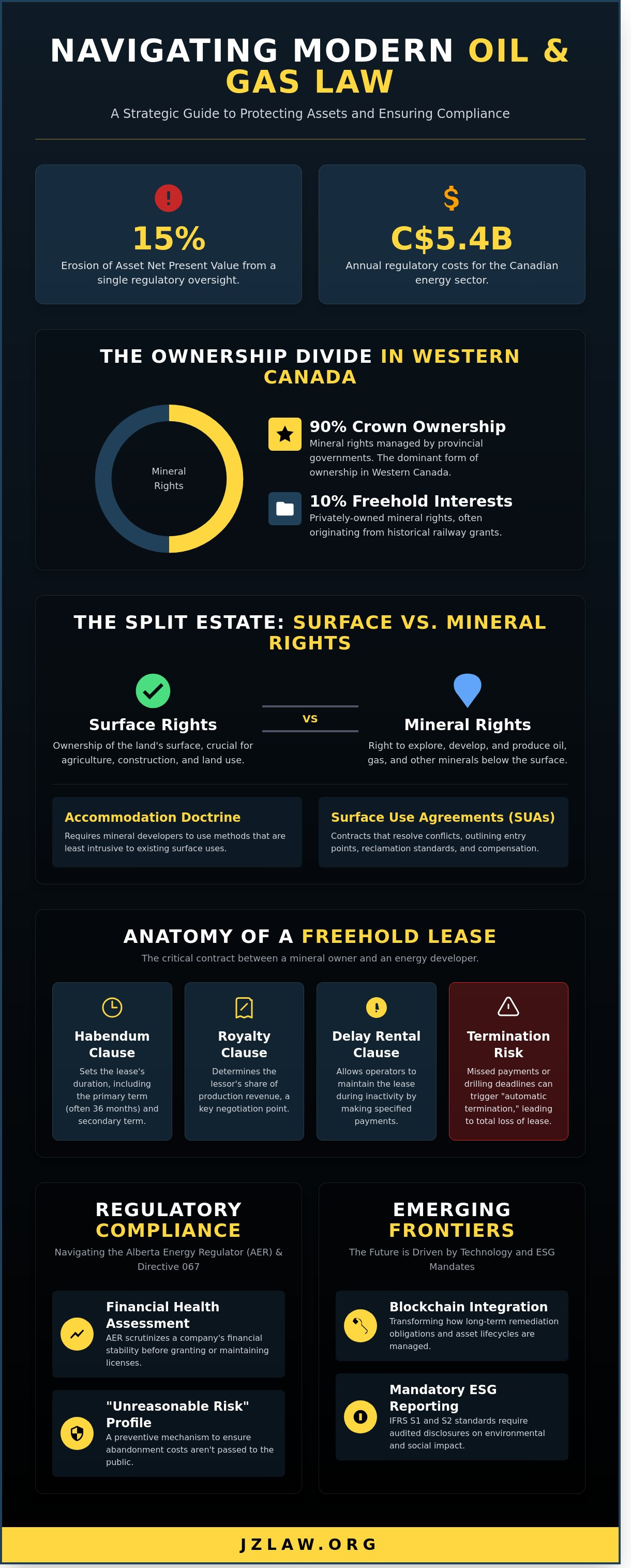
A single regulatory oversight in a multi-million dollar energy project doesn't just delay production; it can erode up to 15% of an asset's net present value before operations even begin. With annual regulatory costs for the Canadian energy sector reaching C$5.4 billion according to 2020 industry data, the margin for error in 2024 has effectively vanished. You've likely felt the strain of reconciling conflicting federal mandates with provincial regulations in Alberta, or the uncertainty that arises when surface rights and mineral interests don't align. Mastering the complexities of oil and gas law is no longer just a matter of compliance; it's a vital strategic safeguard for your capital and your reputation.
We're here to provide the precise legal frameworks you need to manage these risks and secure a definitive advantage during your next joint venture negotiation. You'll gain the clarity required to execute cross-border transactions across North America and Europe while maintaining strict adherence to evolving environmental standards. This article examines the technicalities of mineral leasing, methods for mitigating litigation risks, and the specific regulatory pathways that ensure your energy projects remain both viable and secure.
Key Takeaways
Understand the fundamental distinctions between Freehold and Crown ownership to effectively secure and manage mineral interests across diverse jurisdictions.
Master the specific regulatory requirements of the Alberta Energy Regulator (AER) to ensure your Calgary-based operations remain compliant with evolving environmental mandates.
Learn to structure robust Joint Operating Agreements and conduct rigorous due diligence to mitigate environmental liabilities in complex energy M&A transactions.
Discover how emerging technologies like blockchain are transforming oil and gas law and providing new frameworks for managing long-term remediation obligations.
Identify why a strategic, boutique legal approach offers the necessary agility to navigate the intersection of traditional energy law and modern corporate finance.
Table of Contents Foundations of Oil and Gas Law: Property Rights and Mineral Interests Regulatory Compliance in Major Energy Hubs: Calgary to Frankfurt Commercial Transactions: Joint Ventures, M&A, and Farmout Agreements Emerging Legal Challenges: Tech Integration and Environmental Liability JZ Law: Strategic Legal Counsel for Global Energy Leaders
Foundations of Oil and Gas Law: Property Rights and Mineral Interests
Oil and gas law functions as the structural backbone of the energy sector, governing the transition of hydrocarbons from subsurface reservoirs through midstream transport networks. In Canada, the legal landscape is characterized by a distinct separation between private (Freehold) and government (Crown) ownership. While provincial governments manage approximately 90% of the mineral rights in Western Canada, the remaining 10% consists of Freehold interests granted during the early railway expansions of the late 19th century. This dual system demands a precise, strategic approach to title verification and regulatory compliance.
The Rule of Capture continues to dictate extraction rights across North American jurisdictions, including Alberta and Saskatchewan. This common law doctrine permits a producer to claim all oil or gas recovered from a well located on their land, even if those resources migrated from a neighbor's property. By 2026, however, the Alberta Energy Regulator (AER) and similar bodies have imposed stricter conservation mandates to balance this rule with the protection of correlative rights. These modern frameworks prevent the "waste" of resources and ensure that every owner in a common pool has a fair opportunity to produce their share.
The evolution of energy property law in 2026 focuses heavily on the "split estate" phenomenon. This occurs when the surface title and the mineral title are held by different parties. Effective oil and gas law practice now requires navigating complex surface access disputes that were less prevalent a decade ago. Legal professionals must facilitate a delicate equilibrium between the mineral owner's right to extract and the surface owner's right to undisturbed land use.
Mineral vs. Surface Rights: A Critical Distinction
The dominant estate doctrine traditionally grants mineral owners the legal authority to utilize the surface for exploration and production. This dominance isn't absolute in the current regulatory environment. Courts now frequently apply the accommodation doctrine, which requires developers to adopt the least intrusive methods possible when their operations conflict with existing surface uses. Surface Use Agreements (SUAs) serve as the primary mechanism for resolving these tensions. These contracts outline specific entry points, reclamation standards, and C$ payments for "loss of use" and "adverse effect," ensuring developers maintain a social license to operate.
The Freehold Oil and Gas Lease
The Freehold lease is the fundamental contract between a mineral owner and an energy developer. It contains several high-stakes provisions, such as the Habendum clause, which sets the lease's duration, and the Royalty clause, which determines the lessor's share of production revenue. Delay Rental clauses remain vital for maintaining a lease during periods of inactivity. Operators face significant termination risks; missing a single payment or failing to meet drilling deadlines can trigger involuntary termination through "automatic termination" provisions. The primary term defines the initial window, often narrowed to a 36-month period in 2026, during which a company must establish commercial production to hold the lease amidst rapid market shifts.
Regulatory Compliance in Major Energy Hubs: Calgary to Frankfurt
Operating within the energy sector requires a sophisticated understanding of how regional mandates intersect with global standards. In Calgary, the Alberta Energy Regulator (AER) has intensified its oversight through Directive 067. This regulation, updated in April 2023, mandates a comprehensive assessment of a company's financial health and "unreasonable risk" profile before granting or maintaining licenses. It's a preventive mechanism designed to ensure that the costs of well suspension and abandonment aren't shifted to the public. For firms managing assets across the 49th parallel, the legal complexity doubles as they balance CER requirements in Canada with federal and state rules in the United States.
The role of ESG (Environmental, Social, and Governance) metrics is transitioning from a voluntary framework to a mandatory pillar of oil and gas law. By the 2026 filing cycle, the integration of IFRS S1 and S2 standards will require companies to provide audited disclosures regarding climate-related risks. This shift means that legal strategy must move beyond simple permit acquisition. It now involves long-term liability management and the ability to defend environmental claims in international jurisdictions. Precision in these filings is vital to maintaining investor confidence and securing capital in an increasingly scrutinized market.
North American Regulatory Landscape: Calgary and Denver
In Denver, the landscape shifted significantly in July 2023 when the COGCC was reorganized into the Energy and Carbon Management Commission (ECMC). This change expanded the commission's authority to include carbon sequestration and deep geothermal energy, creating a more complex permitting process for traditional operators. While federal oversight governs interstate pipelines, state-level rules in Colorado often impose stricter setbacks and emission controls. Managing these discrepancies requires a preventive legal approach to avoid costly litigation or project delays. Operators must also account for the C$1.2 billion in potential liabilities associated with aging infrastructure across the Western Canadian Sedimentary Basin.
European Energy Law: Frankfurt and Hamburg
European operations face a distinct set of challenges driven by the EU Green Deal and the REPowerEU plan. In German industrial hubs like Frankfurt and Hamburg, the focus has moved rapidly toward decarbonization mandates. The German Federal Climate Change Act now requires a 65 percent reduction in greenhouse gas emissions by 2030 compared to 1990 levels. Furthermore, Germany's 2024 withdrawal from the Energy Charter Treaty (ECT) has altered the landscape for investment protection. Companies can't rely on old treaty protections for new fossil fuel investments, making the oil and gas law frameworks in these regions focused heavily on the energy transition and hydrogen infrastructure licensing.
Commercial Transactions: Joint Ventures, M&A, and Farmout Agreements
Strategic transactions in the energy sector demand a sophisticated understanding of oil and gas law to balance capital intensity with operational risk. In Calgary's competitive market, the structure of a deal often dictates the long-term viability of the asset. Whether through a corporate merger or a specific asset acquisition, legal frameworks must address the lifecycle of the reservoir, from initial exploration to final reclamation. Precision in these early stages prevents the "litigation creep" that often plagues multi-decade projects.
Joint Operating Agreements (JOAs): These contracts govern the relationship between working interest owners. Most Canadian projects utilize the CAPL (Canadian Association of Petroleum Landmen) Operating Procedure to define the Operator's duties and the Non-Operators' oversight rights.
Due Diligence: Modern energy M&A prioritizes environmental liability over production volume. Buyers must scrutinize Asset Retirement Obligations (ARO) and Licensee Liability Ratings (LLR) to avoid inheriting unfunded cleanup costs that could exceed C$100 million for aging fields.
Farmout Agreements: These serve as vital capital-raising tools for junior explorers. By "farming out" a portion of their working interest in exchange for a drilling commitment, juniors prove up reserves without immediate liquidity.
Unitization and Pooling: Legal mechanisms like mandatory pooling prevent the "rule of capture" from causing inefficient drilling. This ensures maximum recovery from a shared reservoir while protecting the correlative rights of all mineral owners.
Negotiating Joint Venture Agreements
Success in a joint venture hinges on the precision of the accounting procedures and cash call mechanisms. Operators must provide detailed Expenditure Projections; failure by a non-operator to meet a cash call typically triggers a "non-consent" penalty. These penalties often range from 200% to 500% of costs in high-risk deep-basin plays. To maintain business continuity, we recommend structured arbitration under ICDR Canada rules rather than public litigation, which preserves commercial confidentiality and speeds up resolution.
Risk Mitigation in Energy Acquisitions
Identifying hidden liabilities is the cornerstone of a successful acquisition. Beyond title defects, buyers must evaluate "orphan" well potential and historical site contamination under AER Directive 088. When firms scale rapidly, perhaps even considering taking your cannabis company public as a model for alternative capital raises or IPO structures, the regulatory scrutiny intensifies. Cross-border transfers also require meticulous tax structuring to manage "Successor Liability" and optimize the use of flow-through shares, which remain a unique feature of the Canadian tax regime for incentivizing exploration.
Emerging Legal Challenges: Tech Integration and Environmental Liability
The landscape of oil and gas law is undergoing a profound transformation as traditional extraction methods meet 21st-century digital architecture and heightened social accountability. In Canada, the 2021 implementation of the United Nations Declaration on the Rights of Indigenous Peoples Act (UNDRIP) has redefined the "duty to consult," making it a central pillar of project viability. For energy firms raising capital on the Toronto Stock Exchange (TSX) or through San Francisco-based venture capital, securities regulators now demand granular disclosures regarding ESG (Environmental, Social, and Governance) metrics and Indigenous partnerships. These requirements aren't merely bureaucratic hurdles; they're foundational to securing the "social license" required to operate in modern global hubs.
Blockchain and Smart Contracts in Energy
Distributed ledger technology is currently streamlining the administrative burden of royalty management. Smart contracts can automate payments to thousands of mineral rights holders simultaneously, reducing the 30-day or 60-day settlement cycles typical in the industry to near-instantaneous execution. By 2026, blockchain-enabled supply chain tracking will be essential for verifying carbon intensity scores in global markets. In Alberta, the legal enforceability of tokenized mineral rights remains contingent upon their registration as a caveat or transfer under the Land Titles Act, ensuring the digital asset reflects a recognized interest in land.
Environmental Litigation and Liability
Managing the life cycle of assets has become a high-stakes legal exercise. The "polluter pays" principle dictates that liability for spills or leaks is strict, meaning intent or negligence doesn't need to be proven for a company to be held responsible for remediation costs that often exceed C$50 million for significant incidents. The 2026 global methane reduction treaties will impose new monitoring mandates, forcing operators to litigate or settle legacy claims in older fields where infrastructure is aging. Legal strategies for managing these liabilities include:
Asset Retirement Obligations (ARO): Utilizing ring-fenced funds to ensure decommissioning costs don't default to the public purse.
Liability Transfer Agreements: Drafting precise indemnity clauses during the sale of mature assets to specify which party carries the burden of historical contamination.
Proactive Remediation: Engaging with the Alberta Energy Regulator (AER) to manage orphaned well inventories before they trigger mandatory enforcement actions.
Strategic legal planning is the only way to insulate a firm from the compounding risks of environmental debt and technological disruption. Operators must view these challenges as structural shifts rather than temporary obstacles. If your firm requires a sophisticated approach to these evolving regulations, you can consult with our strategic energy litigation team to safeguard your long-term interests.
The intersection of technology and environmental law requires a partner who understands the technical nuances of a drill site and the digital complexities of a blockchain ledger. This dual expertise ensures that contracts signed today remain enforceable and profitable in the regulatory environment of 2030 and beyond. Precision in these matters isn't just about compliance; it's about maintaining a competitive edge in an increasingly scrutinized global market.
JZ Law: Strategic Legal Counsel for Global Energy Leaders
John Zang’s methodology redefines the role of legal counsel by merging the technical rigor of oil and gas law with the sophisticated mechanics of modern corporate finance. This dual expertise is vital for operators who require more than just a review of lease agreements. In an era where energy projects are increasingly tied to complex debt structures and private equity infusions, having a partner who understands both the wellhead and the balance sheet is a distinct competitive advantage.
Boutique representation provides the agility that larger, more rigid firms often lack. When regulatory shifts occur, such as the Alberta Energy Regulator (AER) updating liability management frameworks or Directive 067 requirements, clients need immediate, nuanced advice. JZ Law bridges the gap between strict regulatory compliance and aggressive business growth; it ensures that legal hurdles don't become operational bottlenecks. From the resource-rich basins of Calgary to the financial hubs of San Francisco, the firm maintains a multi-jurisdictional perspective that serves the unique needs of cross-border energy entities.
Comprehensive Corporate Support
Startups in the energy sector face a unique set of hurdles that require an integrated approach to tax structuring and securities law. JZ Law provides the foundational support necessary for these ventures to scale, particularly when navigating the issuance of flow-through shares or preparing for private placements. Beyond basic formation, the firm offers strategic representation before the AER and other provincial bodies, protecting client interests during high-stakes hearings. For a deeper look at how these services apply to various sectors, explore our Expert Legal Counsel for Complex Industries.
Your Strategic Partner in 2026
The energy landscape of 2026 will demand a proactive rather than reactive legal stance. JZ Law addresses the specific challenges of the Calgary and Denver markets by implementing preventive legal audits. These audits identify potential liabilities in asset retirement obligations or contractual gaps before they escalate into litigation that could cost millions of C$. By focusing on risk mitigation, the firm allows energy leaders to focus on extraction and innovation. Contact John Zang for a strategic consultation on your oil and gas interests.
Securing Strategic Advantage in Global Energy Markets
The global energy landscape is shifting toward a model where regulatory precision and technical integration are no longer optional. Navigating the Alberta Energy Regulator (AER) framework requires a sophisticated understanding of how mineral interests align with evolving environmental liabilities. Success in this sector depends on your ability to execute complex joint ventures and tax-efficient corporate transactions that withstand scrutiny in both Calgary and international hubs. It's not just about meeting current standards; it's about anticipating the legal hurdles of tomorrow through meticulous planning and logical oversight.
JZ Law offers a unique blend of boutique service and multi-jurisdictional reach across Canada, the United States, and the European Union. We provide expert counsel in oil and gas law, focusing on high-stakes regulatory compliance involving the AER and SEC. Our firm acts as a dedicated partner, ensuring that your operations remain resilient against market volatility and shifting geopolitical pressures. By prioritizing a preventive approach, we help you avoid costly litigation while maximizing the value of your energy assets. We look forward to helping you navigate these complexities with confidence and clarity.
Frequently Asked Questions
What is the "Rule of Capture" in oil and gas law?
The Rule of Capture is a fundamental principle in oil and gas law that allows a landowner to extract resources from beneath their property, even if those resources migrated from a neighboring tract. This common law doctrine prevents liability for drainage, provided the well doesn't trespass onto adjacent lands. In Alberta, this rule is tempered by the Oil and Gas Conservation Act to ensure correlative rights and prevent waste through regulated well spacing.
How do mineral rights differ between Canada and the United States?
Mineral rights in Canada are predominantly held by the Crown, with about 81 percent of Alberta's mineral resources owned by the provincial government. This contrasts sharply with the United States, where private individuals often own the subsoil rights. While American landowners frequently negotiate private leases, Canadian operators must primarily secure licenses and leases through the Alberta Energy Regulator or similar provincial bodies. This structural difference requires distinct strategies for asset acquisition.
What is a Joint Operating Agreement (JOA) and why is it necessary?
A Joint Operating Agreement is a contract between two or more parties that governs the shared exploration, development, and operation of a specific oil and gas property. It's necessary to define how costs are shared, appoint a designated operator, and establish procedures for decision-making and risk management. Most Canadian JOAs follow the 2015 CAPL Operating Procedure, which provides a standardized framework for managing these complex commercial relationships and mitigating operational disputes.
Can surface owners prevent oil and gas drilling in Calgary or Denver?
Surface owners in Calgary or Denver generally cannot prevent oil and gas drilling because mineral rights are legally dominant over surface rights. In Alberta, the Surface Rights Act ensures that if a voluntary agreement isn't reached, the Land and Property Rights Tribunal can grant a Right of Entry. Surface owners are entitled to compensation, which averaged C$3,500 to C$5,000 per well site annually in recent Alberta lease negotiations, depending on land use.
What are the main regulatory bodies for oil and gas in Alberta?
The Alberta Energy Regulator (AER) serves as the primary oversight body for the province's upstream oil, gas, and coal sectors. It operates under the Responsible Energy Development Act to manage the full life cycle of energy projects. Other key entities include the Alberta Utilities Commission (AUC) for midstream infrastructure and the Department of Energy, which manages the province's mineral rights and the collection of royalties for the public purse.
How is environmental liability handled for abandoned wells in 2026?
Environmental liability for abandoned wells in 2026 is governed by the AER's Inventory Reduction Program, which mandates that companies spend a specific percentage of their decommissioning liability annually. For the 2026 fiscal year, the industry must meet a mandatory spend target, which was set at C$700 million collectively for the sector in 2023 and is adjusted yearly. This ensures that inactive sites are remediated, reducing the long-term burden on the Orphan Well Association.
What is a farmout agreement in the energy sector?
A farmout agreement is a contract where the owner of a leasehold interest, the farmor, assigns a portion of that interest to another party, the farmee, in exchange for drilling services. The farmee earns their interest by completing a specific well to a predetermined depth or production level. This arrangement allows the farmor to maintain the lease without incurring immediate capital costs, while the farmee gains access to proven acreage for exploration.
Does JZ Law handle international oil and gas disputes?
JZ Law provides strategic representation for international oil and gas disputes, leveraging a deep understanding of cross-border legal frameworks and arbitration protocols. Our firm manages complex litigation and alternative dispute resolution for clients operating in global energy hubs. We don't just act as legal executors; we serve as strategic partners who protect your commercial interests in multi-jurisdictional environments through precise risk mitigation and expert oil and gas law advocacy.



Great information for drivers looking to stay prepared throughout the year. Reliable Jump Start Fairfield CT assistance can help restore battery power efficiently and reduce interruptions caused by unexpected vehicle issues.
Choosing a professional ride service can make an anniversary celebration more relaxing and enjoyable from start to finish. I also found this guide on anniversary ride service near me with helpful transportation tips.
A quality used SUV can provide excellent value with modern features and dependable performance. Thanks for sharing these vehicle shopping ideas. used SUVs for sale Rome, NY offers reliable SUV choices.
Very informative guide covering Greenwood Plumbing Repair. Professional repairs completed correctly the first time save homeowners both time and money. The advice shared throughout the article is balanced, practical, and easy to follow.