


Cannabis Social Club Germany: Member Limits and Legal Rules
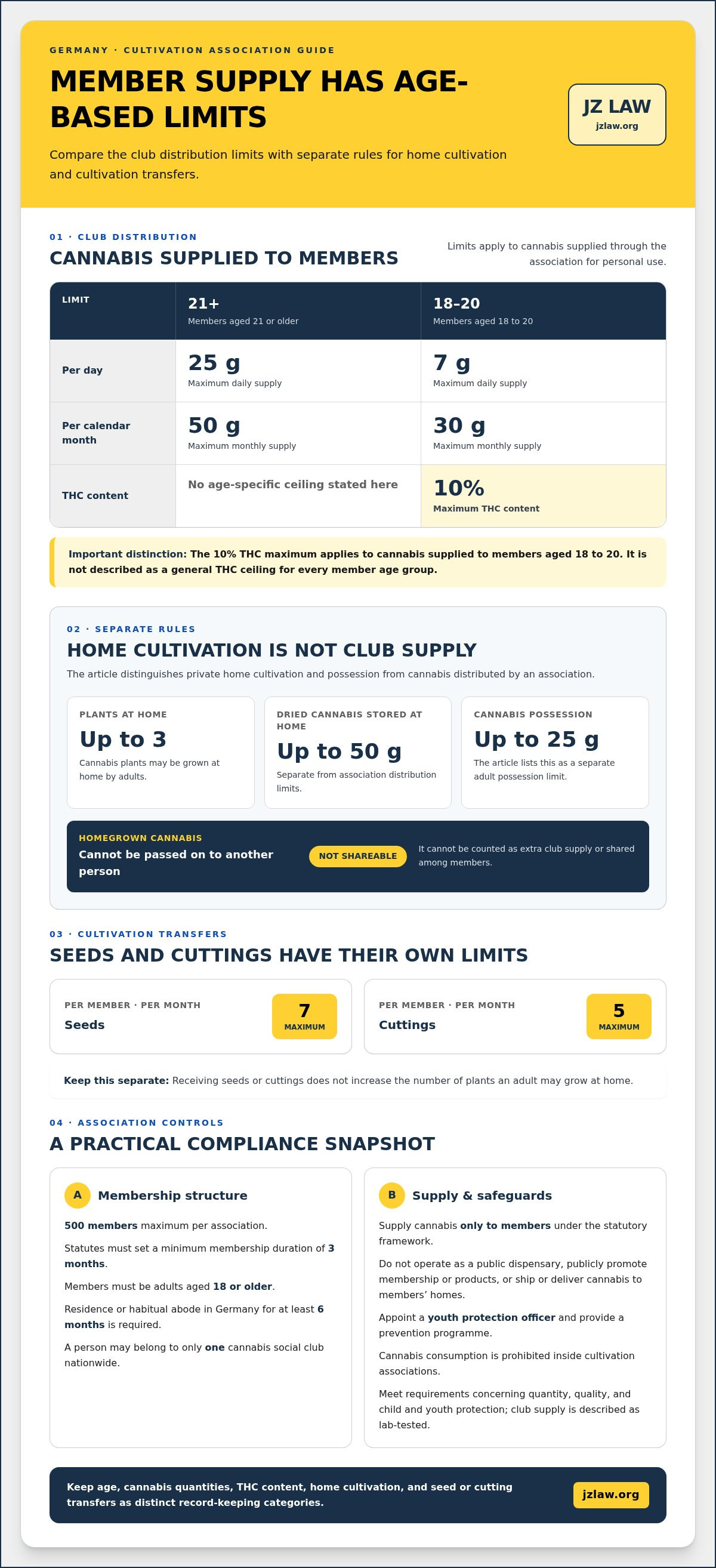
In Germany, members aged 21 or older may receive up to 25 grams of cannabis per day and 50 grams per calendar month from a cannabis cultivation association, according to Gesetze im Internet. Members aged 18 to 20 may receive up to 7 grams per day and 30 grams per month, with a maximum THC content of 10%. A cannabis social club compliance checklist for Germany must account for these age-based limits as well as the rules governing the association itself.
Quantity limits are only one part of compliance. A club’s membership, authorisation, distribution practices, and safeguards also determine whether it operates within Germany’s legal framework. This guide explains how cultivation associations fit into that framework, what they may supply to members, and which core obligations to consider. It also explains why the familiar term “cannabis social club” does not replace the legal requirements that apply to an association.
Table of Contents
How Much Cannabis Can Members Receive?
For members aged 21 or older, clubs may distribute no more than 25 grams per day and 50 grams per calendar month for personal use, according to Gesetze im Internet. Members aged 18 to 20 face lower limits: up to 7 grams per day and 30 grams per month, with cannabis capped at 10% THC. These are the key legal limits on member supply and THC content in Germany.
Because supply allowances can vary by member category, cultivation associations should keep distribution records organized accordingly. Age can affect the daily amount a member may receive. The age-based limits apply to cannabis supplied through the association; they are not interchangeable with rules for possession or home cultivation.
Home cultivation has separate limits. Adults may grow up to three cannabis plants at home and store up to 50 grams of dried cannabis there. Adults may also possess up to 25 grams of cannabis. Homegrown cannabis cannot be passed on to another person, so it cannot be treated as additional club supply or shared among members.
Associations may also transfer seeds and cuttings for home cultivation. Each member may receive up to seven seeds or five cuttings per month. These transfer limits are separate from the plant limit: receiving seeds or cuttings does not increase the number of plants an adult may cultivate at home.
Quality controls matter alongside quantity records. German cultivation associations must comply with requirements concerning quantity, quality, and child and youth protection. Club supply is described as lab-tested, while the 10% THC maximum specifically applies to cannabis supplied to members aged 18 to 20. It should not be mistaken for a general THC ceiling across all member age groups.
For practical compliance, associations should keep age and distribution records clear enough to compare each member’s daily and monthly supply with the applicable limits. Separate seed and cutting records can help distinguish cultivation transfers from cannabis distribution. A cannabis social club compliance checklist for Germany should therefore address age, quantity, THC content, and home cultivation as related but distinct controls.
What Are Cannabis Social Clubs in Germany?
In Germany, “cannabis social clubs” operate as member-based cultivation associations, not ordinary retail outlets. Their membership rules and safeguards determine who may join, how distribution works, and what compliance requires.
Membership Caps and Minimum Duration
A German cultivation association may have no more than 500 members, and its statutes must set a minimum membership duration of three months. These limits make membership a structured relationship rather than a short-term purchase arrangement.
The cap affects how an association plans its membership and cultivation capacity. A September 2025 survey of 220 clubs reported an average of 275 members per club, below the legal ceiling. Associations must also account for waiting periods: clubs may set their own minimum periods before members can receive cannabis.
Member Eligibility and Exclusivity
Membership is limited to adults aged 18 or older who have had their residence or habitual abode in Germany for at least six months. A person may belong to only one cannabis social club nationwide, so membership cannot be duplicated across associations.
These conditions matter at admission, not just when cannabis is distributed. Clubs need to distinguish eligible residents from visitors; tourists generally cannot legally obtain adult-use cannabis through an association. Medical cannabis follows a separate route, having been legal by prescription in Germany since 2017.
Club Distribution and Access Controls
Associations may supply cannabis only to members under the statutory distribution framework. They cannot operate like public dispensaries. German clubs may not publicly promote membership or products, and they may not ship or deliver cannabis to members’ homes.
Access and youth protection require active safeguards. Clubs must appoint a youth protection officer and provide a prevention programme, and cannabis consumption is prohibited inside cultivation associations. Controlled access and a clear separation between distribution and on-site consumption are therefore central operating considerations.
Membership Interest and Compliance Risks
Membership interest has not translated into unlimited club capacity: a September 2025 survey reported an average of 275 members across 220 clubs, against the 500-member ceiling. A separate survey found that 44% of German adult cannabis consumers planned to join a social club, signalling interest rather than guaranteed membership.
Breaches involving eligibility, distribution, promotion, or youth safeguards can expose an association to regulatory enforcement and jeopardize its ability to operate. For founders assessing licensing and operating obligations, guidance on cannabis-club compliance can help frame the legal issues.
German Cannabis Cultivation Associations (CCAs) and Cannabis Social Clubs
Germany’s cannabis reforms distinguish private home cultivation from supply through member-based cultivation associations. That distinction determines which authorisation and operating rules apply.
Legal Foundations for Cultivation Associations
Germany’s Cannabis Act established a framework for registered associations to cultivate and distribute cannabis to members. Section 16, paragraph 5 of the Cannabis Act requires cultivation associations to be founded as registered associations, while Section 13 requires authorisation from the competent authority.
Section 10 of the Act took effect on 1 April 2024, allowing private dispensing associations to cultivate and distribute cannabis within specified quantities. A “cannabis social club” is the common description; the regulated body is a cultivation association. This legal distinction matters because operating as a member group alone does not replace the required association structure or permit.
Premises are also part of the authorisation framework. According to Gesetze im Internet, a cultivation association’s permit must be refused if its premises lie within 200 metres of a school entrance. Location therefore needs to be assessed alongside the association’s legal formation and proposed activities.
Cultivation, Distribution, and Product Traceability
Home and association cultivation are governed by separate rules. Adults may cultivate up to three plants at home, but homegrown cannabis cannot be passed to third parties. An association’s cultivation and member distribution must instead comply with its authorisation and the statutory quantity and quality requirements.
Traceability connects production with lawful distribution. Associations need records linking cultivation batches to the cannabis supplied to members, helping them account for quantities and product quality. This is especially important when handling multiple harvests or distributing different batches.
German cultivation associations must meet requirements for quantity, quality, and child and youth protection. Member supplies are described as lab-tested, making reliable batch identification important to show which product was tested and distributed. These records also help distinguish association-grown cannabis from private home cultivation.
An association’s compliance responsibilities therefore include its registered legal form, authorisation, premises, cultivation records, and controlled distribution. Treating these as connected obligations helps align the legal framework with day-to-day operations.
German cannabis-club legal framework
Germany combines a national cannabis framework with licensing decisions made by local authorities. Federal rules set the structure, while the responsible authority and location shape the licensing process.
Premises and Cultivation Site Rules
Premises and cultivation sites must fit the association’s authorised activities and location restrictions. A cultivation association’s permit must be refused if its premises lie within 200 metres of a school entrance, according to Gesetze im Internet.
Germany’s 16 federal states make licensing decisions through their local authorities, so applicants deal with the competent authority for their area. Applications go to the relevant local district authority, rather than directly to BfArM. This division matters because the national framework does not make every licensing decision centrally.
Authorisations are valid for seven years and can be renewed. A proposed site must therefore meet the location rules and support the association’s authorised cultivation and distribution activities.
Advertising and Public Consumption Rules
German cannabis social clubs may not publicly promote membership or products. Associations must account for this restriction in their communications: promotional messages to the public cannot be treated as ordinary membership notices.
Consumption is also subject to location and time restrictions. Cannabis consumption is prohibited in German pedestrian areas from 7:00 a.m. to 8:00 p.m., and consumption is prohibited inside cultivation associations. These are separate limits: one concerns public pedestrian areas, while the other applies within association premises.
Germany’s reform creates a structured, member-based model rather than unrestricted commercial access. Its European context does not replace domestic requirements: a club must follow German rules on authorisation, premises, advertising, and consumption. For an association assessing its licensing position or site, discuss cannabis licensing requirements as part of its planning.
JZ Law: John Zang Services
JZ Law provides international regulatory guidance and strategic insight for organizations assessing how German cultivation-association requirements intersect with broader corporate strategies. Legal advisory support can help evaluate the administrative application process, proposed operational frameworks, and how club structures relate to evolving compliance standards. These considerations can influence whether a corporate entity's planning aligns with international regulatory expectations.
For organizations pursuing multifaceted corporate strategies, JZ Law also provides Securities Regulation and Taking Companies Public services. These capabilities may be relevant when an international enterprise with cannabis-related interests is considering capital-markets activity, rather than simply forming or operating a local member association. The appropriate legal focus depends on the specific jurisdictional scope and matter.
Contact JZ Law or visit jzlaw.org to discuss your regulatory and corporate legal needs.
Move from Legal Review to a Clear Operating Plan
The next step is to turn regulatory requirements into decisions your association can put into practice. Before committing to an operating model, align its governance documents, proposed site, member processes, and distribution controls with the obligations that apply. This provides a practical basis for identifying legal issues early and addressing them before they disrupt operations.
A cannabis social club compliance checklist for Germany can organize this review, but it should reflect the association’s particular structure and plans. Identify which decisions need legal analysis, who will implement them, and how the organisation will keep procedures consistent as operations develop.
Where licensing or corporate questions require focused legal input, JZ Law can help clarify the issues relevant to your plans. Contact JZ Law about club compliance to discuss the next step. With a deliberate review and a workable operating plan, your association can move forward with greater clarity.
Frequently Asked Questions
What are the legal requirements for founding a cannabis cultivation association in Germany?
Founders must establish a registered association under Section 16, paragraph 5 of the Cannabis Act. The association’s statutes should set out its purpose, membership rules, governance, and minimum membership duration, while meeting the applicable BGB registration requirements. Seven founding board members are needed to establish a cultivation association. Planning these documents together helps align the association’s legal form with its intended cultivation and member distribution activities.
What permits and registrations does a German cannabis cultivation association need?
A cultivation association generally needs to be formally established and authorised before carrying out its regulated activities. Licence applications are submitted to the relevant local district authority, not directly to BfArM. The responsible authority is determined by the association’s location. Its application and registration materials should describe a consistent operating model, including the planned premises and cultivation activities.
What are the rules for club cultivation, cannabis storage, and distribution to members in Germany?
Association cultivation and member distribution must comply with the association’s authorisation and applicable statutory limits. Reconcile each harvest batch with the amount distributed, keeping association inventory separate from members’ private homegrown cannabis. Home cultivation cannot be transferred to others, so it should not appear in club distribution records as member supply. Clubs must also account for product quality and youth-protection safeguards.
What recordkeeping, reporting, and documentation must cannabis cultivation associations maintain?
Associations should organize records to show how their authorised activities work in practice. Useful documents include current statutes, membership eligibility records, cultivation and harvest information, distribution entries, and materials supporting quality and prevention measures. Linking a harvest batch to member distributions, for example, helps explain quantities and product handling. The responsible authority and the association’s specific authorisation determine which reporting obligations apply.
What tax, accounting, and financial rules apply to cannabis social clubs in Germany?
Tax treatment depends on the association’s legal and financial structure, including whether it qualifies as non-profit. Non-profit status may provide access to subsidies and tax breaks available to non-profit organisations, but it is not automatic. Keep financial records consistent with the statutes and actual activities, distinguish member-related funds from other transactions, and document the basis for significant financial decisions.
What practical steps and costs are involved in setting up a compliant cannabis club in Germany?
Start by aligning the association’s statutes, registration, proposed site, and cultivation plan, then prepare an authorisation application for the competent local authority. Budget for premises, association formation, cultivation infrastructure, product controls, and youth-protection measures. Costs vary with the site and operating model, so assess these factors before committing funds. JZ Law provides Cannabis Licensing support for relevant licensing matters.



Comments