


German Cannabis Market Entry: Legal Steps and Compliance
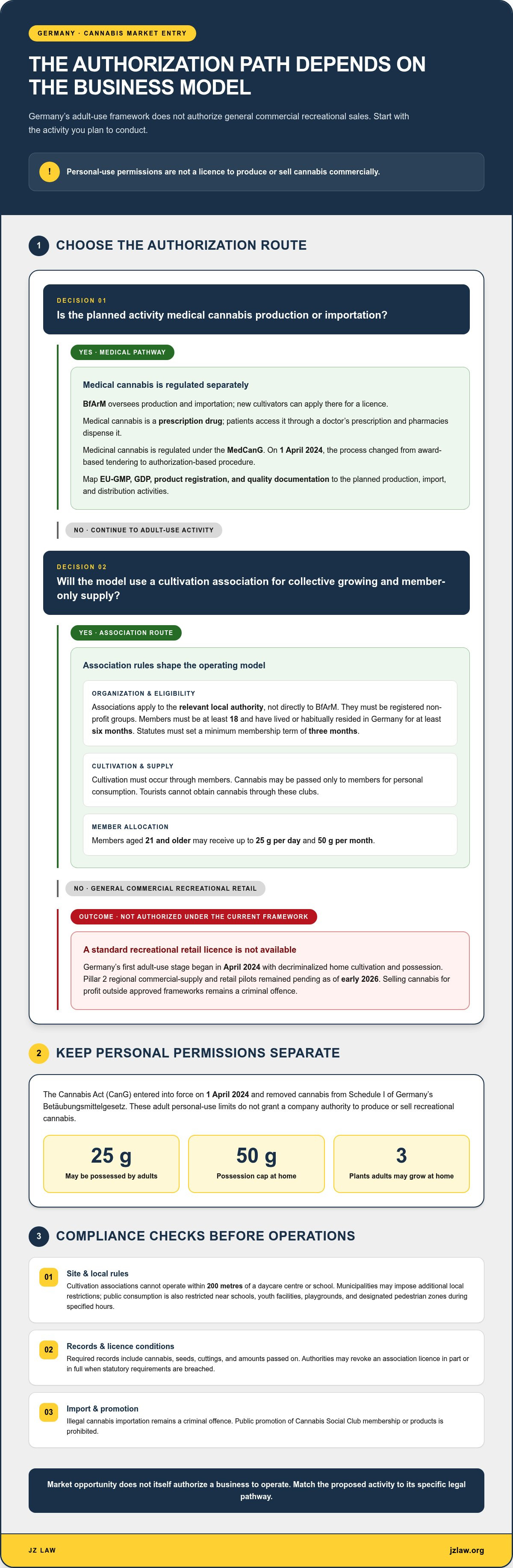
Germany’s nationwide adult-use framework doesn’t permit commercial cannabis retail sales. Its first stage began in April 2024, decriminalizing home cultivation and possession, while Pillar 2 regional commercial-supply and retail pilots remained pending as of early 2026. For Canadian businesses, German cannabis market entry legal requirements therefore depend first on whether the proposed activity is medical, cultivation-association, or a future pilot pathway, rather than a standard recreational retail licence.
That distinction matters: a market opportunity does not itself authorize a business to operate, and medical cannabis follows a separate regulatory framework. This guide explains how Germany’s two-stage approach shapes market entry, what adult-use rules mean for commercial plans, and how banking, financing, and tax considerations fit into a compliant strategy. It also outlines the legal and corporate issues Canadian operators should assess when evaluating a German venture.
Table of Contents
Germany's two-stage recreational cannabis framework
Germany’s first adult-use stage began in April 2024, while Pillar 2 commercial retail pilots remained pending as of early 2026. That divide matters: when advising international clients, JZ Law emphasizes that a consumer marijuana business cannot treat personal possession rules as approval for commercial sales.
Market Entry Licenses and Permits
This framework separates limited adult-use activity from regulated medical supply, so the proposed business model determines its authorization path. For medical cannabis, the Federal Institute for Drugs and Medical Devices (BfArM) oversees production and importation, and new cultivators can apply there for a licence. Since April 2024, medical cannabis has been treated as a prescription drug, under a distinct market framework.
For adult-use cultivation, associations apply to the relevant local authority, not directly to BfArM. This distinction helps JZ Law guide Canadian entrants to avoid treating an association licence as permission to operate commercial retail.
Product Standards and Registration
Product compliance concerns quality controls, authorization, and the supply chain, rather than adult-use possession limits. Germany regulates medicinal cannabis separately under the MedCanG, and its rules changed from award-based tendering to an authorization-based procedure on 1 April 2024. EU-GMP, GDP, product registration, and quality documentation should be mapped to the specific production, import, and distribution activities planned.
Patients access medical cannabis through a doctor’s prescription, and pharmacies dispense it. Since 29 July 2026, unprocessed cannabis flowers and flowers within preparations can no longer be prescribed at statutory health insurance expense. Standardised-quality extracts and products containing dronabinol or nabilone may still be prescribed and reimbursed under Section 31 (6) of Book V.
Promotion is also restricted: the Cannabis Act defines advertising as commercial communication intended to promote consumption or transfer, directly or indirectly. Public promotion of Cannabis Social Club membership or products is prohibited.
Penalties and Compliance Risks
Compliance risks include criminal liability, licence consequences, and loss of access to approved channels. Selling cannabis for profit outside approved frameworks remains a criminal offence, as does illegally importing cannabis into Germany. The distinction between medical authorization and adult-use association activity therefore has significant commercial implications.
For cultivation associations, authorities may revoke a licence in part or in full when statutory requirements are breached. Required records include cannabis, seeds, cuttings, and amounts passed on. Location rules also matter: clubs cannot operate within 200 meters of a daycare centre or school. These controls should inform site selection, cultivation, import, and marketing decisions before operations begin.
Germany's Cannabis Act and adult-use framework
Germany’s Cannabis Act changed personal-use rules, but it did not create an open recreational retail market. Adult-use businesses must distinguish personal permissions from the narrower framework for cultivation associations.
Cannabis Act Market Changes
The Cannabis Act, or CanG, entered into force on 1 April 2024 and removed cannabis from Schedule I of Germany’s Betäubungsmittelgesetz. This shifted adult-use possession and home cultivation into a defined legal framework, while commercial supply remained restricted.
Adults may possess up to 25g and grow up to three plants at home. At home, possession is capped at 50g. These permissions apply to personal use, not a company’s authority to produce or sell recreational cannabis.
For Canadian operators, this commercial distinction is central. Germany’s medical cannabis market follows a separate framework based on prescriptions and pharmacy dispensing. A planned recreational venture cannot rely on medical cannabis rules or personal-use allowances as substitutes for business authorization.
Adult-Use Business Rules
Adult-use cultivation associations are the regulated route for collective cultivation and member supply. Members must be at least 18, and cultivation must occur through members, with cannabis passed only to members for personal consumption.
Membership and allocation limits shape the operating model. Members aged 21 and older may receive up to 25g per day and 50g per month.
Associations must operate as registered non-profit groups. Members must have lived or habitually resided in Germany for at least six months, and the statutes must set a minimum membership term of three months. Tourists cannot obtain cannabis through these clubs.
Public consumption is restricted near schools, youth facilities, playgrounds, and designated pedestrian zones during specified hours. Municipalities may impose additional local restrictions, so location and operating plans should account for local rules as well as federal requirements.
A focused review of Cannabis Licensing considerations can help assess whether an association-based model aligns with the proposed venture.
Germany's Cannabis Act and legal changes
Germany’s Bundestag passed the Cannabis Act on February 23, 2024, and it entered into force on April 1, 2024. Cannabis was removed from Schedule I of the Betäubungsmittelgesetz on that date. Cannabis Social Clubs became legal on July 1, 2024, creating a separate association-based framework rather than authorizing general commercial distribution.
These dates mark distinct legal changes. The April 2024 provisions addressed adult possession and home-grown plants, while the July change enabled cultivation associations under statutory conditions. Medical cannabis remained a separate pathway: prescriptions and pharmacy dispensing are not permissions to sell recreational products.
Governance rules also shape how social clubs operate. Associations must be registered as non-profits, and each board member or other authorized representative must belong to the association. Licence applications must include registry information for those representatives, issued no more than three months before filing.
Operational duties extend beyond cultivation. Associations must keep inventory records for cannabis, seeds, and cuttings, as well as records of cannabis passed to members. They must appoint a youth protection officer and run a prevention programme. Governance, recordkeeping, and safeguarding are therefore part of the operating model.
Promotion is another regulated area. According to Gesetze im Internet, the Act defines advertising as commercial communication intended to promote cannabis consumption or transfer, directly or indirectly. Public promotion of Cannabis Social Club membership or products is prohibited, so promotional plans need to account for both the definition and the specific restriction.
Authorities assess licence eligibility against statutory requirements, including board-member reliability and relevant previous convictions. A cultivation association licence may be refused if these requirements are not met, or revoked in part or in full for non-compliance. Legal structure, personnel, and ongoing controls are connected: approval does not replace continuing compliance obligations.
What are Germany’s current laws for medical cannabis imports and sales?
Germany’s medical cannabis legislation entered into force on 10 March 2017. Since April 2024, medical cannabis has been treated as a prescription drug rather than a narcotic. The Cannabis Act reclassified medical products under the Arzneimittelgesetz (AMG), while the MedCanG governs medicinal cannabis separately from non-medical cannabis.
The Federal Institute for Drugs and Medical Devices oversees cannabis production and importation. Since 1 April 2024, the rules have used an authorization-based procedure instead of award-based tendering. Canadian businesses assessing cultivation or importation must therefore consider the activity, applicable authorization pathway, and pharmaceutical supply chain together.
Medical cannabis is sold through pharmacies, not general retail outlets. Patients need a doctor’s prescription, and pharmacies dispense products prescribed through Germany’s medical system. Products come from certified cultivation and are subject to standards intended to support pharmaceutical quality and consumer protection. Selling for profit outside approved frameworks remains a criminal offence, as does illegal importation into Germany.
Reimbursement through statutory health insurance is narrower than prescription access. Since 29 July 2026, unprocessed cannabis flowers and flowers within preparations can no longer be prescribed at statutory insurance expense. Standardised-quality extracts and medicinal products containing dronabinol or nabilone may still be prescribed and reimbursed under Section 31 (6) of Book V. Patients must complete a six-month trial of an approved, finished cannabis-based pharmaceutical product before qualifying for coverage.
Germany also abandoned statutory health insurance pre-approval for medical cannabis in October 2024. That change concerns reimbursement administration, not the need for a prescription or the pharmacy dispensing route. Market plans should distinguish product import and authorization from downstream prescribing, dispensing, and coverage decisions.
For a structured review of cannabis licensing strategy, align the proposed import or production model with the applicable German regulatory pathway.
JZ Law: John Zang Services
JZ Law advises businesses on how Cannabis Licensing fits their proposed entry strategy, including whether the plan involves medical supply or an association-based adult-use model. Seek legal guidance before committing to a structure, site, or financing plan, since each decision can affect the venture’s regulatory and corporate position.
For businesses considering growth or capital-market activity, JZ Law also provides Securities Regulation and Taking Companies Public services. These may be relevant when a cannabis venture’s corporate plans extend beyond initial market entry. A focused discussion can connect the proposed business model with the legal and strategic issues it raises.
Contact JZ Law or visit jzlaw.org to discuss your plans.
Shape Your Market-Entry Strategy
Market entry planning works best when legal structure, capital strategy, and operational objectives are considered together. Before committing resources, define the activity your business intends to pursue, identify decisions that depend on regulatory approval, and align the corporate plan with the intended route to market. This creates a clearer basis for assessing governance, financing, and cross-border priorities before making major commitments.
JZ Law provides John Zang Services, including Cannabis Licensing, Securities Regulation, and Taking Companies Public. These services may be relevant as a business evaluates its regulatory path and considers future corporate or capital-market objectives. German cannabis market entry legal requirements should be assessed in the context of the venture’s specific model, organizational structure, and wider commercial strategy.
Discuss market entry with JZ Law and identify the next steps for your business through a focused legal discussion.
Frequently Asked Questions
How to Start a Cannabis Business in Germany?
Start by defining whether the venture concerns medical cannabis or adult-use cultivation, since each follows a different legal route. A medical operator must assess the authorization requirements for its specific activity, while a cultivation association applies through the relevant local authority. A conventional recreational retail shop is not permitted under Germany’s current nationwide framework, so a business plan should not depend on that sales model.
Is Cannabis Legal in Germany in 2026?
Yes, but legality depends on the activity and the person involved. Adults may possess up to 25g, cultivate up to three plants at home, and possess up to 50g at home under the Cannabis Act. People under 18 remain prohibited from using cannabis. These personal permissions don’t authorize a company to produce or sell recreational cannabis commercially.
What’s Still Illegal in Germany?
Selling cannabis for profit outside an approved framework and illegally importing cannabis remain criminal offenses. Providing cannabis to minors is also a criminal offence. Cannabis Social Clubs cannot publicly promote membership or products, and consumption is restricted in specified public areas. For a business, the key question is whether each activity, from importation to distribution, falls within an authorized legal pathway.
Which authority is responsible for issuing the licence?
The responsible authority depends on the licence and activity. New cannabis cultivators can apply to the Federal Institute for Drugs and Medical Devices (BfArM), which oversees medical cannabis production and importation. Cannabis Social Club licence applications go to the relevant local authority, or Kreisbehörde, rather than BfArM. Identifying the correct route starts with distinguishing medical production from association-based cultivation.
What are the German requirements for cannabis cultivation, manufacturing, and distribution?
Requirements depend on whether the activity involves medical cannabis or adult-use association cultivation. Cultivation associations may grow cannabis only through members and pass it only to members for personal consumption. Medical cannabis follows a separate pharmaceutical framework, and pharmacies dispense products prescribed by doctors. A business must align its cultivation, manufacturing, and distribution plans with the authorization applicable to its role.
How do companies obtain authorization to import cannabis into Germany?
Companies must pursue the authorization applicable to their medical cannabis import activity through Germany’s regulatory framework. BfArM oversees cannabis importation, and Germany uses an authorization-based procedure. Importing cannabis illegally remains a criminal offence, so a business must establish its lawful authorization pathway before arranging commercial shipments. German cannabis market entry legal requirements depend on the proposed product and the company’s role in the supply chain.


Comments