


How to respond legally to a Health Canada cannabis recall
A cannabis recall is a regulated process, not simply a decision to remove a product from sale. A legal response to a Health Canada cannabis recall starts with notifying Health Canada and submitting the initial recall report before beginning a voluntary recall. After notifying the department that the recall has been initiated, the recalling licence holder must provide a risk evaluation within 72 hours, according to the Department of Justice Canada.
When a cannabis product may pose a health or compliance risk, act promptly and support each step with clear records and a defensible assessment. This guide explains how to identify a potential Health Canada cannabis recall, assess and document risk, meet reporting timelines, trace affected lots, and understand Health Canada’s oversight. It also covers recall simulations and record retention, helping businesses respond systematically rather than improvise.
Table of Contents
How quickly must I report a cannabis recall to Health Canada?
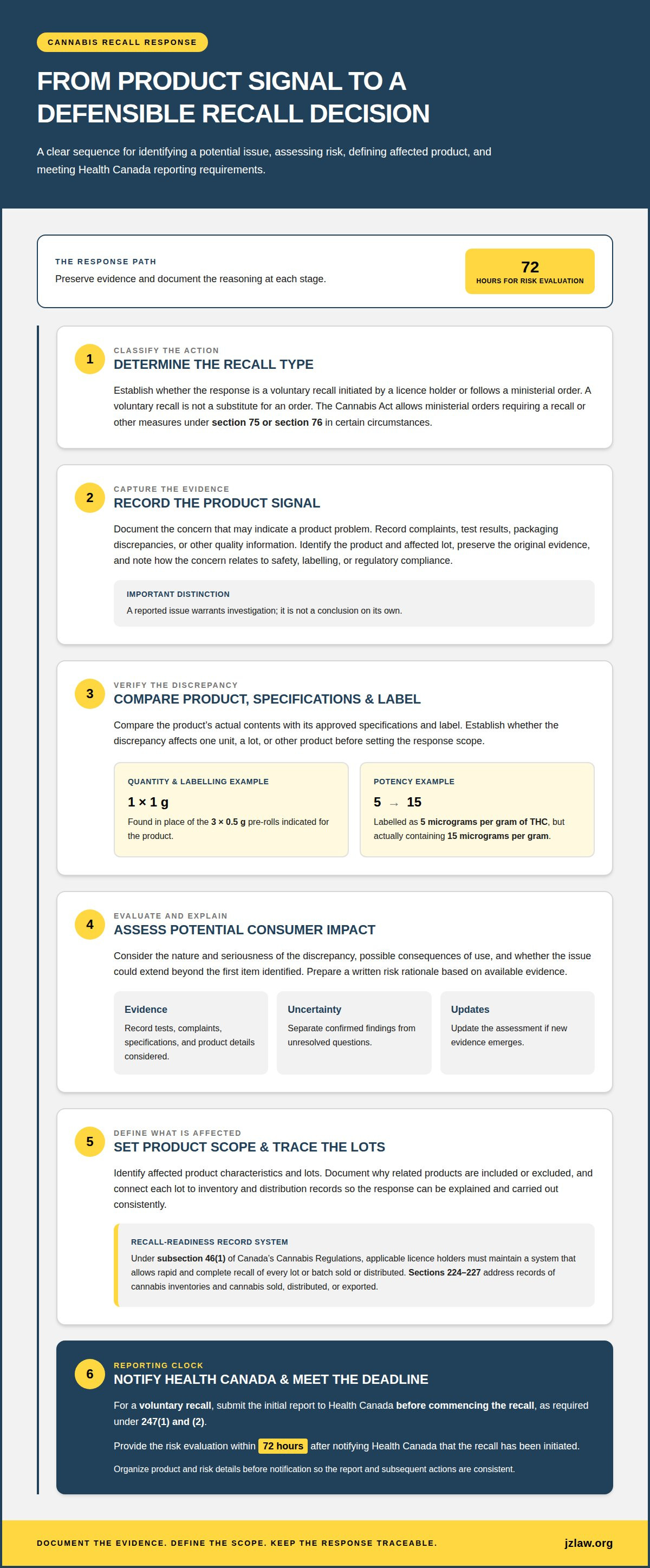
For a voluntary recall, notify Health Canada before beginning the recall. Then complete the risk assessment and reporting steps that apply to the licence holder.
Determine the recall typeFirst, establish whether the recall is voluntary or follows a ministerial order. A voluntary cannabis recall is initiated by a licence holder responding to a product concern; it is not a substitute for a recall ordered by the Minister. The Cannabis Act allows a ministerial order requiring a recall or other measures under section 75 or section 76 in certain circumstances. Identify the basis for the action before setting the response in motion.
Notify Health Canada before a voluntary recallFor a voluntary recall, submit the initial report to Health Canada before commencing the recall, as required under 247(1) and (2). Provide the risk evaluation within 72 hours of notifying Health Canada that the recall has been initiated, according to the Department of Justice Canada. Organize the product and risk details before making the notification so the report and subsequent actions are consistent.
Account for provincial and territorial roles. The federal recall process applies to cannabis licence holders, while provincial and territorial distributors and retailers authorized under subsection 69(1) must not sell a product they know is subject to a voluntary recall for specified quality or regulatory-compliance reasons. A licensed seller should stop affected sales and follow the applicable recall instructions.
If you are a consumer, follow the recall notice’s instructions and do not use the affected product. A recall notice does not by itself establish a right to a refund or replacement. Contact the seller about available remedies, and keep the product and purchase details while the issue is addressed.
For an adverse reaction or product complaint, record the product and lot details, describe the issue, and report it through Health Canada’s cannabis reporting process. If illness or injury occurred, seek appropriate medical care and preserve relevant purchase and product records. Any legal options depend on the circumstances and available evidence.
Non-compliance can lead to regulatory action. The Cannabis Act permits a ministerial order requiring a recall or other measures under section 75 or section 76 in certain circumstances; follow applicable directions and maintain records of the response.
Identifying a recall need and assessing risk
Start by documenting the signal that could indicate a product problem. Record complaints, test results, packaging discrepancies, or other quality information, then identify the product and affected lot. A reported issue warrants investigation, but is not a conclusion on its own. Preserve the original evidence and note how the concern relates to product safety, labelling, or regulatory compliance.
Compare the product’s actual contents with its approved specifications and label. For example, customers found one 1-gram pre-roll instead of the three 0.5-gram pre-rolls indicated for the product. That mismatch identifies a quantity and labelling concern. Establish whether the discrepancy applies to one unit, a lot, or other product before defining the scope of the response.
Assess the potential effect on consumers and the seriousness of the discrepancy. A cannabis product labelled as containing 5 micrograms per gram of THC but actually containing 15 micrograms per gram illustrates a potency difference that can trigger a recall. Consider the nature of the error, the possible consequences of use, and whether the issue could extend beyond the item first identified.
Prepare a written risk rationale based on the available evidence. Separate confirmed findings from unresolved questions, and record the tests, complaints, specifications, and product details considered. Explain why the issue does or does not indicate a risk requiring corrective action. If new evidence emerges, update the assessment instead of relying on an earlier conclusion.
Connect the assessment to a clear product scope and response decision. Identify the affected product characteristics and lots, then document the reason for including or excluding related products. A disciplined record helps explain the decision to Health Canada and supports consistent action across the supply chain. For advice on legal issues affecting a business, consider speaking with legal counsel.
Lot traceability and distribution records
Organize records so each affected lot can be connected to its inventory and distribution history. Under subsection 46(1) of Canada’s Cannabis Regulations, applicable cannabis licence holders must maintain a system allowing rapid and complete recall of every lot or batch sold or distributed, according to Department of Justice Canada.
Assign and preserve a distinct lot or batch identifier throughout the product records. Use it to connect production details with inventory entries and distribution documents. A recall system should let staff trace an identified product to the relevant lot, rather than rely on product names alone. Record corrections so the original entry and the reason for the change remain clear.
Keep inventory and transaction records connected. Sections 224 to 227 of Canada’s Cannabis Regulations address records of cannabis inventories and cannabis sold, distributed or exported. Organize those records so the lot identifier can be followed through each relevant movement. For example, a distribution entry should allow the business to identify which lot left its inventory and where the transaction was recorded.
Map the distribution path for each lot. Link shipping or transfer records to the relevant inventory and sales entries, then record recipient and destination details available in the ordinary course of business. This helps establish which parts of a lot remain in inventory and which have entered distribution. Keep the underlying records together rather than in separate files that require manual reconciliation.
Retain recall-system documents according to section 235 of Canada’s Cannabis Regulations. Keep the procedure, records of recall activity, and supporting material organized under a consistent filing method. Applicable licence holders must conduct a recall simulation at least every 12 months, according to Department of Justice Canada. Most cannabis licence holders must retain simulation records for at least two years.
Test whether staff can retrieve a complete lot history using the identifiers in the system. Document the simulation’s scope, the records used, and any gaps found, then update the process and retain the documentation. A clear audit trail supports timely identification of affected inventory and distribution records, and helps explain how the business determined the recall’s scope.
Health Canada oversight of recalls
Check Health Canada’s Recalls and Safety Alerts website for current cannabis notices. Compare the product name, lot details, and format with the notice, and follow its contact instructions. These notices are a useful reference for consumers and licence holders assessing whether a product has been recalled.
Use Health Canada’s notice to confirm the product and recall scope. Compare the brand, product type, lot or batch identifier, and other identifying details provided. A similar product name alone may not mean your item is affected. If an identifier is unclear, keep the packaging and purchase details when seeking clarification.
Understand Health Canada’s role in a recall. The department monitors cannabis recalls, provides guidance to licence holders, and verifies compliance with the recall requirements in the Cannabis Regulations. A legal response to a Health Canada cannabis recall should account for this oversight by clearly documenting decisions and actions, including how the business addressed the scope in the recall notice.
Track each stage against the reporting requirements. A recalling cannabis licence holder must submit the final recall report within 30 days after the recall is completed, unless an extended timeline is agreed upon, according to Department of Justice Canada. Record the completion date and retain evidence supporting the report’s account of the recall’s progress.
Keep copies of specified recall reports for at least two years. Organize them with supporting records and correspondence so the sequence of events is easy to follow. If Health Canada provides guidance or requests follow-up, retain the relevant communications with the response record. This creates a traceable account of the licence holder’s actions during the recall.
As a consumer, rely on the current notice rather than an old product listing or informal message. Health Canada publishes cannabis recall notices on its Recalls and Safety Alerts website. Check the product identifiers and instructions, then follow the directions for the affected item. Use the contact information or reporting instructions in the notice for recall-related questions.
For legal guidance on how regulatory obligations affect a cannabis business, discuss your situation with legal counsel. A legal response to a Health Canada cannabis recall can involve complex reporting and oversight considerations, and legal advice can help clarify the issues relevant to your circumstances.
JZ Law: Cannabis Licensing
JZ Law offers Cannabis Licensing for businesses dealing with the regulatory requirements of Canada’s cannabis sector. When a recall raises questions about licence obligations, reporting responsibilities, or how regulatory requirements affect business operations, legal counsel can help clarify the issues and support informed decisions. This may be relevant while preparing recall procedures or responding to a product concern, when licensing considerations intersect with operational decisions. JZ Law’s work in cannabis licensing provides a natural next step for businesses seeking legal guidance connected to their licence and regulatory position. The appropriate advice depends on the facts, including the business’s role and the issue involved. Contact JZ Law to discuss your cannabis licensing matter.
Use the recall process to strengthen future decisions
A recall can reveal where responsibilities, records, or decision-making processes need better alignment. After the immediate response, consider how the issue should inform internal controls, staff responsibilities, and future regulatory decisions. A legal response to a Health Canada cannabis recall can therefore help resolve the immediate matter and make the business’s governance approach clearer and more consistent.
JZ Law provides John Zang Services, Cannabis Licensing, and Taking Companies Public. For a cannabis business, legal guidance on licensing can help place regulatory questions in the context of its operations and corporate needs. The next step depends on the issue and the business’s circumstances.
Contact JZ Law about a cannabis recall to discuss your situation and consider a clear path forward.
Frequently Asked Questions
What is a recall?
A recall is an action to remove or address a product that may pose a health risk or fail to meet applicable requirements. For cannabis, this may involve identifying affected products, stopping their distribution or sale, and communicating with relevant parties. The scope depends on the concern and the evidence linking products or batches to it. A recall is different from a routine quality correction that does not require action in the market.
Can a single labelling error really trigger a recall?
Yes. A labelling error can prompt a recall if it creates a safety concern or indicates regulatory non-compliance. For example, inaccurate THC information could affect a consumer’s understanding of a product, while an incorrect quantity declaration could misrepresent the package contents. Assess the nature of the error, its potential impact on consumers, and whether it affects one item or a wider group of products.
What is the difference between a voluntary and a mandatory cannabis recall?
A voluntary recall is initiated by a cannabis licence holder to address a product concern; a mandatory recall is required through a ministerial order. The Cannabis Act allows the Minister to order a recall or other measures under section 75 or section 76 in certain circumstances. The distinction affects who initiates the action, but both situations require a controlled response and clear records.
Who is responsible for product quality and recalls at a licensed producer?
The licensed producer holding the applicable cannabis licence is responsible for meeting the regulatory requirements attached to its activities, including recall readiness where those requirements apply. It should assign clear internal responsibility for assessing product concerns, coordinating decisions, and maintaining relevant records. For cannabis drug licence holders, recall requirements arise under the Food and Drugs Act and its Regulations, rather than the Cannabis Regulations.
What are cannabis licence holders’ recall and notification requirements under the Cannabis Act and Regulations?
For a voluntary recall, the licence holder must notify Health Canada before commencing it, and the initial report must be submitted beforehand under 247(1) and (2). According to Department of Justice Canada, the risk evaluation is due within 72 hours after notification that the recall has been initiated. The final report is due within 30 days after completion, unless an extended timeline is agreed upon.
What penalties can businesses face for failing to comply with a Health Canada cannabis recall?
Non-compliance can lead to regulatory action. In certain circumstances, the Minister may order a recall or other measures under section 75 or section 76 of the Cannabis Act.

Comments