


How to Take a Canadian Company Public on Nasdaq
A Nasdaq listing is not achieved by filing one form: a Canadian company must meet the exchange’s listing requirements and complete the applicable SEC registration and reporting process. Understanding how to take a company public on Nasdaq from Canada also means assessing whether the company qualifies as a foreign private issuer and, if eligible for the Multijurisdictional Disclosure System, can use Form 40-F for its annual report and Form 6-K to furnish material Canadian filings.
Access to U.S. investors can be compelling, but a Nasdaq listing also brings ongoing disclosure, governance, and investor-communication responsibilities. The right structure depends on your company’s circumstances and readiness, not simply its Canadian status.
This article explains how foreign private issuer status affects SEC filings, what annual reporting involves, and why D&O insurance and investor relations belong in your planning. It also brings these considerations together to help you assess the work involved before pursuing a Nasdaq listing.
Table of Contents
D&O insurance and investor relations considerations
Choosing among a Nasdaq IPO, direct listing, SPAC merger, or Canadian exchange listing depends on your financing goals, existing shareholders, readiness, and market strategy. Legal advice can help compare the transaction structures, disclosure demands, and effects on investor access and governance.
Nasdaq eligibility depends on your company’s financial position, share distribution, governance, and chosen listing standard. Your company must satisfy the applicable requirements before its shares can be listed. The relevant standard depends on its circumstances and listing pathway.
Nasdaq’s financial, share-price, market-value, and public-float thresholds vary by listing standard. Assess your company’s financial statements and capitalization against the specific standard it seeks to meet.
Canadian securities laws and provincial regulators remain relevant to a Canadian issuer, including its disclosure obligations and transaction documents. The applicable provincial requirements depend on the company’s connection to each jurisdiction and the offering structure. According to Department of Justice Canada, a designated exchange must notify Canada's Minister of Finance within 30 business days of a qualifying change to its structure, governance, ownership, or operation.
IPO costs can include underwriting, legal, accounting, and listing fees. The total depends on the transaction structure, your company’s readiness, and the professional work required, so no single cost estimate applies to every Canadian issuer.
Common obstacles include failing to meet the applicable listing standard, incomplete disclosure, unresolved governance issues, or a transaction that cannot proceed on its proposed terms. Review capitalization, financial records, and disclosure early to identify potential obstacles before launch.
D&O insurance addresses a distinct planning concern: claims involving directors’ and officers’ decisions. Coverage terms and exclusions matter. When evaluating protection, the board should consider the company’s risk profile and responsibilities as a public issuer.
Investor relations also needs an initial plan. Assign responsibility for consistent shareholder communications, clear explanations of material developments, and responses to investor questions. A designated spokesperson and coordinated process help align communications with the company’s public disclosures across markets.
No single route suits every Canadian company. Compare the alternatives against your financing objectives, shareholder base, readiness, market strategy, eligibility, disclosure needs, governance, and investor access before deciding.
Ongoing SEC reporting on Forms 6-K and 40-F
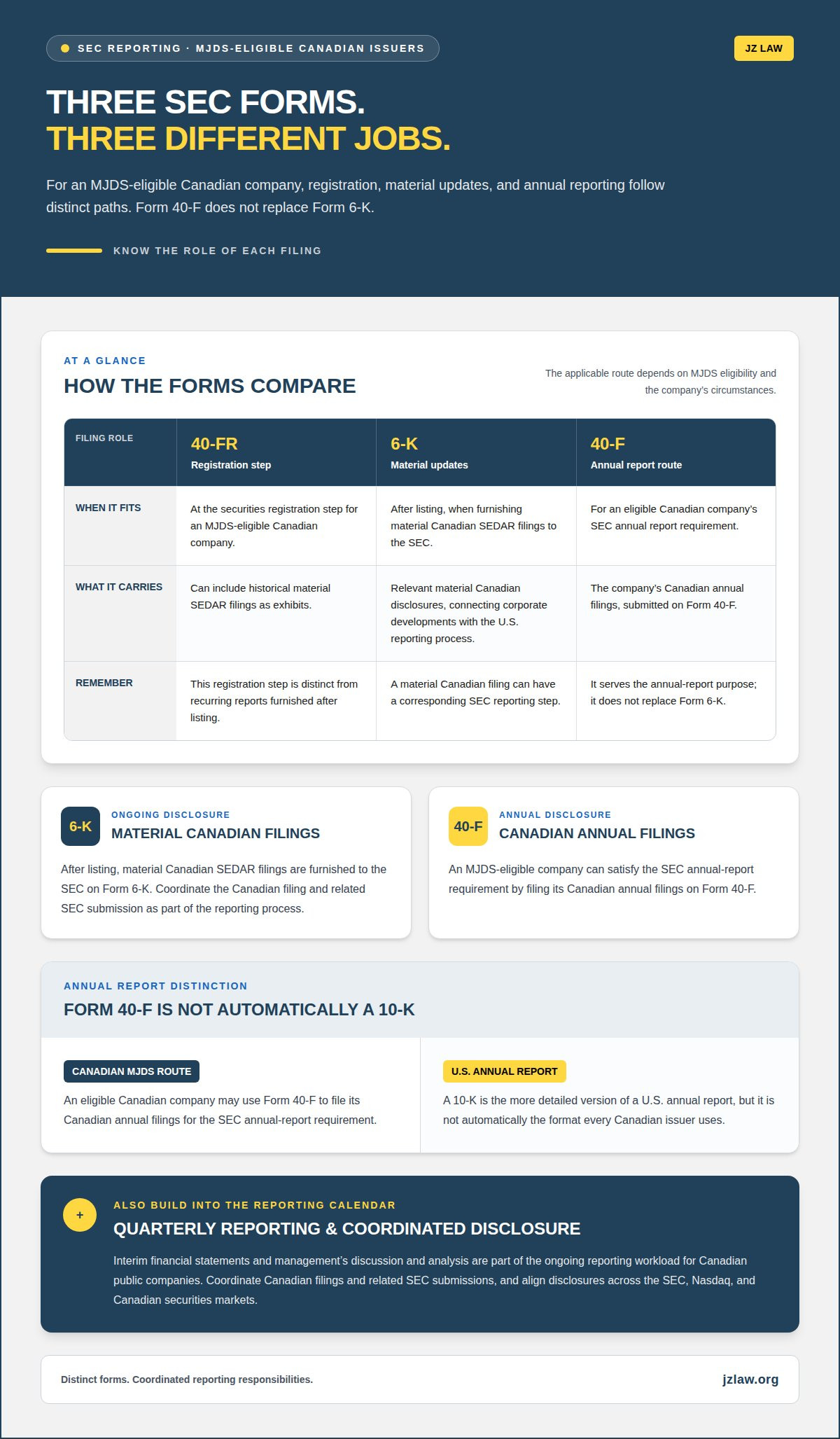
For an MJDS-eligible Canadian company, Form 40-FR can register securities with the SEC and include historical material SEDAR filings as exhibits. That registration step differs from the recurring reports furnished after listing. The applicable route depends on MJDS eligibility and the company’s circumstances.
After listing, an MJDS issuer furnishes material Canadian SEDAR filings to the SEC on Form 6-K. The form carries relevant disclosures into the U.S. reporting process, linking Canadian corporate developments with information available to investors in U.S. markets. A material filing in Canada can therefore have a corresponding SEC reporting step.
Annual reporting follows a separate path. An eligible Canadian company can satisfy the SEC’s annual report requirement by filing its Canadian annual filings on Form 40-F. Form 40-F does not replace Form 6-K: the forms serve different purposes, one addressing annual filings and the other furnishing material Canadian disclosures.
Quarterly reporting is another ongoing consideration. Interim financial statements and management’s discussion and analysis are part of the ongoing reporting workload for Canadian public companies. These reports inform shareholders and give investors a recurring view of financial performance. Build both Canadian filings and the related SEC submission process into the company’s reporting calendar.
Ongoing compliance also means coordinating disclosure across the SEC, Nasdaq, and Canadian securities markets. A corporate event, financial update, or other material development may affect what your company communicates and when it prepares related filings. A consistent process helps align public statements with filed information while shares are trading.
In practice, the reporting team can map each Canadian filing to its SEC treatment, identify the annual Form 40-F cycle, and coordinate quarterly financial reporting. That work is especially relevant for companies seeking U.S. capital while retaining Canadian reporting responsibilities. Coordinated public-company reporting advice can help align these obligations with the listing transaction.
Annual reports and U.S. 10-K filings
A Canadian company relying on the Multijurisdictional Disclosure System can satisfy the SEC’s annual report requirement by filing its Canadian annual filings on Form 40-F. This gives an MJDS-eligible issuer a defined route for connecting Canadian annual disclosure with U.S. reporting. A 10-K is the more detailed version of a U.S. annual report, but it isn’t automatically the format every Canadian issuer uses.
This distinction matters when planning a Nasdaq listing: your company needs to understand which reporting framework applies to its circumstances. The annual report presents the company’s financial performance, business, risks, and assets. The filing route determines how that information is delivered to the SEC, while Canadian filings remain important source documents for an MJDS-based submission.
For example, a company preparing its Canadian annual filings can map the financial statements and related management discussion to its Form 40-F process. This coordination helps identify gaps between the materials prepared for Canadian disclosure and the information needed for U.S. investors. It also gives finance, legal, and corporate teams a shared reporting calendar rather than separate, disconnected filing workflows.
A U.S. 10-K’s greater detail can make it a useful comparison point, even when an eligible Canadian company uses Form 40-F to meet the SEC annual report requirement. The comparison helps decision-makers understand the distinction between the U.S. report format and the Canadian filing route. It also supports clear communication with shareholders across exchanges, where investors need coherent annual information about the listed company.
In practice, the annual reporting plan should identify the applicable SEC route, coordinate it with Canadian annual filings, and assign responsibility for reviewing the disclosure. That planning is relevant before and after a Nasdaq listing, especially when the company’s reporting practices or corporate structure change. Treating Form 40-F and a 10-K as interchangeable can obscure which filing approach fits the issuer’s circumstances.
Foreign private issuer status
For a Canadian company assessing how to take a company public on Nasdaq from Canada, foreign private issuer status is an important part of the SEC reporting analysis. A Canadian company can pursue a Nasdaq listing without automatically creating a U.S. subsidiary. Listing structure and issuer status are related planning questions, but they are distinct decisions. Your company’s legal, operating, and ownership structure informs its U.S. registration and reporting approach.
Status matters because it can affect which SEC reporting framework is available. Canadian companies relying on the Multijurisdictional Disclosure System, or MJDS, can furnish material Canadian filings on Form 6-K and file Canadian annual filings on Form 40-F. MJDS eligibility is distinct from foreign private issuer status; Canadian incorporation alone does not establish that every issuer qualifies.
To qualify for MJDS, a Canadian company must have a Canadian reporting history of 12 months and a public float of at least US$75 million. Public float is market capitalization less shares held by shareholders beneficially owning 10% or more of outstanding equity securities. The company’s shareholder record and capitalization therefore matter when assessing eligibility.
Cross-border planning also involves tax, currency, and reporting coordination. Consider how your Canadian operations, securities offering, financial records, and investor disclosures fit together across jurisdictions. Currency presentation and financial information should align with your reporting approach, while tax structuring depends on your circumstances. These issues call for integrated planning, not simply a stock exchange application.
A clear plan for how to take a company public on Nasdaq from Canada maps the issuer, shareholders, proposed offering, and SEC filing route. That review can clarify whether a U.S. subsidiary serves a specific corporate purpose or adds complexity. For guidance on cross-border listing structure, discuss your Nasdaq listing structure.
JZ Law: Taking Companies Public
JZ Law provides Taking Companies Public and Securities Regulation services to Canadian companies evaluating a Nasdaq listing. The firm can help when you are weighing a transaction structure, preparing securities filings, or aligning Canadian and U.S. considerations before a public offering.
Early legal planning can connect your listing pathway with your company’s circumstances and disclosure responsibilities. As the transaction develops, coordinated advice can address the legal work involved in taking a company public and the accompanying securities regulation issues.
If your company is considering a Nasdaq listing, contact JZ Law to discuss the matter.
Turn your Nasdaq ambition into a considered plan
Next, consider how a public listing would fit your company’s long-term business strategy. Before moving ahead, align the board’s objectives, financing priorities, and internal capacity for operating as a public issuer. A clear view of those priorities can shape a transaction plan that supports the business beyond the listing.
Deciding how to take a company public on Nasdaq from Canada is a strategic exercise, not simply a choice of exchange. Your intended use of capital, ownership structure, and readiness to meet ongoing public-company responsibilities should inform the path forward. JZ Law’s Taking Companies Public service can help companies assess that path and its legal dimensions.
For a focused discussion of your company’s objectives and possible next steps, discuss your Nasdaq plans with JZ Law. A deliberate plan can help your company approach its next stage with greater clarity and confidence.
Frequently Asked Questions
What legal and corporate steps can a professional help a Canadian company complete before a Nasdaq IPO?
Before preparing for a Nasdaq IPO, legal counsel can assess your company’s structure, ownership records, board readiness, and proposed offering. The work may include coordinating transaction documents, securities disclosures, Canadian and SEC filing requirements, and the listing application. For example, an early review of capitalization and corporate records can identify issues to address before investors receive offering materials.
What is the step-by-step timeline for professionally taking a Canadian company public on Nasdaq?
The process generally moves from readiness and transaction planning to financial and disclosure preparation, regulatory review, listing approval, and the offering or other transaction that makes shares publicly traded. Well-prepared companies can complete the Canadian going-public process in six to twelve months; approval of a U.S. stock exchange listing can be completed confidentially over several weeks. These are distinct stages, not a guaranteed combined timetable.
What tax, currency, and cross-border reporting issues arise for Canadian companies listed on Nasdaq?
Canadian securities laws and provincial regulators remain relevant, and reporting must be coordinated across the SEC, Nasdaq, and Canadian markets. An MJDS-eligible company can furnish material Canadian filings on Form 6-K and use Form 40-F for annual filings; no tax or currency issues are covered here.
What are the costs of a Nasdaq IPO, including underwriting, legal, accounting, and listing fees?
Costs can include underwriting, legal, accounting, and listing fees. The total depends on the transaction structure, issuer readiness, and professional work required; U.S. public-company costs are generally two to three times higher than in Canada, both upfront and ongoing.



Comments