


Legal Requirements for Listing on a US Stock Exchange and Share Price
A share count alone doesn’t determine whether a company qualifies for NYSE American. Listing eligibility depends on applicable financial and liquidity standards, and not all outstanding shares may count toward public-float requirements. The distinction matters: shares that exist may not all count toward the required unrestricted public float.
Financial thresholds and share price are important, but eligibility also depends on the public float, corporate governance and the exchange’s review. Meeting technical criteria does not guarantee NYSE American will approve an application.
This article explains how listing standards fit together, including financial and liquidity thresholds, share-price rules, cure periods and which securities may be excluded from the public float. For Canadian companies considering a US listing, understanding these requirements helps clarify the legal and corporate work to address before submitting an application.
Table of Contents
What Are the New NYSE American Listing Requirements for 2026?
NYSE American eligibility depends on the listing route, public float, financial profile and exchange review. NYSE standards can provide comparison points, but they are not NYSE American thresholds.
NYSE American Market Value Thresholds
Market value thresholds measure the value of qualifying publicly held shares at listing. For comparison, a domestic IPO on the NYSE requires at least US$40 million in publicly held shares; existing securities or transfers require at least US$100 million. These are NYSE figures, not stated NYSE American thresholds. Canadian issuers that qualify as foreign private issuers may use alternate NYSE standards, including a US$100 million worldwide public-share value threshold.
Domestic Listing Distribution Requirements
Distribution tests assess whether shares have sufficient holders and trading activity. For existing securities or transfers to the NYSE, one route requires 400 holders of 100 shares or more, plus average monthly trading volume of 100,000 shares during the most recent six months. Alternatives include 2,200 total shareholders with the same six-month volume, or 500 shareholders and average monthly volume of 1 million shares during the most recent 12 months.
Initial Listing Criteria and Exchange Discretion
Initial listing criteria combine quantitative tests with qualitative review. NYSE American’s board considers a candidate’s business, product market, management reputation, growth record, financial integrity, earnings power and outlook. The board must also agree to the exchange’s corporate governance requirements. Meeting technical standards does not compel approval: NYSE American retains discretion to deny an application. For Canadian issuers, the applicable route depends on issuer status and listing structure.
SEC Registration, Disclosure, and Filing Requirements
SEC registration and disclosure depend on the offering and issuer; NYSE Regulation reviews and approves applications for listing on NYSE Exchanges. The available facts don’t identify registration forms or specify financial reporting standards or audit periods, so no particular form or accounting framework should be assumed here. Listed companies must meet applicable filing requirements. Governance includes the exchange’s corporate governance requirements, while specific board independence, audit committee and shareholder rules depend on the applicable standard.
Costs vary by exchange and listing structure. Ongoing compliance includes timely filings and meeting exchange requirements.
Financial and liquidity thresholds
The legal requirements for listing on a US stock exchange depend on the exchange and the financial test selected. NYSE and Nasdaq standards use different measures, so a company should assess each complete listing route rather than combine favourable elements from separate tests.
Under the NYSE domestic earnings test, pre-tax earnings must total at least US$10 million over the last three fiscal years. Earnings must be positive in all three years, including at least US$2 million in each of the two most recent fiscal years. This test centres on sustained earnings, not simply a strong latest-year result. The NYSE also has a global market capitalization test based on public shares.
Standard 2 instead requires at least US$27.5 million in aggregate cash flows over the prior three fiscal years, plus US$110 million in revenue for the previous fiscal year. Those tests measure different financial strengths, so revenue alone doesn’t satisfy the cash-flow route.
Other Nasdaq standards use different indicators. The Global Market Income Standard requires at least US$1 million in income from continuing operations before income taxes in the latest fiscal year or in two of the last three fiscal years. The Capital Market Equity Standard requires at least US$5 million in stockholders’ equity at initial listing.
For Canadian issuers, assess the legal requirements for listing on a US stock exchange against the company’s actual listing route and financial records. Separate revenue, earnings, cash flow and equity tests before comparing them with the applicable thresholds. This helps identify which standard the company may satisfy and where its financial position needs further analysis.
Minimum share-price compliance and cure period
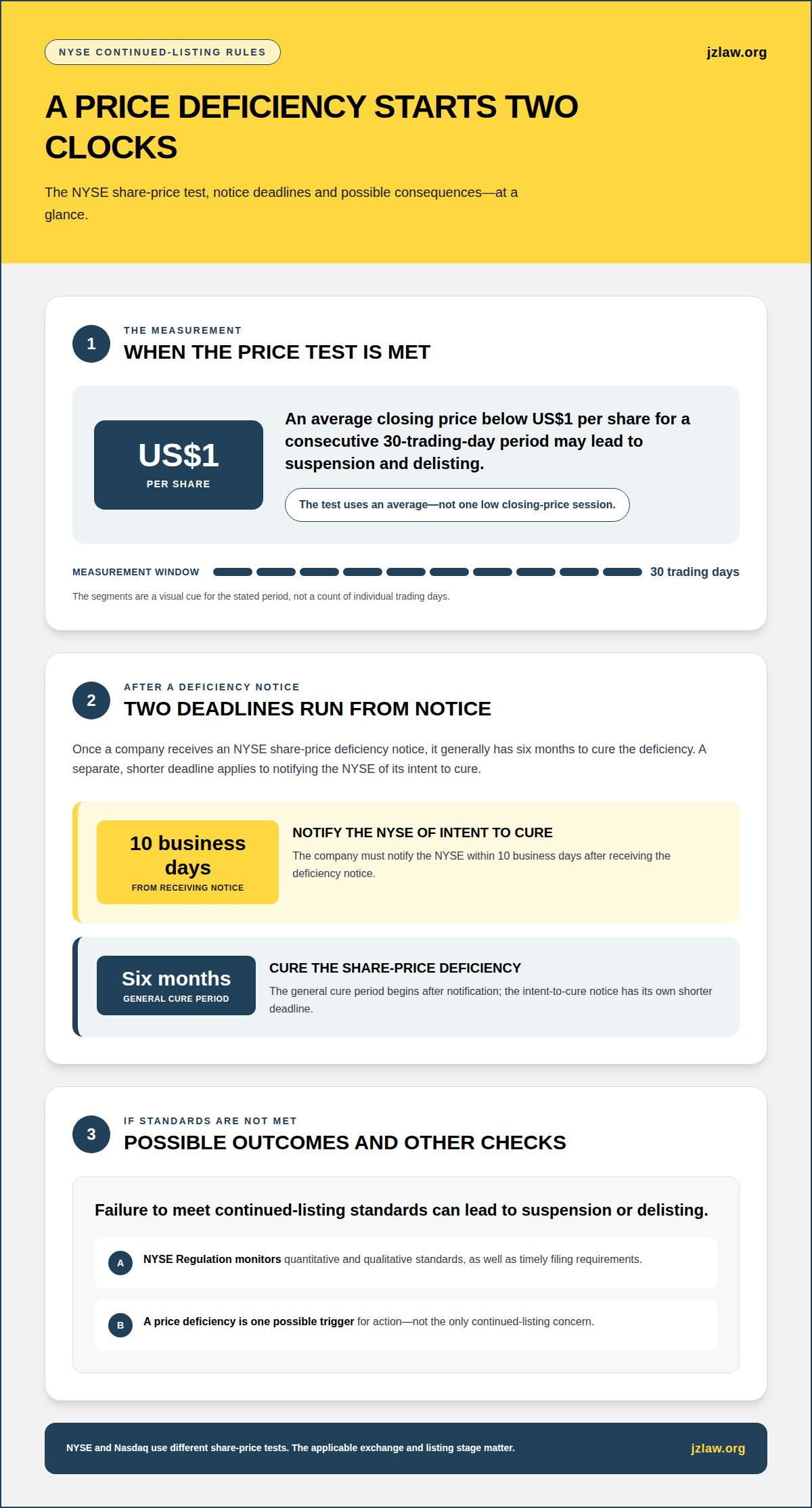
NYSE and Nasdaq use different share-price tests, so the applicable exchange matters. On the NYSE, an average closing price below US$1 per share for a consecutive 30-trading-day period may lead to suspension and delisting.
Minimum Share-Price Compliance
A share-price standard sets a minimum price for initial listing or continued trading. These tests apply at different stages, so meeting Nasdaq’s initial threshold does not establish compliance with NYSE rules.
The NYSE’s 30-trading-day measurement uses an average, not a single closing-price dip. That distinction matters when assessing a potential deficiency: one low session alone doesn’t meet the stated period test. Companies planning a listing should distinguish initial eligibility from ongoing market-price compliance.
Cure Periods and Consequences of Noncompliance
After an NYSE share-price deficiency notice, a company generally has six months to cure it. It must notify the NYSE of its intent to cure within 10 business days after receiving notice. These deadlines make prompt planning important; the cure period begins after notification, while the intent notice has its own shorter deadline.
Failure to meet continued-listing standards can lead to suspension or delisting. NYSE Regulation monitors quantitative and qualitative standards, as well as timely filing requirements, and may initiate those actions when a company is noncompliant. A share-price deficiency is one possible trigger, not the only one.
Other NYSE thresholds illustrate the broader risk. The exchange will initiate suspension and delisting if average global market capitalization stays below US$15 million throughout a consecutive 30-trading-day period, regardless of the initial listing standard. NYSE states that an NYSE-listed company may be subject to suspension and delisting if its average global market capitalization is below US$50 million for a consecutive 30-trading-day period and its stockholders’ equity is below US$50 million.
For an issuer, the practical distinction is whether a deficiency starts a cure process or leads to suspension or delisting. The applicable standard and measurement period determine the response required.
Unrestricted publicly held shares and restricted securities
For NYSE American, the public float calculation focuses on eligible shares, not every issued share. In 2026, certain securities are excluded, so a company seeking to list must distinguish unrestricted publicly held shares from holdings that cannot count toward the applicable float requirement.
Excluded securities include Regulation D or private placement securities, Regulation S securities that cannot be resold in the United States, locked-up shares, certain compensatory issuances, and Rule 144 restricted securities. A company may therefore have substantial outstanding shares while a smaller portion qualifies for its listing calculation. The distinction affects both float eligibility and the market value attributed to qualifying publicly held shares.
For an NYSE American IPO or other underwritten offering, shares held by existing shareholders cannot count toward the required offering-generated float. The calculation must distinguish shares sold in the offering from shares held beforehand. An issuer cannot use existing shareholder holdings to fill a shortfall in the offering-generated float, even if those shares increase the total shares outstanding.
Share-count thresholds on other exchanges illustrate why the listing venue matters. Nasdaq’s stated initial listing requirement includes at least 1,250,000 publicly held shares, while the Nasdaq Global Market requires at least 1.1 million unrestricted publicly held shares. These are Nasdaq standards, not NYSE American thresholds, and shouldn’t be substituted when assessing an NYSE American application.
Start by classifying each share block according to how it was issued, resale restrictions, lock-up status and holder. The issuer can then identify qualifying shares, calculate the relevant public float and assess whether the offering structure provides enough eligible shares. This review can also reveal how restricted securities may reduce the count.
For a review of securities eligibility and offering structure, discuss listing preparation with counsel experienced in taking companies public.
JZ Law
JZ Law advises companies on the legal and corporate considerations involved in pursuing a US listing. Its work in taking companies public and securities regulation is relevant to assessing listing structure, disclosure obligations, offering design and the treatment of restricted shares.
Consider legal support early, while selecting an exchange and reviewing the company’s capitalization, governance and financial position. Addressing these issues together can help align the proposed offering with the applicable listing route and identify structural questions before an application proceeds. The right analysis depends on the issuer’s circumstances and chosen route.
For guidance on a prospective listing, contact JZ Law.
Prepare for the Decisions Ahead
Applying the legal requirements for listing on a US stock exchange is part of a broader corporate decision: whether the proposed financing, ownership structure and public-market plans fit together. Before moving forward, align the company’s objectives with the transaction structure and clarify which decisions require board or shareholder attention. A disciplined preparation process can help coordinate legal and business considerations as the listing plan develops.
JZ Law can support companies considering a public listing through its relevant legal services. A discussion can focus on the company’s objectives, proposed route, and key structural questions, helping identify the legal work that belongs in the next phase. No two listing plans are identical, so the useful starting point is a clear account of what the company intends to achieve and how it plans to get there. Contact JZ Law about listing to discuss your next steps with confidence.
Frequently Asked Questions
What are the NYSE initial listing standards for public float, share price, market capitalization, and shareholders?
NYSE thresholds differ for IPOs and existing securities, and they aren’t interchangeable with NYSE American standards. A domestic IPO generally needs at least US$40 million in publicly held shares and an offering price of US$4 per share. A global market capitalization route requires US$200 million based on public shares. Existing listings or transfers can use alternative distribution tests, which combine shareholder counts with specified trading volume.
What exemptions or alternative listing routes are available for Canadian companies seeking a U.S. exchange listing?
There’s no general Canadian-company exemption in the stated standards, but an issuer qualifying as a foreign private issuer may use NYSE alternate standards. These include a US$100 million worldwide public-share value test, or financial routes based on market capitalization, revenue and cash flow. For example, one route requires US$500 million in global capitalization, US$100 million in recent revenue and US$100 million in aggregate cash flows over three fiscal years.
What corporate governance, board independence, audit committee, and shareholder requirements apply to listed companies?
NYSE American applicants must have their board agree to the exchange’s corporate governance requirements. Specific board-independence, audit committee and shareholder rules depend on the applicable standard; for Nasdaq, certain companies may have up to 90 days after initial listing to achieve a majority-independent board, and common-stockholder meeting quorum must be at least 33 1/3% of outstanding voting shares.



Comments