


Legal support for scaling a business in Berlin: key needs
A Berlin growth plan can outgrow its legal structure before it outgrows its market. Whether a business needs a particular German licence depends on its activities, and licensing work often takes 6-18 months. Early legal support for scaling a business in Berlin can help founders assess licensing alongside the decisions about hiring, contracts and corporate structure that come with expansion.
It’s reasonable to start by asking whether the business can operate lawfully, but licensing is only one part of the picture. As operations grow, the company’s structure, governance, employment practices and commercial agreements may also need to keep pace.
This article explains how growth changes those legal needs, including when licensing matters, what to consider when choosing a German business structure, and how to strengthen contracts and compliance. It also covers tax and VAT planning, so you can see how these decisions fit together as your Berlin business scales.
Table of Contents
Employment policies and compliance as the workforce grows
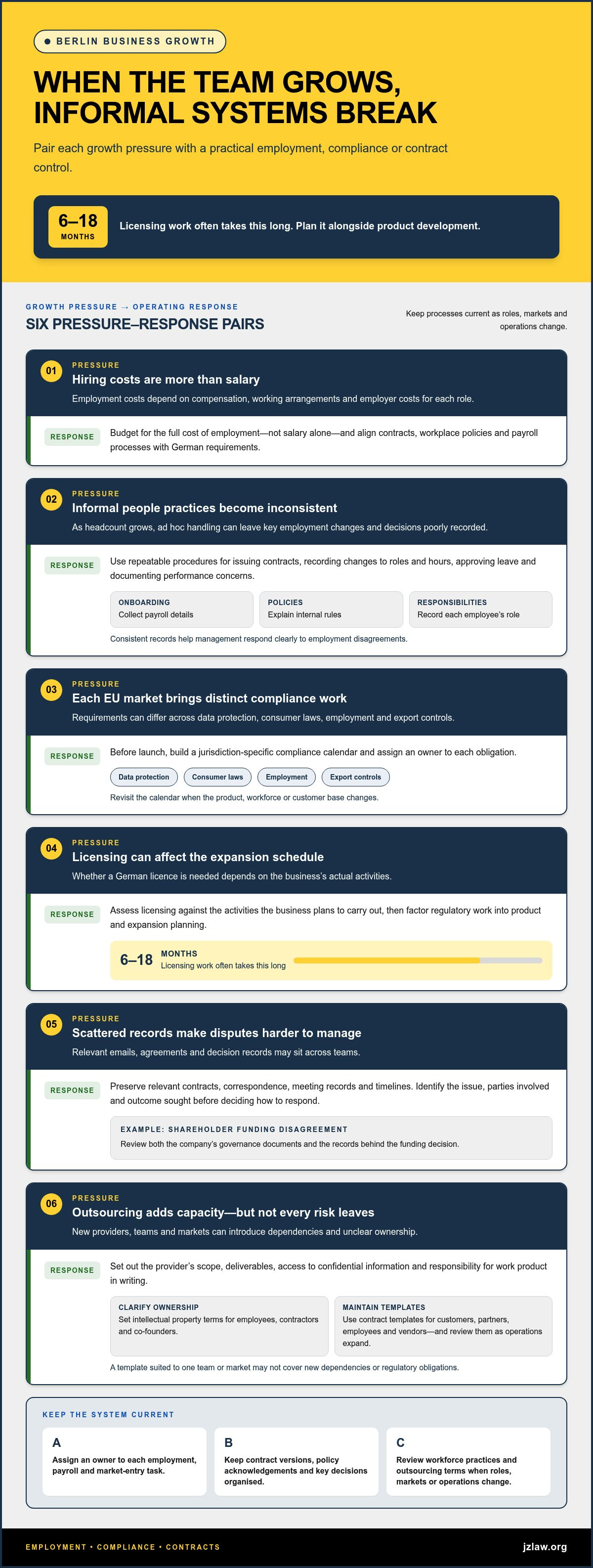
Berlin businesses hiring employees need to align employment contracts, workplace policies and payroll processes with German requirements. Hiring costs depend on compensation, working arrangements and employer costs for each role, so budgets should account for the full cost of employment, not salary alone.
As headcount grows, replace informal practices with repeatable procedures. Set a consistent process for issuing contracts, recording changes to roles and hours, approving leave and documenting performance concerns. A written onboarding checklist, for example, can specify who collects payroll details, explains internal policies and records each employee’s responsibilities. Consistent records also help management respond clearly to employment disagreements.
Expansion into other EU jurisdictions adds distinct compliance work. Technology businesses should account for differences in data protection, consumer laws, employment requirements and export controls in each market. Build a jurisdiction-specific calendar before launch, assign an owner to each obligation, and revisit the calendar when the product, workforce or customer base changes. Licensing timelines are often 6-18 months, so businesses should plan licensing work alongside product development.
Corporate form can affect employee involvement. The European Company (Societas Europaea, or SE) was introduced through a 2001 regulation and an accompanying directive on employee involvement. That makes governance planning relevant when a business considers this structure, especially if its workforce and operations cross borders. The proposed EU Inc. framework leaves employee participation rules subject to the law of the Member State where the board is located, so board location can matter to future planning.
Disputes are harder to manage when emails, agreements and decision records are scattered across teams. For commercial, employment and shareholder disputes, preserve relevant contracts, correspondence, meeting records and timelines. Identify the issue, the parties involved and the outcome sought before deciding how to respond. A shareholder disagreement over funding, for example, may require reviewing both the company’s governance documents and the records behind the decision.
Outsourcing can add capacity, but it does not transfer every risk. Set out each provider’s scope, deliverables, access to confidential information and responsibility for work product in writing. Clarify intellectual property ownership for employees, contractors and co-founders, and use contract templates for customers, partners, employees and vendors. Review templates as operations expand: one suited to a particular team or market may not address new dependencies or regulatory obligations.
Assign a responsible owner to each employment, payroll and market-entry task.
Keep contract versions, policy acknowledgements and key decisions in an organised record system.
Review workforce practices and outsourcing terms whenever roles, markets or business operations change.
How does scaling affect a business's legal needs?
Growth can change how a business makes decisions, allocates capital and manages risk. Legal advice becomes more strategic when founders, investors and operating teams need clear authority.
Governance for a Growing Business
Corporate governance defines decision-making authority, oversight and accountability. As a business grows, its legal structure and management arrangements should continue to fit its ownership, operations and financing plans.
Document which decisions require board approval, who can sign contracts and how conflicts are recorded. Review these arrangements when bringing in investors, creating subsidiaries or changing leadership. Clear procedures let managers handle routine decisions while reserving major commitments for the appropriate decision-makers.
Digital procedures can make governance more consistent across teams. Keep current records of approvals, meeting decisions, delegated authority and contract signatories in an organised system. Periodically review data governance, cybersecurity and AI governance policies to ensure controls still fit the business’s technology and activities. For an AI tool that supports customer decisions, record its purpose, oversight and review process.
Connect legal oversight with strategic planning as the company grows. Assign responsibility for monitoring material contracts, procurement risks and regulatory changes. A central contract register, for example, can flag renewal dates, exclusivity clauses and service dependencies before they limit future choices. These records support management decisions and help teams focus resources on operating priorities.
Companies considering an IPO or an AIM listing need governance that can withstand external scrutiny. Start by assessing whether financial records, ownership information, board decisions and material agreements are organised and consistent. Potential investors will want a clear account of how capital is used, who controls key decisions and which commercial dependencies could affect the business. Treat listing readiness as a corporate project, not a last-minute paperwork exercise.
Tax and VAT Planning
Tax and VAT planning considers how a business’s structure, transactions and markets affect its tax administration. Businesses in Germany involved in cross-border transactions within the EU need to register for a VAT identification number.
Map where the company sells, buys and holds assets, then identify transactions that cross EU borders. A Berlin business selling to customers in another EU country, for example, should account for the VAT identification requirement in its expansion planning. Coordinate tax records with contracts and finance processes so management can trace each transaction’s business purpose and supporting documentation.
When growth involves acquisitions, investment or significant changes in ownership, corporate transaction planning can help connect governance decisions with the commercial deal. Bring the intended structure, approval process and capital objectives into the discussion early, before transaction documents shape the company’s future operating arrangements.
Foundational agreements and legal protections
As the business grows, foundational agreements should keep pace with its people, products and commercial relationships. Review shareholder, customer, supplier and partnership agreements when hiring changes responsibilities or the company enters a new sector. Clarify who owns work created for the business, who may use confidential information, and how decisions or disagreements will be handled. Clear terms give founders and managers a reliable reference when commercial priorities diverge.
Data protection obligations also change as a company processes more information. According to Gesetze im Internet, controllers and processors must appoint a data protection officer if they regularly employ at least 20 Personen (people) who constantly process personal data automatically. Assess what personal data each team handles, which systems process it, and whether the staffing threshold applies. Record the assessment and revisit it when hiring or workflows change.
The GDPR requires businesses to handle personal data lawfully and responsibly. Administrative fines for violations can reach €20 million or 4% of a company’s global annual turnover. These limits make data handling a governance issue, not merely an IT task. Assign responsibility for reviewing access, retention and incident procedures, and make sure employees understand how customer information should be used.
Consumer law needs attention when a growing business changes how it markets, sells or delivers products. A Berlin company entering another market should review customer-facing terms, product claims, cancellation information and data practices against that market’s requirements. A new online subscription, for example, may require different customer communications and renewal processes from a one-time sale. Map the customer journey, then align contracts and notices with the service actually provided.
Intellectual property protection starts with clear ownership and documented rights. Germany-based businesses can protect brand identity through trademark registration and should consider registering trademarks early when expanding into new markets. Before filing, identify the mark the business uses and the markets where it plans to trade. Written agreements should also establish ownership of intellectual property created by employees, contractors, co-founders and commercial partners.
Standard agreements help apply those protections consistently across a larger operation. Create and maintain templates for customers, partners, employees and vendors, then review them when the business model or risk profile changes. A technology company, for instance, should assess whether its customer terms address service dependencies, exclusivity or shared intellectual property. Partnership agreements should define permitted use of each party’s materials and what happens to those rights if the relationship ends.
Map personal data flows and review the DPO threshold as staffing and processing practices change.
Record intellectual property ownership in employee, contractor and partner agreements.
Review customer terms and contract templates before entering a new market or changing a product.
Choosing a German legal structure
Choose a structure based on ownership, decision-making, liability planning and the business’s next stage. For a Berlin company preparing to raise capital, add co-owners or expand across a border, the structure should support those plans without making daily management unnecessarily complex. The key test is fit: compare the intended operations with the responsibilities and governance the structure requires.
German corporations and partnerships engaged in commercial activities must register with the Commercial Register. That makes the choice of structure a practical operating decision, not just a label. Before committing, map who owns the business, who makes strategic decisions, how new investment could affect control, and whether the planned activity requires sector-specific licensing. The Handelsgesetzbuch, Gewerbeordnung and Abgabenordnung are among the laws governing business start-up requirements.
International expansion brings another choice: establish a subsidiary, branch or representative office. These options differ in how the business organises its presence and connects it to the existing entity. A company entering another EU market, for example, should consider where contracts will be made, which team will conduct local operations and how local regulatory obligations affect the arrangement. Local legal advice during planning can help identify issues before expansion requires remediation.
A subsidiary may suit a plan that needs a distinct local operation; a branch or representative office may serve a different commercial purpose. Treat them as structural alternatives, not interchangeable names. Compare each option with the planned activities, the people managing them, expected contracts and the company’s employment footprint. Businesses operating across markets should also account for differences in employment, data protection, consumer law and export controls.
Founders from outside the EU must include immigration status in their planning. Non-EU nationals starting a business in Germany need a residence permit that authorises business activity. Membership in the German Chamber of Commerce and Industry (IHK) is mandatory for most businesses, so include this obligation in establishment planning. These considerations can affect who may operate the business and which administrative steps accompany its structure.
European corporate forms may also enter longer-term planning. The Societas Europaea (SE) framework has around 3,000 registrations, but implementation is fragmented, with a different variant in each EU member state. The EU Inc. proposal, published on 18 March, describes a proposed corporate form; it does not harmonise taxation or labour-market regulation, which remain largely governed by national frameworks. Businesses should distinguish proposed options from structures available for current operations.
For a scaling business, compare structures against a written growth plan covering ownership, management authority, financing, planned markets and regulatory exposure. Revisit the analysis when those factors change. The structure that supports early success may not suit a later acquisition, cross-border operation or major change in employment, so make entity planning part of corporate governance.
What taxes and VAT rules should a business scaling in Berlin plan for?
Tax planning should reflect the business’s legal structure, activities and transaction flows. For a Berlin company, growth can change the relationships between owners, operations, customers and assets. Map those changes before entering a market, acquiring property or restructuring the company. The Abgabenordnung, Germany’s Tax Code, is among the laws governing business start-up requirements, so tax administration belongs in the wider legal plan.
Start with a current picture of how the business earns and spends money. Separate domestic sales from cross-border transactions, identify where customer contracts are performed and record how the company holds or uses assets. A Berlin business opening a location elsewhere, for example, should assess how the change affects its records and tax planning. Keep finance, legal and management teams aligned as the plan develops.
VAT deserves specific attention when transactions cross borders within the European Union. Businesses in Germany involved in cross-border transactions within the EU need to register for a VAT identification number. Build this requirement into market-entry planning, then align invoices, customer records and transaction documentation with actual sales flows. A change in the customer base or trading pattern should prompt a fresh review.
Different business activities can raise different tax questions. A company that sells digital services, holds commercial property or completes a corporate acquisition should map each activity separately. Record which entity signs the relevant contracts, receives income and bears costs. For property expansion, document how the premises will be used and how the transaction relates to business operations. These details provide a clearer basis for organising records and assessing tax implications.
Make tax administration part of the governance calendar as the company grows. Assign responsibility for collecting transaction records, reconciling invoices and escalating changes in business activity. Maintain clear documentation for transactions between related entities, acquisitions and ownership changes. Before expanding, compare the proposed structure with its commercial purpose, planned markets and operating model. This review helps management identify tax and VAT issues before commitments become difficult to unwind.
Map domestic and EU cross-border sales, purchases and business activities.
Include VAT identification number registration in planning for relevant EU transactions.
Keep contracts, invoices and asset records aligned with the company’s operating structure.
If expansion involves acquiring or leasing business premises, address real estate legal considerations alongside the transaction’s tax planning. Reviewing the property arrangement and the company’s intended use can help management connect its legal commitments with its broader growth plan.
JZ Law: John Zang Services
JZ Law provides John Zang Services to businesses facing complex corporate and regulatory decisions. Consider engaging the firm when growth involves capital markets, securities obligations or a regulated cannabis business. Its services include Taking Companies Public, Securities Regulation and Cannabis Licensing, which may be relevant as a company prepares for a public offering, assesses securities requirements or pursues licensing.
For founders, a practical next step is to define the decision at hand, such as assessing a public-market plan or understanding licensing needs, and organise the relevant corporate records and agreements. This gives the discussion a clear business context and connects legal considerations with growth objectives.
To discuss your business’s legal needs, contact JZ Law.
Make your next growth decision with clarity
Scaling is an opportunity to decide what the business should become next. Before committing to a new market, transaction or financing plan, identify the decision that could most shape the company’s direction, then align legal planning with that objective. Focused legal support for scaling a business in Berlin can connect immediate choices with longer-term corporate priorities.
JZ Law provides John Zang Services, including Cannabis Licensing and Taking Companies Public. These services may be relevant when growth involves regulated cannabis activity or preparation for a public-market strategy. A clear outline of your intended direction can make the next discussion focused and practical.
Contact JZ Law about scaling to discuss your business’s legal needs. With deliberate planning, growth decisions can become a stronger foundation for the company’s next stage.
Frequently Asked Questions
Can you help my business scale soundly?
JZ Law works with businesses on corporate and regulatory matters related to growth. Legal support for scaling a business in Berlin can be relevant when expansion involves a transaction, financing strategy, public-market plans or regulated cannabis activity. JZ Law’s services include Corporate Transactions, Tax Structuring, Securities Regulation, Taking Companies Public and Cannabis Licensing. To discuss professional counsel, outline your business objective, the decision requiring attention and any relevant agreements or corporate records.
How do I keep my legal foundation from cracking as I scale?
Review the foundation whenever a material business decision changes who owns, controls or operates the company. An investor joining, a founder leaving, an acquisition or entry into a new market can expose gaps between current documents and actual practice. Compare company records with the proposed change, note any approvals needed, and identify agreements or internal procedures to update before implementation.
How should contracts and practices change when scaling?
Make contract management consistent, then control exceptions. Assign someone to approve departures from standard terms, record why a change was accepted, and track renewal or termination dates. If a customer requests a different service commitment, for example, document the agreed scope and who approved it. Review operational practices alongside contract terms so sales, delivery and finance teams follow the same commitments.
Should I revisit my legal foundation when scaling?
Revisit the plan when a change affects ownership, financing, markets or how the business operates. Legal support for scaling a business in Berlin can connect a planned change with the company’s corporate records and agreements. Before an acquisition, for instance, assemble ownership information, key agreements and board records. This gives decision-makers a clearer basis for assessing what needs to change before the transaction proceeds.
What are the legal steps to starting a business in Germany?
Begin by defining the planned activities, then assess whether they require licensing and select a suitable business structure. Corporations and partnerships engaged in commercial activities must register with the Commercial Register. Membership in the German Chamber of Commerce and Industry is mandatory for most businesses. Non-EU nationals starting a business in Germany need a residence permit authorising business activity, so include immigration status in initial planning.
What legal business structures are available for scaling a company in Berlin, and how do they compare?
German commercial businesses may use corporate or partnership structures; international expansion may also involve a subsidiary, branch or representative office. Compare the options against ownership, decision-making, financing plans and the intended role of each market presence. The Societas Europaea is another corporate form, but its implementation is fragmented across EU member states. Start the comparison with the company’s actual growth plan.
What are the steps, fees, and timelines to form a GmbH or UG in Berlin?
For either form, clarify the intended ownership and management arrangements, prepare formation documents, complete required formalities and address registration. The work and timing depend on document readiness, the chosen structure and administrative processing. Costs depend on the formation documents and required formalities. Build the formation plan around complete decisions and records rather than assuming a fixed timeline or fee.
What Berlin and German commercial register, licensing, and permit requirements apply to growing businesses?
Commercial corporations and partnerships must register with the Commercial Register when engaged in commercial activities. Licensing and permit needs depend on the business’s activities and sector; licensing timelines are often 6-18 months. List the products, services, premises and markets involved, then map which activities may trigger licensing. Berlin businesses should also account for applicable German rules, including the Handelsgesetzbuch and Gewerbeordnung.



Comments