


Minority Shareholder Oppression in Toronto: Rights and Remedies
A corporate decision can be lawful and still be oppressive. In Ontario, a shareholder may ask a court for relief when corporate conduct is oppressive, unfairly prejudicial, or unfairly disregards their interests. Minority shareholder oppression remedies in Toronto can include a fair-value share buyout, compensation, or orders governing the company’s affairs. The key issue is often whether the conduct frustrated the shareholder’s objectively reasonable expectations.
Being a minority owner may limit your influence, but it does not automatically eliminate your legal options. Context matters: exclusion from management, denied access to corporate information, unfair share dilution, or benefits directed to controlling shareholders may support a claim if the evidence shows that reasonable expectations were unmet and harm resulted.
This article explains what may constitute oppression, who can bring a claim, and how Ontario’s corporate statute differs from the federal framework for federally incorporated companies. It also outlines potential court remedies and the factors that shape an appropriate response, helping you understand the issues before deciding what to do next.
Table of Contents
What Constitutes Oppression?
Under section 248(2) of Ontario’s Business Corporations Act (OBCA), oppressive or unfairly prejudicial conduct, and unfair disregard for specified interests, can support court intervention. The analysis turns on reasonable expectations and the circumstances of the company’s decisions.
Examples of Oppressive Conduct
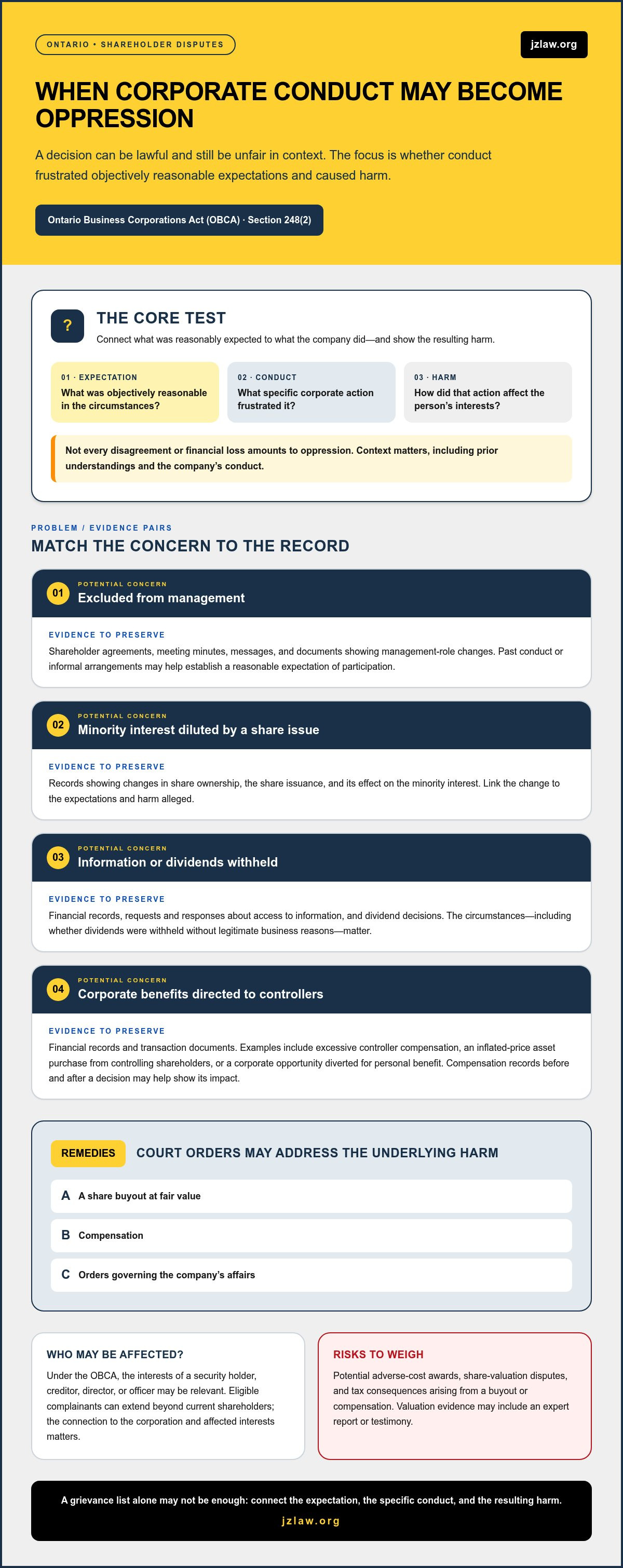
Oppressive conduct may involve using corporate power to benefit controlling shareholders at a minority owner’s expense. For example, directors might approve excessive compensation for majority shareholders, dilute a minority interest by issuing shares, or exclude an active shareholder-employee from management. Each situation depends on its context, including the parties’ prior understandings and the company’s conduct.
Other examples include withholding dividends without legitimate business reasons, denying access to financial information, or diverting a corporate opportunity for a controller’s personal benefit. Ontario courts recognize that a transaction benefiting majority shareholders at minority shareholders’ expense, such as an inflated-price asset purchase from controlling shareholders, may be oppressive. Such patterns can help show how a decision affected the minority owner’s interests and expectations.
Oppressive and Unfairly Prejudicial Conduct
Oppressive conduct generally involves an abuse of corporate power or coercive behaviour. Unfair prejudice focuses on conduct that unfairly harms an affected person’s interests. Under the OBCA, conduct may be oppressive, unfairly prejudicial, or unfairly disregard the interests of a security holder, creditor, director, or officer. The facts determine the applicable legal characterization, not the label given to the dispute.
A decision may be formally lawful yet unfair in the circumstances. For example, a board could follow a contract’s voting process while disregarding a longstanding understanding that an active shareholder would participate in management. Courts consider reasonable expectations, including informal arrangements and past conduct. Not every disagreement or financial loss amounts to oppression.
Evidence of Oppression
Evidence should link an objectively reasonable expectation to specific corporate conduct and resulting harm. Preserve shareholder agreements, meeting minutes, financial records, messages, dividend decisions, and documents showing changes in share ownership or management roles. Records comparing compensation before and after a controller’s decision, for example, may help explain whether the decision unfairly benefited one group.
Potential risks include adverse-cost awards, disputes over share valuation, and tax consequences arising from a buyout or compensation. Valuation evidence may include a business valuation expert’s report or testimony, particularly if the parties disagree about the company’s worth. Record each alleged act and its financial impact: a list of grievances alone may not show that conduct frustrated a reasonable expectation and caused harm.
Who Can Bring An Oppression Claim?
Ontario’s OBCA defines eligible complainants in section 245, extending beyond current shareholders. A claimant’s connection to the corporation and the interests affected help determine whether an oppression claim is available.
Eligible Claimants
Eligible complainants include certain current and former security holders, directors, and officers, as well as people the court considers proper applicants. A beneficial owner may qualify if their interest falls within these categories or the court accepts them as a proper applicant. Creditors may also seek relief when their legitimate corporate interests are affected.
Minority, majority, and equal shareholders can bring claims. A creditor, former security holder, or other non-shareholder must connect the alleged conduct to a legitimate interest in the corporation. For example, a creditor might identify corporate actions that unfairly disregard an interest arising from its dealings with the company.
Direct and Derivative Claims
A direct oppression claim addresses unfair treatment of the claimant’s own interests or reasonable expectations. A derivative claim, by contrast, is brought on the corporation’s behalf when the alleged injury primarily belongs to the company. The distinction matters because the person harmed and the remedy sought differ.
For example, a shareholder excluded from an agreed management role may allege personal harm. If directors’ breach of fiduciary duty caused the corporation to lose a business opportunity, the corporation may be the party directly harmed. A minority shareholder may pursue a derivative action as an alternative. A claim against directors for breach of fiduciary duty may provide another route.
Who responds depends on the alleged conduct. The corporation, controlling shareholders, directors, or officers may be named when their decisions or actions are challenged. Directors and officers can face personal liability for oppressive corporate conduct, even if the corporation formally made the decision. Pleadings should identify each party’s role and link it to the alleged harm.
Legal fees and timelines depend on the dispute’s complexity, the volume of corporate records, contested valuation evidence, and whether issues are resolved before trial. Document production, expert evidence, interim motions, and settlement discussions can affect the schedule and overall expense. Under the OBCA, a plaintiff may ask the court for interim legal costs, but must show that oppression caused financial difficulty and payment is necessary to advance the litigation.
Where a shareholder dispute concerns a company’s property holdings, related real estate law considerations may also affect the interests at stake.
What is the Oppression Remedy?
An oppression remedy gives Ontario courts broad powers to address corporate conduct that unfairly harms protected interests. Section 248(3) of Ontario’s Business Corporations Act (OBCA) identifies examples of orders a court may make.
Court-Ordered Remedies
A court-ordered remedy is tailored to address the oppression and vindicate reasonable expectations. Its scope matters because an order can affect corporate operations, ownership, and relationships between shareholders.
Under OBCA section 248(3), a court may restrain conduct, appoint a receiver, direct a securities purchase, or order the corporation wound up. Other possible orders include requiring financial disclosure, regulating corporate affairs, varying corporate documents, or awarding compensation.
For example, a court could order a controlling shareholder to buy a minority owner’s shares at fair value. In assessing value, courts consider the corporation’s actual worth, rather than a figure artificially reduced by oppressive conduct. A compensation order may instead address proven financial loss while allowing the shareholder to remain invested.
The appropriate order depends on the conduct and the interests that need protection. An order for disclosure may address withheld financial records; a restriction on future conduct may prevent a transaction from repeating the harm. In a serious dispute, a court may appoint someone to oversee operations or manage specific business matters.
Injunctions and Interim Relief
An injunction is a court order that restrains or requires conduct before a dispute reaches final resolution. It may be relevant when a proposed corporate act could worsen the alleged oppression before the court determines the broader claim.
Yes, a minority shareholder may seek an injunction or other interim relief in Ontario. Under section 248(3), a court can restrain conduct, and the requested order should identify the specific act and interests needing protection.
For example, a shareholder might ask the court to prevent a disputed transaction from proceeding while the claim is considered. Interim relief addresses an immediate risk, unlike a final remedy, which may later govern corporate affairs, award compensation, or direct a share purchase.
The evidence and requested terms should link the threatened act to the alleged oppression. A broad request affecting every corporate decision may go beyond the dispute. A narrowly framed order can focus on the transaction or conduct at issue.
In Wilson v. Alharayeri, the Supreme Court of Canada set out principles for personal liability under an oppression remedy. A remedy must be fair, no broader than necessary, linked to vindicating reasonable expectations, and consistent with general corporate law. These limits help courts tailor relief to the harm rather than treating a shareholder dispute as grounds for unrestricted control of the company.
Ontario and federal oppression remedy statutes
For Toronto corporations, the governing oppression statute generally depends on where the company was incorporated. Ontario-incorporated companies are governed by Ontario’s Business Corporations Act (OBCA), while federally incorporated companies are governed by the federal Canada Business Corporations Act (CBCA).
Section 248 of the OBCA provides Ontario’s oppression remedy, allowing an eligible complainant to ask a court to address conduct that is oppressive, unfairly prejudicial, or unfairly disregards relevant interests. Section 241 of the CBCA provides a similar route for eligible complainants of federal corporations. Both statutes focus on the corporation’s conduct and the affected parties’ reasonable expectations, not simply their percentage of ownership.
This distinction matters when a business operates in Ontario but was incorporated federally. A Toronto address alone does not determine which statute applies; the incorporation documents identify the relevant corporate law. The two Acts provide comparable types of relief, but the applicable provisions and procedure depend on the corporation’s legal status.
Ontario’s OBCA also includes protections beyond the core oppression provision. Part XIII allows a court to direct an investigation, which may help examine corporate affairs when records or transactions require scrutiny. Section 207 provides for winding up a corporation, an order that may be available in an oppression case. Courts can also vary shareholder agreements, bylaws, or other corporate documents to address the dispute between shareholders.
Time limits require attention. Ontario oppression claims are generally subject to the two-year limitation period under section 4 of the Limitations Act, 2002. The timing of a limitation period may depend on when the complainant becomes aware of the basis for a claim and whether seeking legal relief is appropriate. The relevant starting point is therefore tied to knowledge of the claim and remedy, not automatically the date of incorporation or the first disagreement.
Genuinely ongoing oppression may reset the limitation period, but a series of separate acts does not automatically count as continuing conduct. Repeated decisions, for example, should not be treated as one ongoing wrong merely because they involve the same shareholders. Identifying when each act occurred, when its effects became apparent, and whether the conduct truly continued helps clarify the limitation analysis.
Shareholder agreements can complement the OBCA or CBCA by setting out governance rights, dispute-resolution procedures, buyout mechanisms, valuation methods, and dividend policies. Those terms may help define reasonable expectations, but they do not replace statutory protections. For a corporation with cross-border operations or complex ownership, the incorporation statute remains the starting point for identifying the applicable oppression framework.
Defining minority shareholder oppression
Minority shareholder oppression is more than a disagreement, disappointing return, or difficult relationship between owners. Under Ontario’s oppression framework, the central question is whether corporate conduct frustrated reasonable expectations and treated an affected interest unfairly. This distinction separates ordinary business risks from claims involving an abuse of corporate power.
Reasonable expectations may arise from more than a written contract. In Ontario, courts may consider shareholder agreements, informal understandings, and historical patterns between the parties. For example, an active founder who regularly participated in management decisions may reasonably expect that role to continue, even without a contract guaranteeing a permanent position.
Expectations must be objectively reasonable, not merely one shareholder’s preference. A minority owner who expects regular dividends despite the company’s documented reinvestment policy may have difficulty showing that expectation was reasonable. By contrast, an established dividend practice followed by unexplained withholding may provide context for a claim about financial treatment.
Use these distinctions to assess whether a dispute involves unfair corporate conduct or an ordinary disagreement:
Business judgment: A decision to retain earnings for a documented expansion may disappoint shareholders without undermining reasonable expectations.
Unequal treatment: Paying controlling owners benefits while withholding comparable rights from a minority holder may require closer scrutiny.
Governance practice: Excluding a shareholder from decisions after years of participation may conflict with the parties’ established arrangement.
Corporate purpose: Using company assets for a controller’s personal benefit may indicate that corporate interests were disregarded.
Illegality is not required: conduct may be technically lawful yet unfair in its circumstances. However, financial harm alone does not establish oppression under Ontario’s Business Corporations Act. A claimant must link an objectively reasonable expectation to specific actions, show how those actions frustrated it, and establish resulting harm.
The analysis also considers how the parties’ relationship developed. A shareholder agreement may define voting rights, dividends, or a buyout process, while years of consistent conduct may clarify an ambiguity. If a contract gives the board broad discretion, the surrounding decisions and how directors exercised that discretion remain relevant.
A practical assessment separates three questions: what expectation existed, what corporate decision or action frustrated it, and what consequence followed. Meeting minutes, for instance, may establish an understanding about management; later board records may show exclusion; financial documents may demonstrate the impact. These connected facts provide more than a bare allegation of unfairness.
For a focused review of how corporate decisions affected shareholder expectations, discuss the facts of your shareholder dispute.
JZ Law: John Zang Services
JZ Law provides John Zang Services for businesses dealing with complex corporate and regulatory matters. If a shareholder dispute involves securities issuance, financing, or disclosure, JZ Law’s Securities Regulation service may address those related concerns. If the company is considering a public listing, Taking Companies Public may also form part of its broader corporate strategy.
The next step depends on the issue: distinguish the oppression dispute from related securities or corporate matters, then identify which decisions and records need attention. This can help frame a focused discussion of the business context and legal questions involved.
To discuss your circumstances, contact JZ Law or visit jzlaw.org.
Choose a deliberate next step
Before taking a position in a shareholder dispute, consider what outcome would protect your interests and the company’s ability to operate. A clearly defined objective can focus discussions on practical options, such as clarifying governance, negotiating a separation, or addressing a corporate decision.
If you are assessing minority shareholder oppression remedies in Toronto, organize the documents and decisions that explain the dispute, then consider how they relate to the business’s broader legal and commercial issues. JZ Law provides John Zang Services, Cannabis Licensing, and Taking Companies Public, alongside other corporate and regulatory services.
To discuss your options, contact JZ Law about your options. A measured, well-informed next step can help you approach the dispute with greater clarity.
Frequently Asked Questions
Can Minority Shareholders Seek Legal Remedies in Toronto?
Yes. A minority shareholder in a Toronto corporation can seek court relief under Ontario’s oppression provisions if corporate conduct meets the statutory test. The minority shareholder oppression remedies available in Toronto depend on the corporation’s incorporation and the interests affected. A provincially incorporated company is generally considered under Ontario’s OBCA, while a federally incorporated company is governed by the CBCA. The company’s Toronto location alone does not determine which statute applies.
What counts as minority shareholder oppression under Ontario law?
Ontario oppression concerns corporate conduct that is oppressive, unfairly prejudicial, or unfairly disregards a protected interest. Courts examine the parties’ reasonable expectations and whether the company’s conduct failed to meet them. A disagreement about business strategy or a disappointing financial result, by itself, is not enough. The evidence should link a specific corporate action to an expectation, such as an agreed governance role, and show the resulting harm.
What remedies are available under the Ontario Business Corporations Act oppression remedy?
The OBCA allows courts to choose orders suited to the harm and the interests requiring protection. Depending on the circumstances, relief may address governance, ownership, access to information, or financial loss. An order requiring disclosure, for example, could address a records dispute, while a share purchase could resolve an irreparable ownership conflict. The court’s response must be fair, proportionate, and tied to vindicating reasonable expectations, rather than imposing broader control than the dispute requires.
How do Ontario courts determine a fair-value buyout price for minority shares?
Ontario courts assess the corporation’s actual worth and avoid valuations artificially reduced by oppressive conduct. Valuation evidence may include financial statements, corporate records, and an expert report or testimony. If disputed decisions diverted value from the company before a buyout, for example, the evidence should help distinguish that effect from the business’s underlying worth. The court considers the valuation record and circumstances of the alleged oppression, rather than treating any single accounting figure as automatically decisive.
What are the steps and limitation periods for filing an oppression claim in Toronto?
First, identify whether the corporation was incorporated under Ontario or federal law, then gather records showing the relevant conduct, expectations, and harm. Ontario claims are generally subject to a two-year limitation period under section 4 of the Limitations Act, 2002. It begins when the complainant knew or reasonably ought to have known that the claim was reasonably made out and oppression relief was appropriate. Truly continuing oppression may affect timing, but distinct acts do not automatically become continuing conduct.
How do oppression claims compare with shareholder derivative actions in Ontario?
An oppression claim addresses unfair treatment of a complainant’s interests, while a derivative action is brought on the corporation’s behalf for harm primarily suffered by the company. Exclusion from an agreed shareholder role, for example, concerns personal interests; directors’ alleged diversion of a corporate opportunity may harm the company itself. This distinction affects who suffered the loss and who benefits from relief. Minority shareholders can pursue derivative actions as an alternative when corporate harm is central.
Are there Ontario cases showing common remedies for minority shareholder oppression?
Wilson v. Alharayeri, a Supreme Court of Canada decision, sets out principles relevant to personal liability in oppression cases. A remedy must be fair, no broader than necessary, connected to vindicating reasonable expectations, and consistent with general corporate law. Ontario courts can apply these principles when selecting relief, including compensation or orders affecting corporate conduct. The case helps explain the limits on remedies; it does not guarantee a particular outcome.
What are the typical costs, timelines, and legal fees for a Toronto shareholder oppression case?
Costs and timelines depend on the dispute’s complexity, the volume of corporate records, valuation evidence, and whether issues settle before trial. Document production, expert evidence, interim motions, and settlement discussions can affect both. A plaintiff may seek interim legal costs by showing that oppression caused financial difficulty and payment is necessary to advance the litigation.



Comments