


Navigating Cannabis Advertising Regulations in Ontario
Ontario cannabis advertising is governed by federal rules and Ontario retail standards, so navigating cannabis advertising regulations in Ontario means considering both. The federal Cannabis Act sets the promotion framework, including sections 17 to 24, while Ontario laws and the Registrar’s Standards for Cannabis Retail Stores add requirements for retail advertising.
It’s understandable to assume that a promotion allowed under federal law is also acceptable in a store. But Ontario’s retail standards can further restrict how a business advertises. This article explains who oversees the rules, what limits apply to promotional content and claims, and how federal requirements interact with Ontario standards. It also covers practical considerations for cannabis retailers, including in-store promotions, signage and advertising that could appeal to young people.
Table of Contents
Who regulates cannabis advertising?
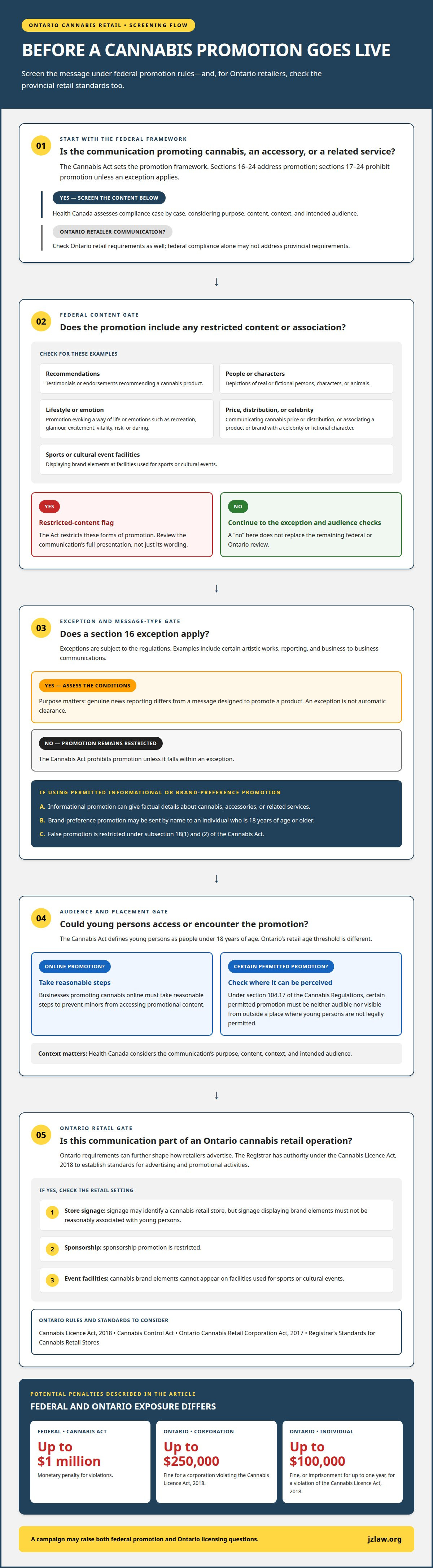
Federal cannabis advertising is governed primarily by the Cannabis Act and Cannabis Regulations. Health Canada assesses compliance case by case, considering each communication’s purpose, content, context and intended audience. Ontario retailers must also follow provincial requirements, covered later in this article.
Prohibited Cannabis Promotion
The Cannabis Act prohibits promotion unless it falls within an exception, limiting how businesses can present cannabis and related brands. Prohibited content includes testimonials or endorsements that recommend a product, and depictions of real or fictional persons, characters or animals. Promotions must not evoke positive or negative emotions or a way of life, such as recreation, glamour, excitement, vitality, risk or daring.
Sections 17 to 24 address promotion of cannabis, accessories and related services. The restrictions also cover communicating cannabis price or distribution, associating a product or brand with a celebrity or fictional character, and displaying brand elements at sports or cultural event facilities. Section 20 addresses foreign media, while section 21 addresses promotion used in sponsorship. These limits make the communication’s full presentation relevant, not just its wording.
Exceptions for Artistic and Business Communications
Section 16 sets out situations where sections 17 to 24 do not apply, subject to the regulations. Exceptions include certain artistic works, reporting and business-to-business communications. Their purpose matters: a genuine news report about cannabis differs from a message designed to promote a product. The distinction matters when content could inform the public while also providing commercial exposure.
Permitted informational promotion can give factual details about cannabis, accessories or related services. Brand-preference promotion may be sent by name to an individual who is 18 years of age or older. Online promotions require reasonable steps to prevent minors from accessing the content. Under section 104.17 of the Cannabis Regulations, certain permitted promotion must be neither audible nor visible from outside a place where young persons are not legally permitted. These conditions define where and to whom the communication can reach.
Federal and provincial regulation of cannabis advertising
Federal legislation sets the national framework for promotion, while provinces oversee distribution and sales practices. Ontario retailers need to account for both levels when planning consumer communications.
Federal and Provincial Responsibilities
The federal government regulates cannabis promotion through the Cannabis Act and its regulations. Provinces and territories oversee distribution and sales practices, including rules for Ontario’s retail environment. This division matters because complying with federal legislation alone may not address every provincial requirement.
In Ontario, the Cannabis Licence Act, 2018 gives the Registrar authority to establish standards for advertising and promotional activities. Retailers must also consider the Cannabis Control Act, the Ontario Cannabis Retail Corporation Act, 2017, and the Registrar’s Standards for Cannabis Retail Stores. A promotion’s manner, location and audience can therefore raise distinct federal and provincial questions.
Federal Legislation and Health Canada Resources
The Cannabis Act’s promotion provisions appear in sections 16 to 24, while the Cannabis Regulations set additional requirements. These rules aim to protect public health and public safety, including protecting young persons and others from inducements to use cannabis. The Act defines young persons as people under 18 years of age; Ontario’s retail age threshold is different.
Health Canada assesses federal compliance case by case, considering a communication’s purpose, content, context and intended audience. For example, a factual product message and a lifestyle-focused campaign may be assessed differently, even if both mention the same product. Reviewing federal legislation alongside Health Canada’s compliance approach helps businesses assess the communication as a whole, rather than relying on isolated wording.
Federal and Ontario Penalties
Non-compliance can carry substantial consequences under federal and Ontario legislation. The federal Cannabis Act can impose a monetary penalty of up to $1 million for violations. In Ontario, a corporation that violates the Cannabis Licence Act, 2018 may face a fine of up to $250,000.
For an individual in Ontario, a violation of the Cannabis Licence Act, 2018 may result in a fine of up to $100,000 or imprisonment for up to one year. These penalties differ by jurisdiction and the person or organization involved. Since a retailer’s campaign may engage both federal promotion rules and provincial licensing standards, legal review can help identify the relevant obligations before publication.
Restrictions on lifestyle and excessive-consumption claims
Ontario businesses may use signage to identify a cannabis retail store, but signage displaying brand elements must not be reasonably associated with young persons. Sponsorship promotion is restricted, and cannabis brand elements cannot appear on facilities used for sports or cultural events. The event setting and audience therefore matter.
The Cannabis Act restricts youth appeal, testimonials, lifestyle claims and health claims. It prohibits testimonials or endorsements recommending cannabis, depictions of real or fictional persons, characters or animals, and promotion evoking positive or negative emotions or a way of life, including recreation, glamour or excitement. Section 104.12 of the Cannabis Regulations addresses health and cosmetic benefit claims, while false promotion is restricted under subsection 18(1) and (2) of the Act.
Age-gated channels do not remove every restriction. Businesses promoting cannabis online must take reasonable steps to prevent minors from accessing promotional content. Factual information or brand-preference promotion may be permitted in communications sent by name to an individual 18 years of age or older, subject to the Act and regulations. A public post that is accessible to young persons presents a different audience issue than an age-restricted communication.
Display restrictions also apply to where cannabis and brand elements can be seen. Sections 29 and 30 of the Cannabis Act address displaying cannabis or accessories where young persons may see them. Section 104.19 of the Cannabis Regulations prohibits displaying a cannabis-related brand element in or visible from a public place frequented mainly by young persons. A sign near a youth-focused venue can therefore raise concerns even if its wording is factual.
Ontario’s Registrar’s Standards for Cannabis Retail Stores allow exterior signage identifying the business but restrict other forms of retailer promotion. Staff training should cover promotions that could encourage excessive consumption or appeal to younger audiences. Reviewing the message, placement, channel and audience together helps businesses assess whether a campaign complies with federal and provincial restrictions.
Ontario cannabis retail advertising standards
A legal professional can review the complete advertisement against federal promotion rules and Ontario retail standards before publication. The review should consider the message, claims, audience, format, placement and applicable records, rather than assessing a slogan in isolation.
Ontario’s Registrar’s Standards for Cannabis Retail Stores allow exterior signage that identifies the business while restricting other retailer promotions. In-store promotions, including discounts and loyalty programs, must comply with advertising requirements. At the point of sale, promotion is permitted when limited to cannabis availability, price or both. Assess a discount message for both its content and how customers encounter it.
The federal prohibition also shapes retail advertising: factual claims must not become misleading, and a campaign cannot suggest glamour, recreation, risk or daring. Health and cosmetic benefit claims face restrictions under section 104.12 of the Cannabis Regulations. A professional review can examine the advertisement’s wording, images, intended audience and retail setting, then identify provisions that may apply under federal and Ontario rules.
Recordkeeping is part of compliance. The Cannabis Regulations require businesses to retain samples or copies of promotional materials for a product for two years after the last day the promotion ran. Keeping the final version alongside its publication period creates a clear record of what appeared and when.
Ad Standards does not accept preclearance submissions for recreational cannabis, cannabis topicals or edibles at this time. That makes legal assessment before release particularly relevant for campaigns involving products, accessories, discounts or distribution statements. A focused review can flag concerns in the full creative and its proposed placement before publication. Request a legal review of your cannabis advertisement before it goes live.
JZ Law: Cannabis Licensing
JZ Law provides cannabis licensing counsel to businesses addressing regulatory requirements in Ontario’s cannabis sector. If a proposed promotion raises questions about licensing obligations, advertising standards are only part of the analysis; the business’s regulatory position may matter too.
JZ Law can help assess cannabis licensing issues in light of a business’s plans and regulatory responsibilities. This is a relevant next step when a campaign, retail activity or broader business decision intersects with licensing compliance. The focus is on how applicable requirements relate to the business, rather than treating each promotion as an isolated marketing choice.
Build compliance into your next campaign
Make legal review part of campaign planning, rather than a final correction after creative work is complete. A considered approach to navigating cannabis advertising regulations in Ontario can help your business assess how a proposed message fits its audience, placement and wider commercial objectives before publication.
Advertising decisions can also affect broader business priorities. JZ Law offers cannabis licensing, John Zang Services and assistance with taking companies public, supporting businesses with legal matters across regulatory and corporate contexts.
If you have questions about an upcoming campaign or how advertising requirements affect your business, contact JZ Law to discuss your advertising questions. A clear next step can help you move forward with greater confidence and a more considered compliance strategy.
Frequently Asked Questions
What federal cannabis advertising rules apply in Canada under the Cannabis Act and its regulations?
Beyond general promotion limits, the Cannabis Regulations address flavours and promotions involving other regulated products. Section 104.11 addresses flavours, while sections 104.15 and 104.16 address alcoholic beverages, tobacco and vaping products. For example, a campaign combining cannabis branding with vape-related material warrants review under these provisions. The relevant assessment considers the creative as presented, not merely the product name in its text.
What cannabis advertising restrictions apply specifically in Ontario?
An Ontario-specific review should identify the retail authorization and the Registrar’s standards relevant to the store. For businesses navigating cannabis advertising regulations in Ontario, federal compliance alone does not settle every provincial retail question. Record who owns the campaign, where it will appear, and whether it promotes the store or a particular product. These details help identify the provincial requirements that apply.
Can Ontario cannabis retailers advertise prices, discounts, or promotions?
Some price communications are permitted, but the details and context matter. Section 24(1) of the Cannabis Act addresses inducements related to the sale of cannabis or accessories, so a promotion involving a bonus or added benefit deserves careful classification. Keep the proposed offer terms and the intended point-of-sale presentation together for review. This can help distinguish a price notice from a broader promotional inducement.
What rules govern cannabis advertising on websites, social media, and email in Ontario?
Online communications are assessed as promotions, whether they appear on a website, social platform or in an email. For businesses navigating cannabis advertising regulations in Ontario, review the complete message and how it will be distributed, including accompanying images and audience settings. A social post shared beyond its original audience may reach people the campaign did not intend to address.
What packaging, branding, and product display rules affect cannabis advertising in Ontario?
Brand elements are subject to technical limits in addition to rules about placement. Section 104.2 of the Cannabis Regulations sets requirements for brand-element dimensions, and section 104.18 restricts the number of brand elements used in a promotion. These provisions matter when a design places multiple logos or marks together. Assessing the finished layout helps identify issues that may not be apparent from reviewing text alone.
What age-gating and audience-targeting requirements apply to online cannabis advertising in Canada?
Online audience controls should be considered alongside the creative’s content and likely appeal. Clause 13 of the Canadian Code of Advertising Standards addresses advertising to minors, providing an additional standard relevant to audience review. For example, an age-screened page still needs careful assessment if its imagery or tone could attract young people. The channel’s access controls and the advertisement itself are separate considerations.



Comments