


OCM Violation Notice Response Lawyer NYC: Your Defense Options
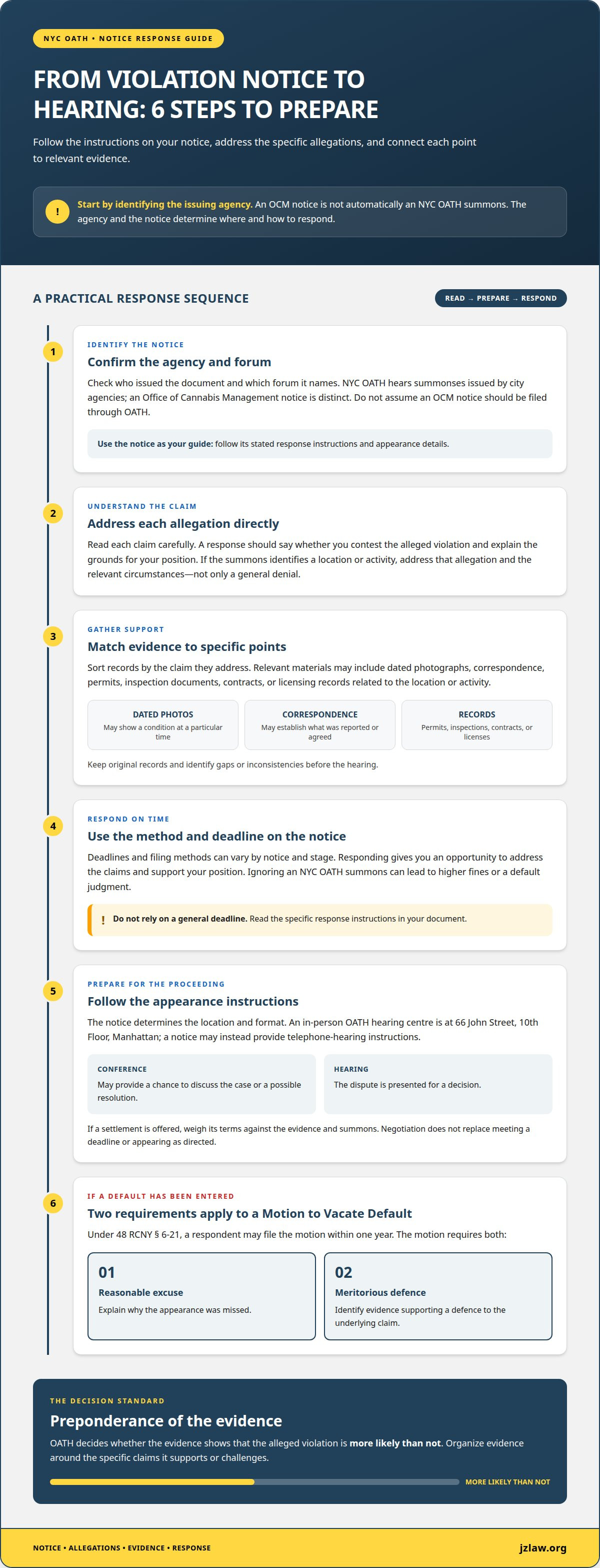
You do not need a lawyer to appear at a New York City OATH hearing. An OCM violation notice response lawyer in NYC can help assess the allegations and prepare a defence, but you may represent yourself. OATH applies the preponderance-of-the-evidence standard, so the decision turns on whether the evidence shows the alleged violation is more likely than not.
A notice can raise difficult questions: what is alleged, how to respond, and what evidence may support your position. This guide explains how to assess the notice, identify possible defences, and find the applicable deadline and submission method.
Legal counsel may be useful when the allegations or potential consequences are complex. The goal is to clarify your options so you can make an informed decision about what to do next.
Table of Contents
Is an attorney required for an OATH hearing?
No. You may appear at a New York City Office of Administrative Trials and Hearings (OATH) hearing without an attorney. OATH handles summonses issued by city agencies for regulatory and code violations. An attorney may represent you, but whether to hire one depends on the allegations, evidence, and potential consequences.
First, identify the issuing agency and the forum named on the notice. Do not assume an OCM notice is an OATH summons. If the notice directs you to OATH, follow its response and appearance instructions. OATH applies a preponderance-of-the-evidence standard: the evidence must make the alleged violation more likely than not.
For an in-person appearance, the main NYC OATH hearing centre is at 66 John Street, 10th Floor, in Manhattan. A notice may instead provide instructions for a telephone hearing. Read the appearance details carefully: the location and format on your notice determine how to participate, and a telephone hearing does not require travel to the centre.
Conferences and hearings serve different purposes. A conference may offer a chance to discuss the case or a possible resolution; a hearing is where the dispute is presented for a decision. If the agency offers a settlement, weigh its terms against the evidence and summons before agreeing. Negotiation may resolve a dispute, but it does not replace meeting a deadline or appearing as directed.
Do not confuse NYC OATH with the Occupational Safety and Health Review Commission (OSHRC). OSHRC handles a separate federal review process, not NYC administrative summonses. A person seeking review of an OSHRC administrative law judge’s report must petition within 20 days after docketing. That deadline does not apply to an OATH case. For an OATH decision, judicial review may be sought in New York Supreme Court through an Article 78 proceeding.
Violation-notice responses and defenses
If an OCM notice directs you to respond through NYC OATH, ignoring it can lead to higher fines or a default judgment. Responding on time gives you an opportunity to address the specific claims and support a defence with the notice and relevant evidence.
Responding to Violation Notices
A response says whether you contest the alleged violation and explains the grounds for your position. The allegations, response method, and hearing instructions determine what action is required. Read each claim carefully and address the alleged conduct directly rather than relying on a general denial.
For example, if an OATH summons identifies a location or activity, address that allegation and explain the relevant circumstances. If the notice offers a resolution, review its terms before deciding whether to accept it or contest the claims. A contract, inspection record, or other contemporaneous document may help clarify what happened.
Evidence for Defending Violations
Evidence is material that supports your account or challenges an allegation in the notice. It matters because OATH decides cases using the preponderance-of-the-evidence standard. Sort records by the claim they address, including dated photographs, correspondence, permits, inspection documents, or a contract related to the location or activity described.
Link each document to a specific point. A dated photograph may show a condition at a particular time, while correspondence may establish what was reported or agreed. Keep original records and identify gaps or inconsistencies before the hearing. This focused approach separates supporting evidence from unsupported assertions.
Consequences of Ignoring a Notice
Ignoring an NYC OATH summons can lead to higher fines or a default judgment, leaving the allegations uncontested at the scheduled stage. This can limit your options, making the original response deadline especially important.
If a default has already been entered, a respondent may file a Motion to Vacate Default within one year under 48 RCNY § 6-21. The motion requires both a reasonable excuse for missing the appearance and a meritorious defence. Those are separate requirements: explain the absence and identify evidence supporting a defence to the underlying claim.
For a notice involving property use, real estate law counsel can help assess how the allegations relate to the property and the available records.
Agency-specific violations and penalties
An OCM violation notice in New York City generally means the New York State Office of Cannabis Management has issued a notice alleging cannabis-related noncompliance. It is distinct from a summons issued by a New York City department, so identify the issuing agency before choosing how to respond.
The agency named on the document matters because the process and potential penalty depend on the alleged conduct. NYC OATH hears summonses issued by city agencies for regulatory and code violations. Do not assume an OCM notice is an OATH summons or respond through OATH automatically. Follow the instructions on the notice.
OATH penalties vary by violation type. Minor sanitation violations can carry penalties starting at $50, while hazardous Department of Buildings violations can reach $25,000 or more per count. Those examples concern specific NYC violations, not OCM penalties. Do not apply a DOB or sanitation amount to a cannabis matter without a basis in the notice.
Building-code cases also show why the issuing department matters. Severe or repeated New York City building-code violations can lead to criminal proceedings or property liens if left unaddressed. Correcting a cited condition may help address the property issue, but it does not by itself determine whether the agency can establish a violation.
For a cannabis-related notice, separate the alleged conduct from the proposed resolution. Identify the agency, cited activity, stated response deadline, and consequences described in the document. Then match each claim to relevant records, such as licensing documents or communications. The agency determines where a filing goes, and the notice states how to respond. This can help prevent confusion between OCM proceedings and a city administrative hearing.
Potential penalties are not the only factor in deciding how to respond. The number and nature of the allegations, the supporting records, and any effect on a property or business can shape your approach. A careful review can distinguish a correctable issue from a disputed claim and keep the response focused on the agency’s stated grounds.
Filing deadline and filing methods
Deadlines depend on whether the document is an OCM notice or an NYC OATH summons. The named agency and the notice’s instructions determine where and how to respond. An OCM violation notice response lawyer in NYC can help distinguish the applicable process if the issuer or required filing is unclear.
For NYC OATH matters, many violations have a 60-day cure window. That period concerns correcting the cited violation, not necessarily every response deadline. An appeal of an OATH decision must first be filed with the OATH Appeals Division within 30 days of the decision. Identify whether you are responding to a summons, correcting a condition, or appealing a ruling.
Use the filing method stated in the notice or applicable OATH instructions. The document may specify a hearing format, submission channel, or required information; follow those directions rather than making assumptions. Keep a copy of your submission and any confirmation of receipt. Record the date you received the notice and preserve the envelope or delivery details with your case documents.
A missed OATH hearing can lead to a default judgment. If that occurs, a Motion to Vacate Default may be filed within one year under 48 RCNY § 6-21. The motion must provide a reasonable excuse for the absence and identify a meritorious defence. An appeal and a motion to vacate address different procedural situations, so the case stage determines which filing applies.
After an OATH decision, judicial review may be sought in New York Supreme Court through an Article 78 proceeding. That is separate from the initial OATH appeal and has its own procedural requirements. If you need help determining whether an OCM notice or an OATH decision controls your next filing, an OCM violation notice response lawyer in NYC can assess the distinction. For property-related issues, consult real estate law counsel about how the notice may affect the property.
JZ Law
JZ Law can help assess how a cannabis-related notice intersects with licensing obligations and business decisions. Consider counsel if the notice raises questions about your licence, the agency’s allegations, supporting records, or potential effects on operations. A focused review can distinguish a licensing concern from a separate city summons and identify the issues to address in your response.
JZ Law handles Cannabis Licensing and regulatory matters, providing relevant context for these questions. The appropriate approach depends on the notice, issuing agency, and available evidence, not a one-size-fits-all response.
Choose a considered next step
A notice can affect more than your immediate response. It may also raise questions about how your business will manage regulatory obligations going forward. Consider the agency’s stated concerns, the records relevant to them, and the broader business context. Keeping these issues distinct can make your next decision clearer.
If you are considering an OCM violation notice response lawyer in NYC, JZ Law can discuss the notice and the regulatory issues it raises. JZ Law offers John Zang Services, Cannabis Licensing, and Taking Companies Public. The discussion should start with the document and your objectives, not assumptions about the outcome.
Contact JZ Law about your notice to discuss your next steps. A clear, well-considered response can help you move forward with greater focus.
Frequently Asked Questions
What is OATH and what happens after I get an NYC violation summons?
The NYC Office of Administrative Trials and Hearings (OATH) hears summonses issued by city agencies for regulatory and code violations. After receiving a summons, identify the issuing agency, alleged violation, and response instructions on the document. A summons may direct you to a hearing or provide another response option. Keep the summons and related correspondence together so the case details are easy to review.
What should I do if I receive a violation notice in Jackson Heights?
In Jackson Heights, first identify the agency that issued the notice; the neighbourhood does not determine the procedure. A New York City agency summons may direct you to OATH, while a cannabis-related notice may come from the New York State Office of Cannabis Management. Follow the named agency’s instructions, note any stated deadline, and organize records related to the location and alleged conduct.
How do I respond to a New York OCM violation notice?
Use the response method and deadline stated on the OCM notice, and address the specific allegations instead of sending a general objection. Separate the claims and gather relevant records, such as licensing materials or communications with the agency. Keep a copy of your submission and any acknowledgement. If the notice’s language or potential effect on your cannabis business is unclear, legal counsel can assess the issues.
What is the deadline to respond to an OCM violation notice?
There is no single OCM response deadline established here for every notice; use the deadline stated in your document. Do not assume an OATH deadline applies to an OCM matter. The 60-day cure window and 30-day appeal period discussed for NYC OATH violations concern those OATH processes. Identify the issuer and the specific action requested before calculating your response date.
Can a lawyer challenge or appeal an OCM violation in NYC?
A lawyer can review the notice, assess the allegations and evidence, and advise on available ways to challenge it. The appropriate procedure depends on the issuing agency and the type of decision. An OATH decision may be reviewed through an Article 78 proceeding in New York Supreme Court, but that route should not be assumed to govern an OCM notice. Check which process the notice identifies.
What evidence should I gather to dispute an OCM violation notice?
Gather records that help establish what happened and how the notice relates to your business. Relevant materials may include the cannabis licence and application records, internal compliance policies, transaction records, and communications with the Office of Cannabis Management. For business owners seeking help with bookkeeping or resolving broader financial discrepancies, CJ Business Solutions, LLC provides specialized accounting and tax resolution services. Organize each item by the allegation it addresses, noting dates and context that may help explain it. Do not alter original records while preparing your response.



Comments