


Post-IPO compliance checklist for TSX investor communications and reporting
Going public does not end a company’s compliance work; it begins ongoing disclosure and governance responsibilities. For Toronto issuers, a post-IPO compliance checklist for TSX companies should cover continuous disclosure, financial reporting controls, investor communications and board practices. Canadian securities legislation requires immediate press-release disclosure of each material change involving an issuer.
That continuing workload can be demanding, particularly because reporting deadlines are often shorter and more definitive after a company goes public. A clear framework helps management coordinate disclosure decisions, reporting processes and governance responsibilities instead of treating them as separate tasks.
This guide covers key post-listing checks, including material-change reporting, financial controls, shareholder communications and board structure. It also explains how securities regulation and corporate counsel can support the transition from IPO closing to ongoing public-company compliance.
Table of Contents
Continuous disclosure and materiality
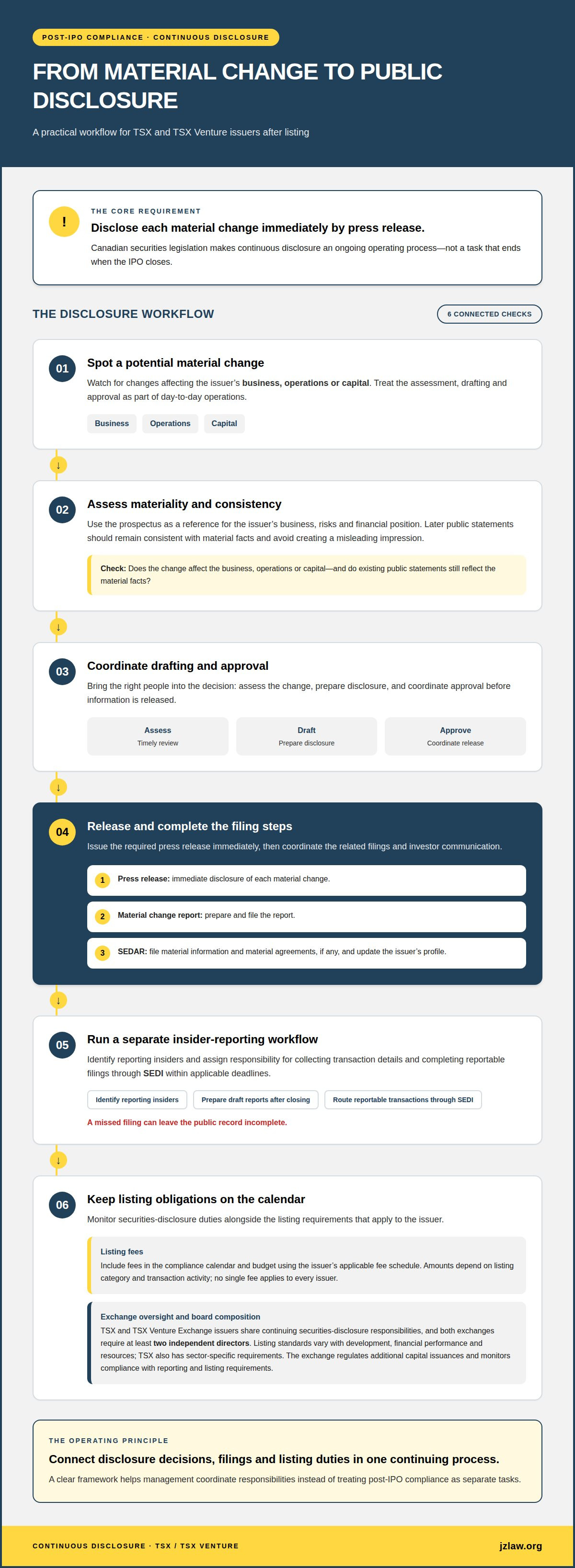
After an IPO, continuous disclosure becomes an operating process, not a closing task. Canadian securities legislation requires an issuer to disclose each material change immediately by press release. A change affecting the business, operations or capital should prompt timely assessment, drafting and approval, followed by coordinated filing and investor communication.
TSX and TSX Venture Exchange issuers share continuing securities-disclosure responsibilities, and both exchanges require at least two independent directors. Listing standards differ according to an issuer’s development, financial performance and resources, with sector-specific requirements on TSX. Readiness for growth therefore includes monitoring both securities-law disclosure and the listing requirements that apply to the issuer.
Prospectus disclosures remain a useful reference after listing. A prospectus explains the issuer’s business, risks and financial position to investors; later public statements should be consistent with material facts and avoid creating a misleading impression. After closing, the checklist includes filing material agreements on SEDAR, if any, preparing a material change report, issuing a press release and filing material information, and updating the issuer’s SEDAR profile.
Insider reporting needs a separate workflow. Prepare draft insider trading reports after closing, identify reporting insiders and route reportable transactions through SEDI. Assign responsibility for collecting transaction details and completing filings within applicable deadlines; a missed filing can leave the public record incomplete.
Include TSX listing fees in the post-IPO compliance calendar and budget, using the issuer’s applicable fee schedule. The amount depends on the relevant listing category and transaction activity, so no single fee applies to every issuer. The exchange also regulates additional capital issuances and monitors compliance with established reporting and listing requirements.
Financial reporting systems and controls
After going public, financial reporting depends on systems that produce complete, reliable statements on tighter schedules. Management and staff face more definitive, often shorter reporting deadlines after listing. A control review should assess the technology supporting financial reporting, identify process weaknesses and assign responsibility for addressing gaps. For example, the close process should specify who prepares each account reconciliation and who reviews it before the financial statements are finalized. A post-IPO compliance checklist for TSX Toronto can connect these controls to recurring reporting tasks.
Becoming a reporting issuer in Canada also changes the reporting structure around the business. Due diligence for an initial public offering considers financial statements, historical accounting practices and internal controls. After listing, those processes need to support ongoing public-company reporting, not only the prospectus and IPO closing. A readiness review can consider reporting procedures, controls, governance, taxation, budgeting and forecasting together, helping management address the links between systems and disclosure obligations.
Annual and interim reports require coordinated input from finance, operations and senior management. A controlled calendar can set internal milestones for gathering data, reviewing estimates, resolving discrepancies and approving statements before filing deadlines. Clear account ownership and documented review procedures help explain how reported figures were prepared. External auditors also play a role: an auditor of a public company must participate in the Canadian Public Accountability Board oversight program.
SEC periodic reporting is a separate consideration, not a standard TSX filing step. For a U.S. IPO, the registration statement is usually filed on Form S-1, and submissions go through EDGAR; those are U.S. processes, not Canadian requirements. An issuer with U.S. reporting obligations should coordinate those filings separately from Canadian reporting. Within a post-IPO compliance checklist for TSX Toronto, this distinction helps keep domestic reporting requirements separate from cross-border obligations. Legal advice on public-company planning can help address reporting structure and cross-border considerations as the business grows.
Investor relations and shareholder communications
After a public offering, investor relations connects securities disclosure with shareholder questions about performance, strategy and risk. The function may be handled by an employee, contractor or firm. Whichever structure the issuer uses, assign responsibility for coordinating approved information, maintaining communication records and directing inquiries to the appropriate company representative.
A practical post-IPO process assesses each proposed communication before release. Investor presentations, earnings materials, website updates and media responses should use current public information and describe the business consistently. For example, if management discusses a growth plan with analysts, it should not withhold the same material facts from other investors. Coordinate communications with legal, finance and corporate governance leads so operational updates do not conflict with securities disclosure.
Set a clear approval path for investor and media requests. A designated spokesperson can coordinate with the disclosure team, while other employees route questions rather than provide selective updates. Prepare approved background materials for recurring topics, such as company strategy or an announced offering. Keep records of presentations and significant inquiries so the company can identify inconsistent statements and assess whether new information requires a disclosure review.
The TSX monitors compliance with ongoing listing requirements, so a failure can bring an issuer’s listing compliance under scrutiny. A particular penalty, trading halt or delisting should not be assumed from a reporting failure alone; the relevant exchange requirements and circumstances matter. This monitoring makes timely escalation important: a missed report, inconsistent investor statement or unresolved shareholder inquiry should promptly reach the responsible team.
Investor relations should support consistent public-market communication over time, not just around earnings announcements. A calendar can coordinate planned updates with reporting milestones, while a contact log tracks recurring shareholder concerns. Reviewing these themes helps management identify where public explanations need clarity. This disciplined approach supports credible communication without allowing investor outreach to replace required regulatory disclosure.
Corporate governance policies and structure
After listing, governance should connect board oversight, internal controls and capital-markets decisions. TSX-listed companies must have at least two independent directors. For TSX companies, National Instrument 51-101 requires three independent directors on the audit committee. These requirements should inform board composition, committee mandates and appointment planning.
Annual meetings, proxy materials and shareholder voting belong in the corporate calendar. The issuer should coordinate meeting preparation with its governing documents and applicable corporate requirements, including preparing and distributing proxy materials and recording voting outcomes. Because the process depends on the issuer’s corporate structure and circumstances, governance procedures should identify responsible officers, approval steps and records for each meeting.
Internal controls need board-level oversight as well as operational ownership. A governance framework can assign committees responsibility for reviewing financial reporting, documenting conflicts and escalating significant control concerns. For example, a proposed transaction involving a director’s interest should follow the issuer’s conflict procedures and be recorded for appropriate review. Clear mandates help directors distinguish oversight from management’s day-to-day duties.
Additional securities listings, private placements and other equity issuances need transaction-specific review. The TSX regulates additional capital issuances and monitors compliance with listing requirements. Before approving a financing, the issuer should assess its structure, potential effect on existing investors and applicable exchange requirements, including whether shareholder approval is required. The answer depends on the proposed transaction and relevant rules, not a single approval threshold.
Governance also supports sound decisions as the company grows. Board materials should identify the decision requested, relevant risks and any connection to the issuer’s public disclosures. This lets directors consider capital markets implications alongside corporate strategy. For a review of board processes, equity transactions and exchange requirements, discuss TSX governance and listing matters.
JZ Law
JZ Law helps TSX issuers assess how securities regulation applies to their post-IPO disclosure, reporting and governance processes. This support is relevant when a material development raises disclosure questions, a financing may affect listing obligations, or board practices need to align with public-company requirements. Legal analysis can connect obligations with the issuer’s corporate structure and business objectives instead of treating each filing or governance decision in isolation.
For companies approaching a public listing, JZ Law’s Taking Companies Public service addresses legal and transactional considerations before the transition. For listed issuers, Securities Regulation is relevant when ongoing disclosure duties or capital-markets activity require legal analysis. A focused review can clarify the issues, identify decision points and support a coordinated compliance approach.
Contact JZ Law to discuss post-IPO securities and governance matters.
Build compliance into the company’s next stage
Public-company obligations evolve as an issuer grows, changes its operations or considers a new transaction. A post-IPO compliance checklist for TSX Toronto is most useful as a working framework, reviewed as responsibilities and business priorities change. The next step is to connect legal oversight with the company’s decision-making: clarify who assesses new developments, who approves public statements and how emerging issues reach the board.
That structure can help management address regulatory questions early, before a financing, operational change or investor communication creates pressure for a rushed decision. JZ Law’s securities regulation and corporate law services can help assess how applicable requirements relate to an issuer’s circumstances and planned activity.
Discuss TSX compliance with JZ Law and consider how a structured legal review can support the company’s next stage. A deliberate approach gives management a clearer basis for decisions as the business develops.
Frequently Asked Questions
What are the TSX timely disclosure rules for material changes and news releases?
Canadian securities legislation requires immediate press-release disclosure of each material change involving an issuer. For example, if a significant operational development changes the company’s outlook, the issuer should assess whether it is a material change and coordinate disclosure before sharing the information selectively with investors or media. A defined escalation route helps management identify the issue, reach a disclosure decision and prepare consistent public communications.
What are the annual and interim financial reporting deadlines for TSX-listed companies?
Annual and interim filing dates depend on the issuer’s reporting obligations and fiscal year-end, so the calendar should use the deadlines that apply to that company rather than assume one date fits every issuer. Map each reporting period to its applicable due date, then schedule internal drafting, review, approval and SEDAR filing milestones in advance. This helps identify delays while there is time to resolve them.
How can a securities lawyer build and manage a post-IPO compliance calendar and checklist for a newly TSX-listed Canadian company?
A securities lawyer can map an issuer’s disclosure, financial reporting, insider reporting, governance and exchange obligations into one calendar, with an owner and approval path for each item. The calendar can also include event-triggered tasks, such as assessing a proposed financing or material operational change, which may arise outside routine reporting cycles. Management then has a structured basis for assigning work and escalating time-sensitive issues.
What ongoing disclosure and governance rules differ between the TSX and TSX Venture Exchange?
Both exchanges share continuing securities-disclosure responsibilities and require at least two independent directors. Their listing standards differ based on issuer development, financial performance and resources; TSX also has sector-specific requirements, and TSX companies must have three independent directors on the audit committee.
What insider reporting deadlines and SEDI filing requirements apply after an IPO in Canada?
Route reportable insider transactions through SEDI, with responsibility assigned for collecting transaction details and completing filings within applicable deadlines. The deadline depends on the applicable requirements.



Comments