


Smart contract law in California: rules, clauses and automation
Code can execute a transaction without settling what the parties legally agreed. Under California smart contract law, a coded arrangement may be enforceable if it meets basic contract requirements, including offer, acceptance, consideration and mutual intent. Electronic form alone does not invalidate it. At JZ Law, we help clients navigate these complex digital transactions, recognizing that automation and legal agreement are related, but they are not the same thing.
It is easy to assume that a smart contract is simply a conventional contract written in code. In practice, code may automatically carry out selected terms, while consent, interpretation and performance still depend on the parties’ agreement and the surrounding facts.
This article explains what smart contracts are and how they execute automatically, then distinguishes them from smart legal contracts, which pair natural-language terms with machine-readable provisions. It also covers how governing-law and forum-selection clauses can address cross-border arrangements, along with the legal and drafting considerations that arise when a transaction relies on code.
Table of Contents
What Are Smart Contracts?
A smart contract is a computer program stored on a blockchain that runs when predefined conditions are met. In California, code can automate transactions, but the legal question remains whether the parties formed an agreement with offer, acceptance, consideration and mutual intent. The Uniform Electronic Transactions Act (UETA) and the federal Electronic Signatures in Global and National Commerce Act (E-SIGN) recognize electronic contracts; electronic form alone doesn’t settle what the parties agreed.
A conflict can arise when written terms promise one result but code produces another. For example, a written agreement may require payment only after delivery, while a coding error triggers payment as soon as a shipment is marked dispatched. The transaction hash, audit reports, key-management logs and off-chain communications can help establish what happened and what the parties intended. A court may need technical evidence and expert assistance to interpret the code, identify an error and assess whether execution matched the agreement.
Can smart contracts be used for real estate, consumer or other regulated transactions in California? They may be, but code alone does not establish an enforceable agreement. Offer, acceptance, consideration and mutual intent still matter, and some agreements may need to meet writing requirements, such as the statute of frauds.
What disclosures and consumer-protection rules apply to smart contracts in California? Electronic records and signatures may be recognized, but their legal effect depends on the circumstances. Clear notice, assent and transaction-specific requirements still matter; the coded process doesn’t replace them.
What are the tax and privacy implications of using smart contracts in California? Automation does not determine how a transaction is characterized for tax purposes. The underlying transfer and the parties’ arrangements matter. Recording personal information on a blockchain can also complicate compliance with the California Consumer Privacy Act (CCPA), because on-chain data can be difficult to remove.
Hybrid agreements address these risks by pairing readable legal terms with selected coded provisions. They can specify which document governs if code and text conflict, explain triggers and exceptions, and set out a process for resolving bugs or unintended asset transfers. This structure makes the parties’ intent easier to assess than code alone.
Governing law and forum selection clauses
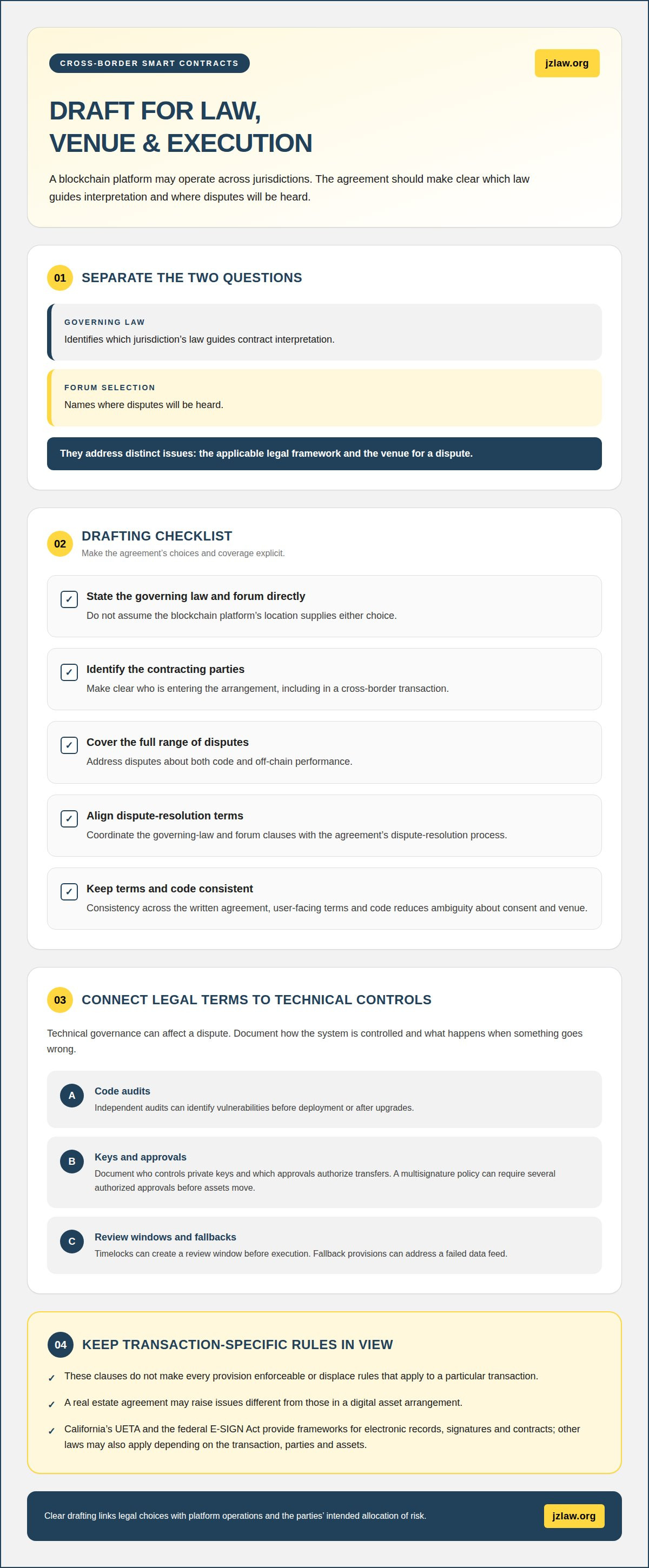
A blockchain platform can execute transactions globally, even when the parties and relevant assets are in different jurisdictions. A governing-law clause identifies which jurisdiction’s law guides contract interpretation. A forum-selection clause names where disputes will be heard. They address distinct questions: the applicable legal framework and the venue for a dispute. Without clear drafting, parties may argue about both after execution.
For example, a California business and an overseas counterparty might use a digital platform hosted across several countries. Their agreement can select California law and a specified forum, while clarifying that the platform’s location does not decide either issue. The drafting should identify the contracting parties, cover disputes about code and off-chain performance, and align these clauses with the agreement’s dispute-resolution process.
What laws govern smart contracts and blockchain transactions in California? California’s Uniform Electronic Transactions Act (UETA) and the federal Electronic Signatures in Global and National Commerce Act (E-SIGN) provide frameworks for electronic records, signatures and contracts. Other laws may also apply, depending on the transaction’s subject, parties and assets.
These clauses do not make every provision enforceable or displace rules that apply to a particular transaction. A real estate agreement, for example, may raise issues that differ from those in a digital asset arrangement. For cross-border deals, state the governing law and forum directly instead of assuming a blockchain platform supplies either. Consistency across the written agreement, user-facing terms and code reduces ambiguity about consent and venue.
Technical governance can also affect a dispute. Independent code audits can identify vulnerabilities before deployment or after upgrades. Agreements can document who controls private keys, which approvals authorize transfers and what emergency procedures apply. For example, a multisignature policy can require several authorized approvals before assets move. Timelocks can create a review window before execution, while fallback provisions can address a failed data feed.
For transactions involving complex assets or cross-border obligations, careful transaction planning can connect the legal clauses with operational controls, platform governance and the parties’ intended allocation of risk.
Difference between smart contracts and smart legal contracts
The key distinction is whether code simply executes a function or forms part of a wider legal agreement. That difference affects how parties express intent and resolve disputes.
Code-Based and Legal Agreements
A smart contract is computer code that executes programmed instructions. A smart legal contract combines natural-language terms with selected machine-readable provisions. The distinction matters because code can transfer assets without recording the parties’ full agreement or intent.
Consider a decentralized platform that releases payment when an oracle reports delivery. The code handles execution, but may not explain exceptions, remedies or what happens if the data is wrong. A central platform may have an operator who can intervene, while decentralized systems may distribute control among participants. In either case, a separate written agreement can state the commercial terms, explain how the code implements them and identify which terms govern if they conflict.
There is no formal legal definition of a smart legal contract. In practice, the term describes an agreement whose legal language remains readable while selected provisions operate through code. This structure can help business and technical teams compare the intended transaction with the program’s actual functions.
Legal Enforceability in California
In California, enforceability depends on contract formation and the parties’ agreement, not simply on whether code runs. A smart contract may support an enforceable agreement when offer, acceptance, consideration and mutual intent are present.
The Uniform Electronic Transactions Act (UETA) and the federal Electronic Signatures in Global and National Commerce Act (E-SIGN) recognize electronic records and signatures. They do not make every coded program a binding contract. For example, a user’s interaction with a platform may show assent, but the interface, notice and transaction terms help establish what the user accepted.
When code and legal language diverge, the agreement’s wording, the parties’ conduct and technical evidence can help clarify intent. Repository history may show how a function changed, while transaction logs may show how it executed. Courts may need technical assistance to understand those records, but legal interpretation still concerns the nature of the agreement and the parties’ obligations. A plain-language document alongside the code gives readers a clearer account of both.
Are smart contracts legally enforceable in California?
California smart contract law can recognize an agreement that meets ordinary contract requirements. The key questions are whether the parties made an offer, accepted it, exchanged consideration and showed mutual intent. Code execution alone does not establish these elements. Transaction records and surrounding communications can help show what the parties agreed to.
Electronic form doesn’t invalidate an agreement. California adopted the Uniform Electronic Transactions Act (UETA) in 1999, and UETA §7(b) says a record or signature can’t be denied legal effect solely because it’s electronic. The federal Electronic Signatures in Global and National Commerce Act (E-SIGN), enacted in 2000, also recognizes electronic contracts and signatures.
Automated formation has a specific UETA framework. Section 14 addresses contracts formed by electronic agents acting for a person, while §9(a) concerns attribution of an electronic record or signature. For example, a platform’s programmed acceptance could be relevant evidence, but the surrounding interface and transaction terms help establish who acted and what they accepted.
Some agreements also have to meet writing requirements. A smart contract’s transaction history or coded terms may help document an arrangement, but the relevant question is whether it meets the applicable requirement. A property transfer, for example, can involve formalities beyond an automated payment. A blockchain entry alone does not resolve every real estate issue.
Evidence in a dispute may include transaction hashes, deployment records, interface screenshots, wallet ownership and communications outside the blockchain. These records can help establish authority, assent and whether execution matched the agreed terms. If code transferred assets after a faulty trigger, they can also help identify the error and assess potential remedies such as damages, rescission or an injunction. These are practical considerations in smart contract law in California.
For a property transaction involving automated terms, review how the coded provisions fit the agreement through real estate law guidance.
JZ Law: John Zang Services
JZ Law provides legal services to businesses assessing complex corporate and regulatory matters connected to technology-driven transactions. When a blockchain arrangement involves token issuance, investment activity or a planned public offering, the legal analysis may extend beyond code to securities regulation and corporate structure.
JZ Law’s Securities Regulation and Taking Companies Public services can help when those issues intersect with a company’s financing or plans to enter public markets. Cannabis Licensing is a separate service for businesses addressing licensing needs in that sector. The appropriate focus depends on the transaction: a code dispute alone differs from a securities or corporate matter involving automated execution.
For a transaction involving these corporate or regulatory issues, contact JZ Law or visit jzlaw.org.
Make the next decision before deployment
Before committing a transaction to code, define the business outcome the automation is meant to achieve. Record who may authorize changes, how exceptions will be handled and what evidence will show that each party accepted the arrangement. These decisions give legal drafting and technical implementation a shared point of reference.
A focused review can also identify whether a proposed arrangement raises broader corporate, securities or regulatory questions. This is where smart contract law in California becomes a practical planning issue: the code’s operation, the parties’ rights and the transaction’s business purpose need to work together. Addressing that alignment early can help prevent avoidable disputes.
If you’re assessing a proposed smart-contract transaction or need to align its legal terms with your business objectives, contact JZ Law about your smart contract questions. A considered next step can help you move forward with greater clarity.
Frequently Asked Questions
What is a smart contract under California law?
Under California law, a smart contract is computer code that can automatically carry out programmed actions, such as releasing a digital asset after a specified event. The code’s operation doesn’t by itself settle whether the parties formed a binding agreement. For instance, a program may transfer a token, while the parties’ communications and conduct help establish the legal obligations behind that transfer.
Does California recognize electronic signatures and records used in smart contracts?
Yes. California’s Uniform Electronic Transactions Act (UETA) and the federal Electronic Signatures in Global and National Commerce Act recognize electronic records and signatures. UETA also addresses attribution: §9(a) concerns whether a record or signature is attributable to a person, while §14 covers contracts formed through electronic agents. A business should preserve evidence showing who used the system and what action they took.
How do California contract requirements apply to smart contracts, including offer, acceptance, and consideration?
California contract requirements apply to the agreement behind the code: offer, acceptance, consideration and mutual intent must be assessed. A user clicking an acceptance control, for example, may be relevant, but the displayed terms and the context of the action matter. Keep records of the version shown, the user’s acceptance and the transaction executed by the code, so the evidence connects assent to specific terms.
Who is liable for smart-contract bugs, exploits, or incorrect automated performance under California law?
Responsibility depends on the parties’ roles, the agreement and the facts surrounding the failure. A developer, operator, party controlling a key or participant responsible for an external data feed may each have a different role. For a mistaken transfer, relevant evidence can include code history, audit findings, approvals and communications. These records help assess who controlled the system and what duties the parties accepted.
How do California courts resolve smart-contract disputes and determine jurisdiction?
California courts may assess the parties’ agreement, transaction records and technical evidence, including deployment artifacts, wallet records and oracle settings. Jurisdiction and venue can depend on the parties, the transaction and any applicable forum-selection clause. A dispute may involve investigation, court motions and discovery, or be resolved through mediation or arbitration. A clause naming the forum helps define where the parties agreed to bring a claim.
What steps should California businesses take to draft, audit, and deploy enforceable smart contracts?
Businesses should align readable terms with the code, specify what happens if they conflict, and document who can approve deployments or control keys. Before deployment, an independent audit can examine security and business logic; after an upgrade, review the changed functions again. Define fallback procedures for failed data feeds, errors and emergencies, then retain the final agreement, audit materials and deployment records.



Comments