


Strategic Corporate Transactions 2026: A Legal Guide for Global Business Hubs
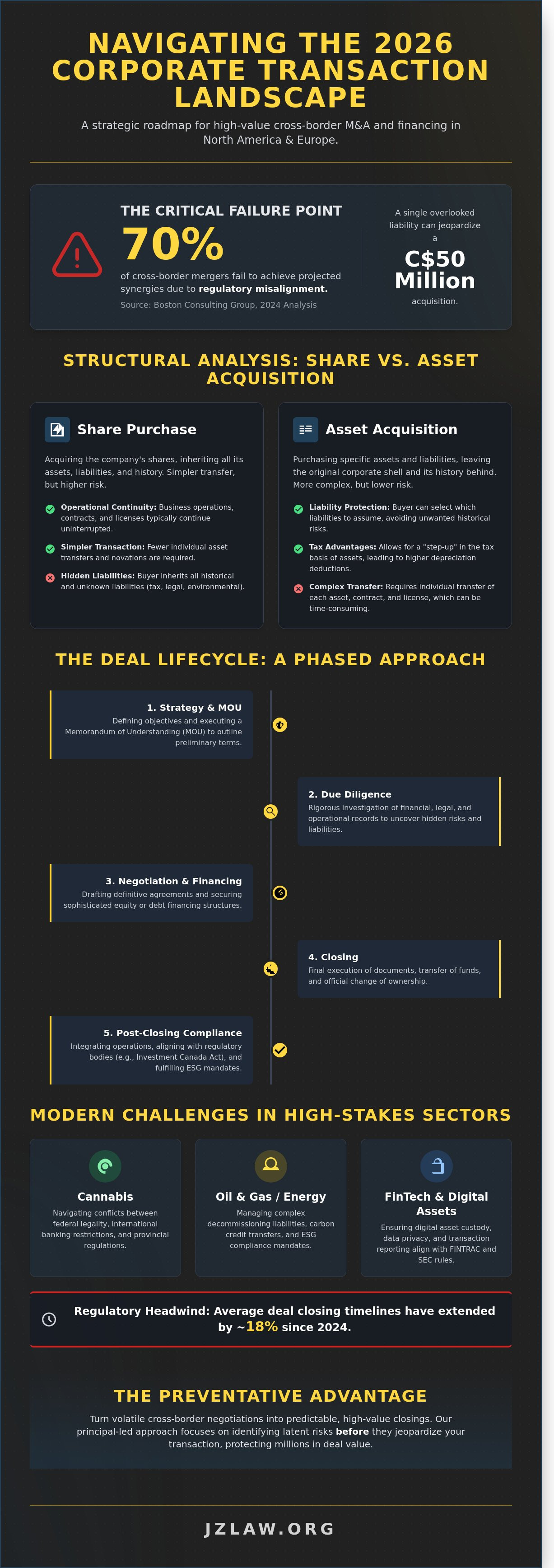
Did you know that a 2024 analysis by the Boston Consulting Group revealed that 70% of cross-border mergers fail to achieve their projected synergies due to regulatory misalignment? For Canadian executives planning for 2026, the stakes for corporate transactions have reached a critical threshold. You've likely experienced the friction of navigating the dissonant legal requirements between Ottawa, Washington, and Berlin. It's a reality where a single overlooked liability in a German due diligence report can jeopardize a C$50 million acquisition or a complex public listing.
We recognize that your objective isn't merely to sign a contract, but to establish a secure, long-term foundation for international expansion. This guide promises to equip you with the expert legal frameworks necessary to master modern corporate transactions across North American and European hubs. We'll explore a clear roadmap for M&A success, focusing on risk mitigation through preventative legal structuring and the elimination of inefficient tax hurdles. By the end of this analysis, you'll understand how to turn volatile cross-border negotiations into predictable, high-value closings.
Key Takeaways
Learn to navigate the 2026 landscape of corporate transactions by integrating digital asset strategies and ESG compliance into your global growth framework.
Evaluate the strategic advantages of share purchases versus asset acquisitions to optimize liability protection and operational scaling within the Canadian regulatory environment.
Master the critical phases of the deal lifecycle, from the precise execution of a Memorandum of Understanding to the rigours of post-closing regulatory alignment.
Identify how a preventative, principal-led legal approach can mitigate hidden risks in high-stakes sectors such as emerging energy, cannabis, and digital finance.
Gain insights into securing capital through sophisticated equity and debt financing structures tailored for competitive North American and European business hubs.
Table of Contents Defining Corporate Transactions in a 2026 Global Context Primary Categories: M&A, Private Equity, and Securities Offerings Structural Analysis: Share Purchases vs. Asset Acquisitions The Lifecycle of a Transaction: From MOU to Post-Closing Compliance The JZ Law Advantage: Preventative Strategic Counsel for High-Stakes Deals
Defining Corporate Transactions in a 2026 Global Context
Corporate transactions represent the sophisticated legal and financial frameworks used to expand, reorganize, or divest business interests. By 2026, these processes have moved beyond simple paper-based transfers. They now incorporate a complex layer of digital asset integration and stringent ESG (Environmental, Social, and Governance) compliance protocols. While the fundamental goal remains business growth, the execution requires a synthesis of traditional contract law and modern technological fluency. The modern mergers and acquisitions landscape demands that legal counsel operates as a strategic architect rather than a mere document drafter. This shift ensures that the deal structure supports the long-term commercial viability of the entity.
Global economic integration hasn't created a uniform legal environment. Distinctive local requirements in financial hubs like Toronto, New York, and San Francisco necessitate specialized approaches. For instance, a transaction involving a Canadian entity must navigate the specificities of the Investment Canada Act, which differs fundamentally from the regulatory scrutiny found in the United States. Corporate transactions in 2026 are defined by this tension between global ambition and local regulatory precision.
The Strategic Importance of Transactional Law
Precision in legal structuring directly influences a company's terminal valuation. A poorly defined intellectual property clause or a misunderstood tax indemnity can erode C$10 million or more in deal value overnight. JZ Law has observed a definitive move toward preventative law, where the firm's role is to identify latent litigation risks before any binding agreement is signed. In jurisdictions like Vancouver, balancing shareholder profit with the 2025-mandated ESG reporting standards requires a sophisticated legal touch that aligns fiduciary duties with public regulatory expectations.
Key Stakeholders in Modern Deal-Making
The 2026 deal-making environment features an evolved cast of participants. Venture Capital (VC) and Private Equity (PE) firms now prioritize "exit-ready" compliance structures from the initial investment phase. Regulatory bodies have also increased their influence on deal velocity. Recent data shows that updated FINTRAC guidelines in Canada and evolving SEC oversight in the United States have extended average closing timelines by approximately 18% since 2024. This environment makes specialized counsel indispensable for niche Canadian sectors, particularly in the following areas:
Cannabis: Navigating the intersection of federal legality and international banking restrictions.
Oil and Gas: Managing complex decommissioning liabilities and carbon credit transfers.
FinTech: Ensuring digital asset custody aligns with provincial securities commissions.
Success in these high-stakes environments depends on the ability to anticipate regulatory hurdles before they become deal-breakers. It's about creating a secure path for capital to flow while maintaining the highest standards of legal integrity.
Primary Categories: M&A, Private Equity, and Securities Offerings
Corporate transactions represent the mechanisms through which companies evolve, scale, and eventually exit. These operations require a blend of tactical precision and strategic foresight. Whether a firm seeks to consolidate assets for market dominance in Denver or Hamburg, the legal framework must support long-term stability rather than just the immediate closing. In competitive tech sectors, securing equity or debt financing isn't just about the influx of capital; it's about the specific terms that allow for scaling without crippling dilution of founder control.
Mergers and Acquisitions (M&A) Strategies
Choosing the right path for expansion in Calgary’s energy sector often comes down to horizontal versus vertical integration. Horizontal mergers allow firms to achieve market dominance by absorbing competitors, while vertical mergers allow for control over the entire value chain. Legal hurdles in cross-border M&A between German and Canadian entities often center on tax treaties and foreign investment reviews under the Investment Canada Act. Integrating oil and gas law into corporate restructuring ensures that asset transfers comply with the specific environmental liabilities and regulatory permits inherent in the Canadian energy landscape. Precision in these deals prevents the C$500,000+ cleanup costs often hidden in poorly vetted asset acquisitions.
Securities and Corporate Finance
Managing the complexities of IPOs, SPACs, and direct listings on the TSX or NASDAQ requires a meticulous approach to disclosure. In 2022, the Canadian venture capital market saw C$10 billion invested across 706 deals, highlighting the massive appetite for private placements. These placements offer reduced regulatory burdens compared to public offerings, yet they restrict liquidity to a smaller pool of accredited investors. The role of cryptocurrency law is expanding as modern fundraising adopts tokenized asset transactions to streamline capital flow and enhance transparency.
Compliance with securities regulations in New York City and Toronto is essential to maintain investor trust and avoid the C$1 million+ fines associated with disclosure failures. Specific industries face even higher barriers to entry. For instance, taking your cannabis company public involves navigating a labyrinth of cross-border restrictions and specialized audit requirements that differ significantly from traditional retail sectors. Every transaction type demands a unique set of documents:
Subscription Agreements: Defining the terms of private equity entry.
Prospectus Filings: Ensuring full transparency for public market participants.
Asset Purchase Agreements (APA): Detailing the specific transfer of liabilities and rights.
Token Purchase Agreements: Governing the issuance of digital assets in modern finance.
Strategic legal guidance acts as a preventive measure against future litigation and regulatory friction. If you're preparing for a significant transition, seeking a strategic legal partner ensures your interests remain protected throughout the lifecycle of the deal.
Structural Analysis: Share Purchases vs. Asset Acquisitions
The choice between a share purchase and an asset acquisition represents the most critical strategic fork in corporate transactions. Each path carries distinct legal consequences for liability, tax efficiency, and operational continuity. In a share purchase, the buyer acquires the target company's entire legal history. This includes every asset, contract, and historical liability. While this provides seamless continuity for business operations in international hubs like Frankfurt or Berlin, it demands rigorous preventative legal audits. Without deep due diligence, a buyer might unknowingly inherit environmental liabilities or unresolved litigation from years prior.
The Share Purchase Framework
Share deals are often preferred for their simplicity in maintaining operational momentum. In Canada, sellers frequently push for share sales to utilize the Lifetime Capital Gains Exemption (LCGE), which reached C$1,016,836 for the 2024 tax year. This structure ensures that employee contracts and existing vendor relationships remain intact without the need for mass re-negotiation. However, complexity arises when dealing with minority shareholders. We often implement "drag-along" rights to ensure a 100% transfer of ownership. In the Canadian cannabis sector, entity transfers require strict adherence to Health Canada's licensing requirements under the Cannabis Act; making share deals preferable to avoid the arduous process of re-applying for site-specific licenses.
The Asset Purchase Advantage
Asset acquisitions offer a "cherry-picking" mechanism that's vital in high-risk sectors. A buyer in the Alberta oil and gas industry might select specific producing wells while leaving behind abandoned sites with heavy reclamation liabilities. This structure allows for a "step-up" in the tax basis of the assets. It lets the buyer claim higher depreciation, known as Capital Cost Allowance (CCA) in Canada, against future income. This contrasts with German regulations where Section 8b of the Corporate Income Tax Act (KStG) provides a 95% tax exemption for corporate sellers in share deals, creating a different set of incentives for European counterparts.
The primary hurdle in asset-based corporate transactions involves the assignability of contracts. Most commercial agreements require explicit third-party consent for transfer. For cryptocurrency exchanges and fintech firms, this involves migrating complex intellectual property portfolios and ensuring that regulatory registrations with FINTRAC or provincial securities commissions remain valid. While asset deals offer superior risk mitigation, the administrative burden of transferring individual titles and permits can increase closing costs by 15% to 20% compared to share transfers. Key considerations include:
Successor Liability: Share deals inherit all past legal debts; asset deals generally don't, provided they aren't structured to defraud creditors.
Employee Transitions: In share deals, contracts usually continue by operation of law. In asset deals, employees are often terminated and rehired by the buyer.
Third-Party Consents: Asset deals require individual consent for every lease, license, and supply agreement.
Strategic planning must account for these structural nuances early in the negotiation phase. Whether managing a fintech merger or an industrial acquisition, the legal framework chosen dictates the long-term fiscal health of the resulting entity.
The Lifecycle of a Transaction: From MOU to Post-Closing Compliance
Successful corporate transactions follow a disciplined chronological path that balances momentum with meticulous risk mitigation. The process initiates with preliminary negotiations, leading to the execution of a Memorandum of Understanding (MOU). This document establishes the core commercial terms, exclusivity periods, and confidentiality obligations. While the MOU serves as a strategic roadmap, the subsequent phase of rigorous due diligence is where the legal team uncovers financial or regulatory "skeletons" that could fundamentally alter the valuation.
Negotiating the definitive agreement follows, typically through a Share Purchase Agreement (SPA) or Asset Purchase Agreement (APA). These documents define the final risk allocation, including representations, warranties, and indemnities. The lifecycle concludes with signing and closing, which triggers mandatory post-completion filings with regulators such as the Ontario Securities Commission (OSC) in Canada or the SEC in the United States. Accuracy during this final stage is vital to avoid administrative penalties or market volatility.
Due Diligence: The Preventative Shield
A preventative approach during due diligence protects the buyer from inherited liabilities. Legal reviews examine corporate minute books, intellectual property ownership, and pending litigation history. In high-growth sectors, regulatory due diligence ensures cannabis licensing or crypto compliance remains intact. For energy transactions in Alberta or Colorado, environmental due diligence is a critical requirement. These assessments often reveal remediation costs that can exceed C$250,000, necessitating price adjustments or the creation of specific indemnity funds before the deal proceeds.
Closing and Post-Closing Obligations
The closing phase involves the complex management of escrow arrangements and holdbacks. Buyers often retain 10% to 15% of the purchase price in escrow for 12 to 24 months to cover potential indemnification claims. Public companies in Toronto must adhere to strict reporting timelines, often filing Material Change Reports within 10 days of the transaction. Beyond the paperwork, integrating the new entity into existing corporate governance frameworks in Hamburg or New York is vital for long-term operational success. This structural alignment ensures the corporate transactions achieve their intended strategic synergy without compromising compliance standards.
Ensure your deal is protected by engaging a strategic legal partner to manage every phase of your next transaction.
The JZ Law Advantage: Preventative Strategic Counsel for High-Stakes Deals
JZ Law operates on a principle of direct accountability. Unlike traditional "big law" structures where files often filter down to junior associates, every phase of your deal receives direct oversight from John Zang. This principal-led methodology ensures that sophisticated corporate transactions aren't just processed; they're strategically engineered to minimize risk and maximize long-term valuation. We prioritize a preventative approach, identifying potential friction points before they escalate into costly legal disputes.
Why a Boutique Approach Wins in 2026
Agility is a primary asset in the current economic climate. JZ Law bypasses the "associate mill" model, providing clients with immediate access to senior counsel for every decision. This structure allows for tailored tax structuring that supports specific C$10 million to C$100 million growth trajectories. In the cryptocurrency sector, where regulations frequently shift within a single fiscal quarter, our firm provides the rapid response times necessary to maintain compliance. We don't just react to change. We anticipate it through rigorous analysis of current Canadian Securities Administrators (CSA) guidelines and international trends.
Your Strategic Partner in Corporate Law
Success in complex deals requires more than just technical knowledge; it demands foresight. We focus on ironclad contract drafting designed to stop litigation before it starts. Our expertise excels at the intersection of real estate law and corporate restructuring, a critical area for firms managing diverse asset portfolios across North America and Europe. We maintain a commitment to professional excellence that ensures your security remains the top priority during volatile market shifts.
JZ Law acts as a seamless cross-border bridge for modern enterprises. We navigate the distinct legal requirements of Calgary, Toronto, and Vancouver while maintaining active operational knowledge of NYC, Denver, Hamburg, Berlin, and Frankfurt. Our firm specializes in "frontier" regulations, specifically within the Cannabis Act framework and emerging energy sectors. This global reach ensures that whether you're managing a merger in Alberta or a financing round in Germany, your interests remain protected by a unified strategic vision. Our services include:
Direct Senior Access: You work with John Zang, not a rotating team of juniors.
Regulatory Mastery: Deep expertise in Crypto, Cannabis, and Green Energy sectors.
Global Logistics: Seamless execution across major Canadian, American, and German hubs.
Preventative Drafting: Contracts built to withstand 2026 market pressures and judicial scrutiny.
Choosing JZ Law means securing a partner who understands the nuances of corporate transactions in a globalized economy. We provide the precision of a specialist with the reach of a multinational firm, ensuring your business remains resilient, compliant, and positioned for sustainable growth.
Securing Your Market Position in the 2026 Global Economy
The evolution of global markets toward 2026 demands a shift from reactive legal support to proactive, preventative strategy. Successfully executing corporate transactions requires more than just drafting documents. It necessitates a deep understanding of the structural differences between asset acquisitions and share purchases within the Canadian regulatory framework. Whether you're navigating the volatile C$ values in the Oil & Gas sector or the emerging compliance standards for Crypto and Cannabis, the lifecycle of a deal hinges on meticulous post-closing integration.
JZ Law operates as a principal-led boutique firm that brings direct senior expertise to every file. With established cross-border experience across 8 primary global business hubs, the firm bridges the gap between complex international law and localized Canadian business interests. Protecting your capital in high-stakes environments involves identifying risks before they manifest at the MOU stage. You deserve a partner who views legal counsel as a strategic asset rather than a mere administrative hurdle.
Consult with John Zang for your next strategic corporate transaction. Your vision for 2026 is entirely achievable with the right structural foundation in place.
Frequently Asked Questions
What is the difference between a merger and an acquisition?
A merger involves two companies combining to form a new entity or one surviving corporation, while an acquisition occurs when one company purchases the majority stake or assets of another. In the Canadian market, mergers often follow the "Plan of Arrangement" under the Canada Business Corporations Act, requiring court approval. Conversely, acquisitions are typically structured as share purchases or asset deals where the buyer assumes direct control of the target's operations.
How long does a typical corporate transaction take to close in 2026?
Most corporate transactions in 2026 require between six and twelve months to reach a definitive close. This timeline accounts for the 30 day initial review period mandated by the Competition Bureau of Canada for large deals. Complex cross-border agreements or those involving sensitive industries under the Investment Canada Act often extend beyond the 180 day mark due to enhanced national security screenings and rigorous regulatory scrutiny.
Why is a Memorandum of Understanding (MOU) important in a deal?
A Memorandum of Understanding establishes the fundamental framework of a deal and signals a serious intent to proceed before formal binding contracts are drafted. It outlines essential terms like purchase price and exclusivity periods, which often last 30 to 60 days. While mostly non-binding, the MOU serves as a roadmap that prevents deal creep and ensures both parties align on the transaction's strategic objectives from the very outset.
What are the key regulatory hurdles for cross-border transactions between Canada and Germany?
Cross-border deals between Canada and Germany must navigate the Investment Canada Act and Germany's Foreign Trade and Payments Ordinance. For acquisitions of Canadian businesses with an enterprise value exceeding C$1.326 billion in 2024, mandatory review is required. Similarly, German authorities scrutinize investments in critical infrastructure, often requiring a 4 month review period to ensure compliance with European Union and national security protocols that protect domestic interests.
How does securities regulation affect taking a company public?
Securities regulation dictates the mandatory filing of a prospectus with provincial bodies like the Ontario Securities Commission to ensure full disclosure to investors. Companies must comply with National Instrument 41-101, which governs general prospectus requirements. This process involves rigorous financial auditing and the disclosure of all material facts, ensuring that the public offering meets the transparency standards necessary for listing on the Toronto Stock Exchange.
What is due diligence, and why is it the most critical part of a transaction?
Due diligence is the comprehensive investigation of a target company's financial, legal, and operational status to identify hidden liabilities before a deal closes. It's the most critical part of a transaction because it validates the C$ value assigned to the business and prevents post-closing litigation. Statistics show that roughly 70% of failed corporate transactions cite inadequate due diligence as a primary cause for the deal's ultimate collapse.
Can JZ Law assist with cryptocurrency-based corporate financing?
JZ Law provides strategic legal frameworks for cryptocurrency-based financing, ensuring compliance with the Canadian Securities Administrators' evolving guidelines. We help clients navigate the registration requirements for crypto-asset trading platforms and the issuance of security tokens. Our team focuses on the intersection of blockchain technology and corporate law to facilitate secure, transparent capital raises that meet current Canadian regulatory standards for digital financial instruments.
Does JZ Law handle family or criminal law matters?
JZ Law doesn't handle family or criminal law matters, as our practice is strictly dedicated to corporate, commercial, and technology law. We maintain this specialization to provide the highest level of precision in complex business negotiations and regulatory compliance. If a client requires assistance with matrimonial disputes or criminal defense, we provide referrals to trusted specialists within our professional network to ensure their needs are met.



The idea of keeping personal care simple and thoughtful gives me a reason to slow down and consider the details. A small consistent habit can be easier to assess than several unfamiliar changes introduced together. The name Krasotaizdorove gives this theme a memorable reference point, while personal care ideas keeps the subject in focus. I can imagine different responses depending on the situation, which makes the question more interesting. What would help someone decide which parts of a personal-care routine are useful to them?
What interests me about exploring visual ideas through observation is how a broad idea becomes part of an ordinary day. A small choice of colour or viewpoint can change the feeling of an image. That is why the connection between Jimdonica and creative visual expression makes me want to think through an example. It leaves me curious about the steps between understanding an idea and putting it into practice. How would you describe that change to someone who has not seen the work?
I keep coming back to the everyday side of discovering cultural connections through everyday stories, where a simple detail can lead to a wider question. An ordinary tradition can show how people remember and share a sense of place. With Harmonie Tirol in mind, cultural storytelling ideas feels like a topic worth exploring one question at a time. That is the part I would keep thinking about after moving on to something else. How would you invite different people to describe what the same tradition means to them?
I like thinking about building a personal connection with words through small observations rather than trying to reach a conclusion immediately. A single remembered detail can give a short piece of writing a clearer sense of place. That is why the connection between Getrecommendationletter and reading and creative writing makes me want to think through an example. I can imagine different responses depending on the situation, which makes the question more interesting. What would you keep when shortening a story without losing its atmosphere?
What interests me about building confidence through manageable learning goals is how a broad idea becomes part of an ordinary day. A clear first step can make a difficult subject feel more approachable. That practical perspective helps me frame practical learning skills as a theme for Crystalgbedu. I can imagine different responses depending on the situation, which makes the question more interesting. How do you decide what to practise when a topic initially seems too broad?