


Alberta Liquor License Guide 2026: Strategic Legal Counsel for Calgary Businesses
Would you risk a C$10,000 investment on a commercial lease if you knew a single oversight in your personal financial disclosure could lead to an immediate AGLC application rejection? For many Calgary entrepreneurs, the process of securing an alberta liquor license feels less like a standard business step and more like a high stakes legal gamble where the regulations are constantly shifting. We understand that the bureaucratic requirements of the Alberta Gaming, Liquor and Cannabis commission are daunting; the 2024 fiscal year saw a marked increase in scrutiny regarding the interaction between liquor and cannabis licensing sites.
Our firm provides the precise legal roadmap you need to secure your license and maintain full regulatory compliance without the stress of unexpected delays. You'll gain a thorough understanding of the 2026 license classes and the exact strategies required to align your operational goals with provincial law. This guide breaks down mandatory background checks, staff certification requirements, and the preventive measures that protect your business from future enforcement actions. We'll ensure your corporate growth remains unhindered by administrative hurdles.
Key Takeaways
Understand the AGLC’s regulatory framework and the legal implications of viewing a license as a strictly monitored privilege rather than an inherent right.
Identify which of the five primary license classes aligns with your specific business model to ensure alignment with your operational and revenue objectives.
Navigate the rigorous application process, including personal history disclosures and the financial integrity screenings required for all stakeholders.
Implement proactive compliance measures and mandatory staff training to mitigate regulatory risk and maintain the integrity of your alberta liquor license.
Discover the importance of strategic legal oversight when managing licensing transitions during complex corporate events like mergers or restructuring.
Table of Contents Navigating the Alberta Liquor Licensing Landscape in 2026 Understanding the 5 Primary Classes of Alberta Liquor Licenses The AGLC Application Process: A Step-by-Step Compliance Roadmap Mitigating Regulatory Risk: Inspections and ProServe Compliance Strategic Legal Counsel for Complex Hospitality and Corporate Licensing
Navigating the Alberta Liquor Licensing Landscape in 2026
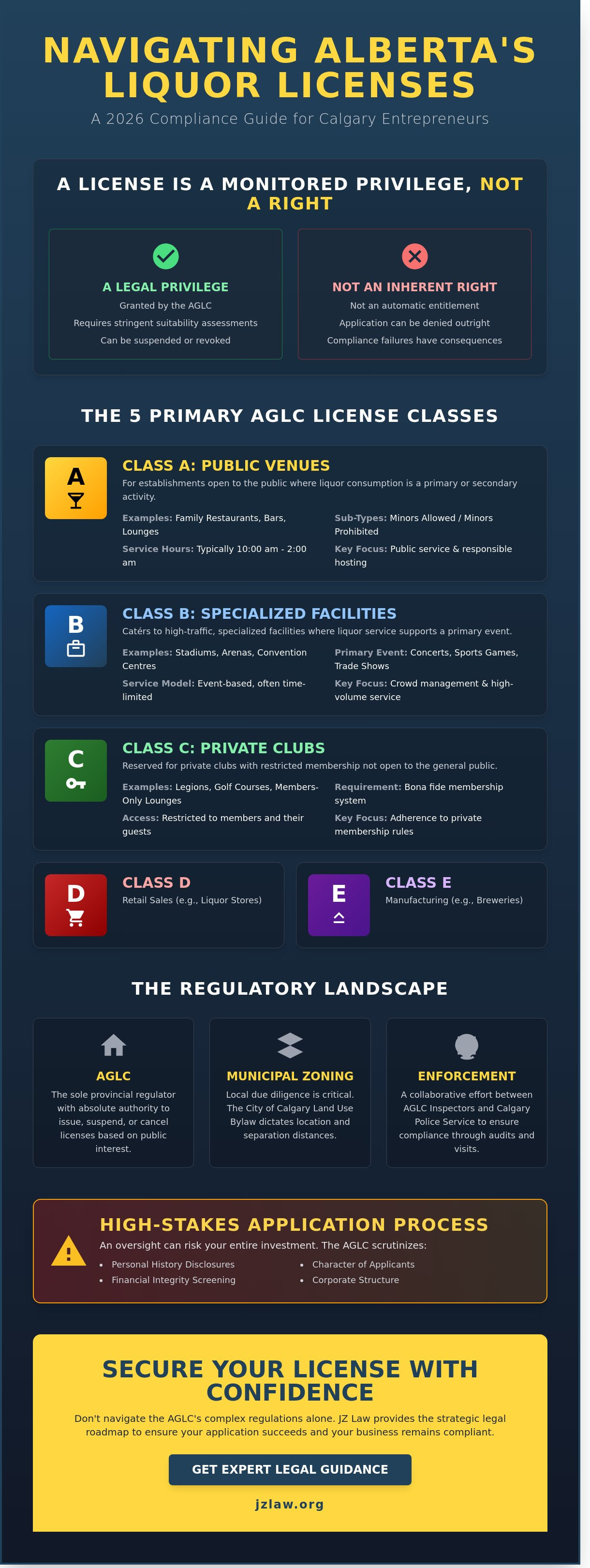
The regulatory environment for securing an alberta liquor license in 2026 requires a sophisticated understanding of both provincial mandates and municipal constraints. The Alberta Gaming, Liquor and Cannabis Commission (AGLC) operates as the sole provincial regulator, exercising absolute authority over the distribution and sale of controlled substances. Prospective operators must recognize that a license is categorized as a legal privilege rather than an inherent right. This distinction is critical; the AGLC maintains the power to deny or revoke permissions based on stringent suitability assessments. As of January 2026, the shift toward a compliance-first operational model is no longer optional for businesses seeking longevity in this sector.
Obtaining an alberta liquor license involves a rigorous vetting process that extends beyond financial viability. The commission scrutinizes the character of applicants, their financial history, and the physical location of the proposed business. Before initiating provincial applications, entrepreneurs in Calgary must prioritize local municipal zoning. The City of Calgary Land Use Bylaw 1P2007 dictates specific separation distances between liquor stores and schools, parks, or other restricted zones. Failure to secure a Development Permit at the municipal level renders the provincial application moot, making local due diligence the primary step in any strategic expansion plan.
The Legal Framework: Gaming, Liquor and Cannabis Act
The Gaming, Liquor and Cannabis Act serves as the primary legislative pillar governing all alcohol-related activities in the province. This Act provides a rigid structure that distinguishes between retail, hospitality, and manufacturing interests, ensuring that market participants don't engage in prohibited cross-sector influences. Recent updates in 2026 have moved toward integrated regulatory oversight. This means businesses holding multiple license types, such as a boutique distillery with an attached retail space, face unified reporting requirements. A preventive legal strategy ensures that operational structures align with these legislative nuances before significant capital is committed.
Key Entities and Governing Bodies in Alberta
The AGLC Board holds the ultimate authority to issue, suspend, or cancel licenses. Their decisions are based on the public interest and the integrity of the industry. Enforcement is a collaborative effort involving AGLC inspectors and the Calgary Police Service, who conduct regular audits and site visits to ensure adherence to service hours and age verification protocols. While provincial laws govern the commerce aspect, federal health standards regulate product safety and labeling. Navigating this multi-jurisdictional web requires a methodical, evidence-based approach to compliance that anticipates regulatory shifts before they impact the bottom line.
Understanding the 5 Primary Classes of Alberta Liquor Licenses
Selecting the appropriate alberta liquor license requires a precise understanding of how the Alberta Gaming, Liquor and Cannabis (AGLC) categorizes commercial activity. Every classification carries distinct legal obligations regarding service hours, minor supervision, and financial reporting. Business owners must align their operational goals with these frameworks to avoid costly compliance errors or license revocations during the application process. Choosing the wrong class doesn't just delay your opening; it can fundamentally alter your revenue potential and tax obligations.
Commercial and Public Licenses (Class A, B, and C)
Class A licenses apply to venues open to the general public where liquor consumption is a primary or secondary activity. This category splits into "Minors Allowed" establishments, such as family restaurants, and "Minors Prohibited" venues, including bars, lounges, and taprooms. Under AGLC guidelines, service typically runs from 10:00 am until 2:00 am, with all consumption ending by 3:00 am. Class B licenses cater to high-traffic, specialized facilities like the Scotiabank Saddledome or large convention centres. In these environments, liquor service supports a primary event like a hockey game or a trade show. Class C licenses are reserved for private clubs, such as the Royal Canadian Legion or restricted-membership golf courses. These entities require strict guest registries and membership verification to maintain their private status. They don't permit general public entry without an invitation from a member in good standing.
Retail, Delivery, and Manufacturing (Class D and E)
Class D licenses govern the retail sale of liquor for consumption off-premises. This includes standalone liquor stores, delivery services, and hotel off-sales. For entrepreneurs in the cannabis sector, understanding Class D is vital. It represents the closest regulatory parallel to retail cannabis operations regarding inventory tracking and age verification protocols. Class E licenses focus on manufacturers, including the 40+ craft breweries currently operating within Calgary city limits as of late 2023. These licenses allow for production and, in specific cases, onsite tasting rooms where the manufacturer's own products are showcased.
Strategic growth often involves navigating "tied-house" restrictions. These rules prevent manufacturers from having direct or indirect financial interests in retail outlets to ensure fair market competition. If you're planning a complex business model involving both production and retail, obtaining strategic legal counsel is a prudent step to ensure your corporate structure complies with AGLC anti-competition policies. Missteps in these relationships can lead to immediate application denials or the suspension of existing permits. Balancing multiple license types requires a robust compliance framework to manage different sets of operational rules simultaneously. You'll need to maintain separate accounting records and staff training certifications for each distinct license class your business holds.
The AGLC Application Process: A Step-by-Step Compliance Roadmap
Securing a retail cannabis permit requires more than just administrative filing; it demands a transparent, strategic presentation of your entire business structure. The Alberta Gaming, Liquor and Cannabis (AGLC) commission operates with a high level of scrutiny. The regulatory rigour involved is comparable to obtaining an alberta liquor license, where financial transparency remains the cornerstone of the evaluation. Applicants must submit a comprehensive Personal History Report and satisfy the "good character" requirement through exhaustive background checks. This phase is critical because any omission, however minor, suggests a lack of integrity that can lead to an immediate rejection of the file.
Background Checks and Financial Integrity
The AGLC defines "associates" broadly, encompassing any individual or entity holding 10% or more of the equity, or those who exert significant influence over the operations. These stakeholders must undergo criminal record checks and provide five years of financial history. A common pitfall is the inability to provide a clear audit trail for initial capital. If a shareholder contributes C$100,000 without documented proof of the funds' origin, the AGLC will likely pause the application. Engaging legal counsel to prepare these disclosure packages ensures that high-stakes investors meet the commission's standards for financial integrity without exposing the business to unnecessary delays. Our preventive approach focuses on identifying these documentation gaps before the AGLC finds them, ensuring the alberta liquor license or cannabis permit standards are met with precision.
Premises and Operational Documentation
Your chosen Calgary location must comply with both provincial mandates and municipal regulations, specifically the Calgary Land Use Bylaw 1P2007. This bylaw enforces strict separation distances, such as the 150-meter buffer required between cannabis stores and schools or emergency shelters. You'll need to submit detailed floor plans that highlight secure storage areas and point-of-sale configurations. Beyond physical layout, the AGLC requires proof of occupancy and valid insurance policies.
When negotiating a lease, it's vital to include a "condition precedent" clause. This legal safeguard allows you to terminate or pause the lease if the AGLC denies your application, protecting your capital from being tied to a site you can't legally operate. Once the physical site meets all safety standards, a 21-day public notification period begins. During this time, Calgary residents can voice objections. Handling these community concerns with a professional, fact-based response is essential for maintaining your standing. The process concludes with a final on-site inspection. If the inspector confirms the security systems and layout match the approved plans, the AGLC issues the physical license certificate, allowing you to order inventory.
Mitigating Regulatory Risk: Inspections and ProServe Compliance
Operating under an alberta liquor license requires more than just initial approval; it demands a perpetual state of audit-readiness. The Alberta Gaming, Liquor and Cannabis (AGLC) commission maintains rigorous oversight through unannounced inspections that evaluate everything from floor plans to employee conduct. Licensees must maintain their "Liquor Service Provider" status by ensuring every individual involved in the sale or service of alcohol completes the mandatory ProServe training. This isn't a suggestion. It's a foundational requirement for risk mitigation. Businesses that fail to internalize these standards risk not only financial penalties but the permanent loss of their operating privileges.
Staff Training and Responsible Service Standards
All staff members, including managers and security personnel, must obtain ProServe certification within 30 days of their hire date. If an inspector finds an uncertified employee serving patrons after this window, the business faces immediate administrative action. We advise clients to implement a formal "House Policy" that exceeds minimum provincial standards. This document should standardize how your team handles intoxicated patrons and verifies identification for anyone appearing under age 25. Such protocols are vital when addressing "Social Host" liability. In a commercial setting, your business can be held legally responsible for injuries or damages caused by an over-served customer even after they leave your premises. Consistency in these daily operations reduces the likelihood of the three most common violations: over-service, selling to minors, and making unauthorized structural changes to the service area without prior AGLC written consent.
Handling Administrative Sanctions and Appeals
When an AGLC inspector arrives, they'll examine your records, signage, and staff certifications. You should document every interaction during these visits and maintain a log of any verbal warnings provided. If a violation is noted, the sanctions follow a progressive spectrum. A first-time minor infraction might result in a warning letter, but repeated or severe violations can lead to fines starting at C$500, license suspensions, or total revocation. It's essential to recognize that regulatory frameworks in Alberta often overlap. The rigorous documentation habits required for an alberta liquor license are directly applicable to the complexities of cannabis licensing, as both sectors demand strict age verification and inventory control.
If your business receives a "Notice of Administrative Sanction," you've the right to a hearing before the AGLC Board. These proceedings are formal. Professional representation is vital during these hearings or subsequent judicial reviews to protect your commercial interests and ensure that the penalty is proportionate to the alleged infraction. Strategic defense at this stage can prevent a single mistake from ending your business operations.
For strategic guidance on maintaining your standing with provincial regulators and defending your commercial interests, consult with our legal experts.
Strategic Legal Counsel for Complex Hospitality and Corporate Licensing
Securing an alberta liquor license represents more than a regulatory hurdle; it's a fundamental pillar of a company's market valuation. At JZ Law, we view licensing as a critical element within strategic corporate transactions. Whether you're expanding a cannabis retail footprint or managing a diverse hospitality portfolio, the legal continuity of your permits dictates your operational viability. John Zang leverages extensive experience in multi-jurisdictional regulatory frameworks to ensure that licensing hurdles don't derail high-stakes business objectives.
Preventative legal audits serve as the foundation of our approach. We ensure your business remains "sale-ready" at all times by maintaining meticulous compliance records and anticipating regulatory shifts. This proactive stance prevents the significant delays often seen in transactions where licensing documentation is found lacking during the final stages of closing. Our strategic audit process involves:
Conducting comprehensive compliance reviews of existing permits to identify potential liabilities.
Identifying red flags in corporate structure that might trigger intensive AGLC investigations.
Aligning licensing timelines with broader corporate restructuring or expansion goals.
Standardizing reporting protocols across multi-unit operations to ensure uniform compliance.
Licensing in Corporate Mergers and Acquisitions
During a merger or acquisition, due diligence must extend beyond financial statements to verify the validity and standing of the target's licenses. Navigating the Alberta Gaming, Liquor and Cannabis (AGLC) requirements during a sale requires a precise understanding of whether a transfer of ownership is permitted or if a new application is mandatory. We protect corporate value by securing licensing continuity, ensuring that revenue streams remain uninterrupted throughout the transition period. Failure to account for the AGLC's processing windows for background checks can jeopardize the entire closing schedule.
The JZ Law Approach: Precision and Professionalism
Our firm prioritizes logistically sound and legally airtight regulatory filings. We provide specialized counsel for niche sectors, such as oil and gas hospitality assets, where remote site licensing and camp service permits present unique legal challenges. John Zang's methodology removes the ambiguity from the alberta liquor license process, allowing executives to focus on growth rather than red tape. We don't just fill out forms; we build a legal framework that supports long-term profitability. Contact John Zang today to schedule a consultation regarding your Alberta licensing strategy and corporate compliance needs.
Securing Your Operational Future in Alberta’s 2026 Hospitality Market
Success in Calgary’s competitive hospitality sector requires a rigorous adherence to the AGLC’s evolving standards. Navigating the five primary classes of an alberta liquor license demands a preventative mindset to ensure your business avoids the costly delays associated with administrative oversights. By integrating mandatory ProServe compliance and robust internal inspection protocols into your daily operations, you protect your commercial investment from unnecessary regulatory scrutiny. It’s about more than just obtaining a permit; it’s about maintaining the legal integrity of your brand through every stage of growth.
John Zang leads a Calgary-based boutique legal practice that specializes in these complex regulatory sectors. He acts as a strategic partner for corporate growth, helping you anticipate legal hurdles before they impact your bottom line. His expertise ensures that your licensing strategy remains resilient amidst shifting provincial policies. Whether you’re launching a new venture or scaling a corporate hospitality group, precise legal guidance provides the security your business deserves. Take the next step toward a compliant and profitable 2026.
Frequently Asked Questions
How long does it take to get a liquor license in Alberta?
Obtaining an alberta liquor license typically requires a processing period of 10 to 12 weeks from the date a complete application is submitted to the AGLC. This timeline includes a mandatory 21 day public notification period where the community can provide feedback on the proposed location. Delays often occur if municipal approvals or floor plans don't meet specific regulatory standards.
What is the cost of an Alberta liquor license in 2026?
The total cost for a standard Class A or B alberta liquor license is currently C$1,400 based on AGLC fee structures. This amount consists of a non-refundable C$700 application fee and an initial C$700 annual license fee. Applicants must also account for additional costs like municipal development permits and criminal record checks which vary by jurisdiction.
Can I sell my liquor license if I sell my Calgary business?
You can't sell or transfer a liquor license to a new owner when selling a business in Calgary. AGLC regulations require the new proprietor to submit a fresh application for their own license. The existing license is cancelled once the sale is finalized. Buyers should initiate this process at least 60 days before the closing date to avoid service interruptions.
Do I need a separate license for a special event at my restaurant?
You don't need a separate license if the event stays within your restaurant's permanently licensed boundaries. However, hosting a function in an unlicensed area like a parking lot or a temporary patio requires a Special Event License. These permits must be secured through the AGLC portal at least 10 business days before the scheduled event.
What is ProServe and who in my company needs it?
ProServe is Alberta's mandatory social responsibility training program designed to reduce underage drinking and overconsumption. Every employee involved in the sale or service of alcohol, including managers and security personnel, must complete this certification. Staff have 30 days from their hire date to obtain their ProServe credentials, which remain valid for five years.
Can a criminal record prevent me from getting an Alberta liquor license?
A criminal record can lead to a license denial if the AGLC determines the applicant isn't of good character or if the offenses relate to the business's integrity. Background checks are mandatory for all directors and shareholders holding 5 percent or more of the company's shares. Each case is reviewed individually, focusing on the nature of the crime and how recently it occurred.
What happens if my liquor license application is contested by the community?
If a community member files a valid objection during the 21 day posting period, the AGLC will investigate the concerns raised. This process often involves a formal hearing where the applicant and the objector present their cases to the AGLC Board. Resolving these disputes can add 30 to 60 days to the overall approval timeline.
Does a liquor license expire, and how do I renew it?
Alberta liquor licenses expire annually on a date determined by the AGLC. Owners must submit a renewal application and pay the C$700 annual fee before the current license lapses. Failing to renew on time results in the immediate suspension of alcohol sales. Most businesses receive a renewal notice 60 days before the expiry date.



Comments