


Cannabis Industry Financing in 2026: Legal Strategies for Global Growth
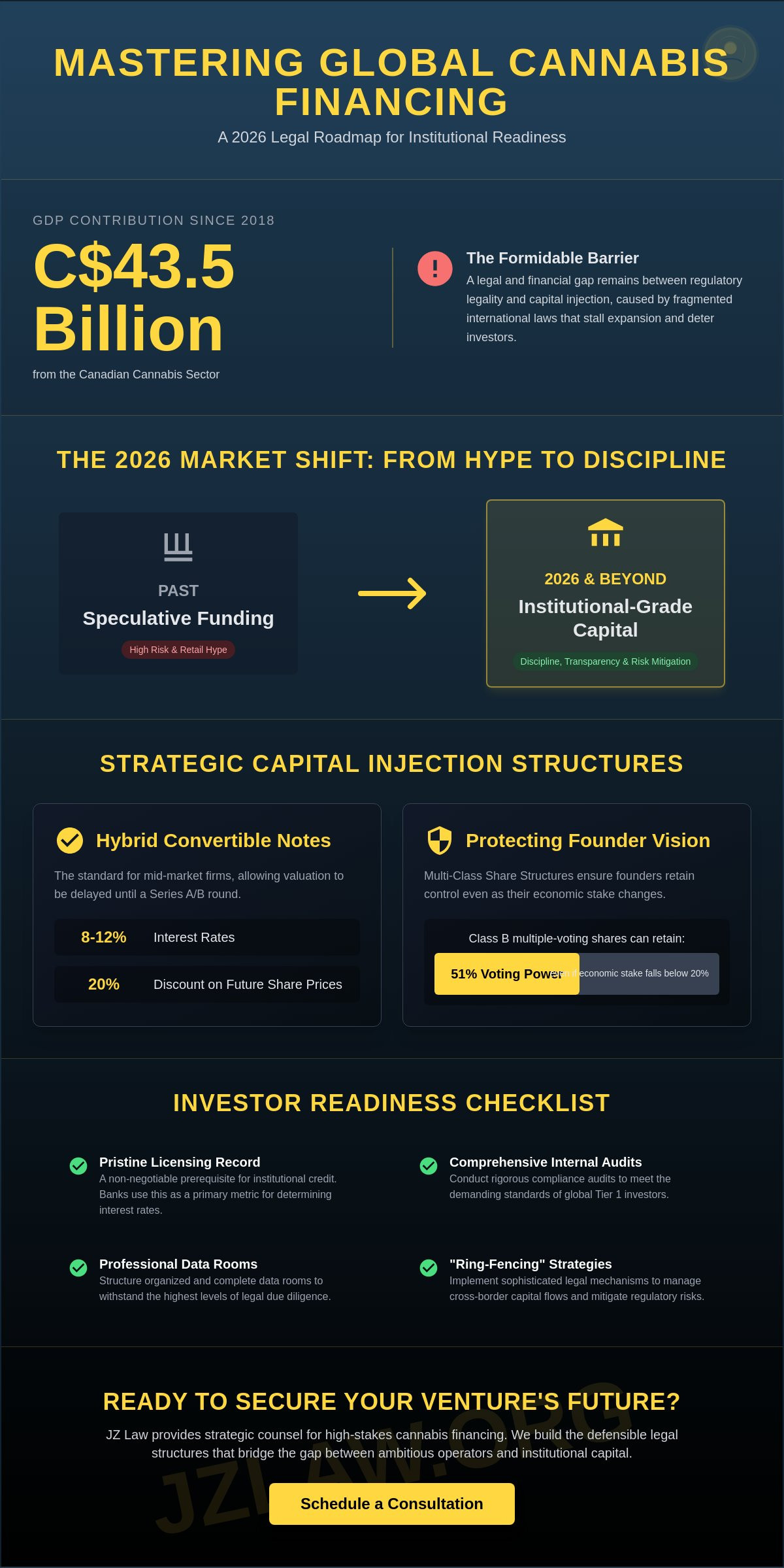
If your corporate structure cannot withstand the rigorous scrutiny of a Tier 1 financial institution's AML audit, is your venture truly prepared for the global stage? You've likely realized that while the Canadian cannabis sector has contributed over C$43.5 billion to the national GDP since 2018, the gap between regulatory legality and actual capital injection remains a formidable barrier for most operators. The friction between Calgary’s provincial frameworks, New York’s social equity mandates, and Berlin’s medical standards often creates a legal paralysis that stalls international expansion. This guide offers a sophisticated roadmap to master cannabis industry financing by addressing these fragmented legal landscapes with surgical precision. You'll learn to optimize your tax and corporate structures to ensure investor readiness while maintaining strict compliance with local securities laws across diverse jurisdictions. We'll examine the specific legal mechanisms required to bridge the divide between ambitious expansion and institutional grade security in an increasingly complex international market.
Key Takeaways
Understand the evolution of the 2026 capital markets as the sector shifts from speculative funding toward institutional-grade debt and equity.
Navigate the legal intricacies of cannabis industry financing by selecting optimal capital injection models, such as hybrid convertible notes, tailored to high-growth ventures.
Implement sophisticated "ring-fencing" strategies to manage cross-border capital flows and mitigate regulatory risks between the Canadian market and international jurisdictions like Germany and the US.
Prepare for rigorous institutional scrutiny by conducting comprehensive internal compliance audits and structuring professional data rooms that meet global investor standards.
Gain strategic insights into taking companies public on North American exchanges through a preventative, business-oriented legal approach.
Table of Contents The Landscape of Cannabis Industry Financing in 2026 Strategic Legal Structures for Capital Injection Cross-Border Challenges: Calgary, New York, and Berlin Legal Due Diligence: Preparing for Investor Scrutiny JZ Law: Strategic Counsel for High-Stakes Cannabis Financing
The Landscape of Cannabis Industry Financing in 2026
By 2026, the global cannabis capital markets have matured into a sophisticated ecosystem where disciplined fiscal management outweighs raw hype. The transition from speculative retail funding to institutional-grade debt and equity is nearly complete. Institutional investors now demand the same level of transparency and risk mitigation they expect from the pharmaceutical or beverage industries. In Canadian hubs like Calgary, municipal clarity regarding land use and business permits has created a stable environment that attracts significant capital. Legal counsel serves as the primary architect in these deals, ensuring that every C$ invested is protected by a robust regulatory framework. It's no longer enough to have a viable product; you must have a defensible legal structure that satisfies the rigorous due diligence of Tier 1 lenders.
The role of the attorney has shifted from simple compliance to strategic partnership. We bridge the gap between ambitious cannabis operators and conservative financial institutions. By 2026, cannabis industry financing involves complex cross-border structures that require a deep understanding of both local bylaws and international trade laws. This professionalization has led to a decrease in the cost of capital for well-governed firms, while speculative ventures without legal foundations find themselves increasingly isolated from the market.
The 2026 Regulatory Environment in Global Hubs
Germany’s 2025 expansion of commercial supply chains has catalysed a wave of financing across Berlin and Frankfurt, influencing how European markets perceive risk. In North America, the 2024 implementation of the SAFE Banking Act's updated provisions has allowed operations in Denver and NYC to access more traditional financial services. Securing cannabis licensing remains the non-negotiable prerequisite for any entity seeking institutional credit. Without a pristine license record, the cost of capital remains prohibitively high. Banks now use licensing status as a primary metric for determining interest rates on commercial loans.
Institutional vs. Alternative Capital Sources
While Tier 1 banks in Canada have increased their exposure, many remain selective, often requiring 150% collateralization for mid-market operators. This gap is filled by specialized cannabis REITs and private equity funds headquartered in Toronto and Vancouver, which provided over C$2.4 billion in alternative funding during the 2025 fiscal year. Many firms now utilize corporate transactions to secure bridge financing, allowing them to scale quickly while waiting for traditional debt markets to fully thaw. These transactions often involve:
Sale-leaseback agreements involving cultivation facilities in British Columbia.
Convertible debt instruments with strict governance covenants.
Syndicated loans led by boutique investment banks in Toronto.
The ability to navigate these diverse funding streams determines a company's longevity. It's a period of consolidation where the legally prepared thrive and the disorganized are absorbed. Our firm focuses on creating the preventive legal structures that make these transactions possible, ensuring that our clients are positioned as low-risk assets in a high-growth industry.
Strategic Legal Structures for Capital Injection
The landscape of cannabis industry financing has shifted from speculative venture capital to disciplined, structured investment. By 2026, the Canadian market has stabilized, yet the cost of capital remains a primary concern for operators. Choosing between equity, debt, or hybrid models requires a granular understanding of the 2026 tax environment and provincial regulatory shifts. Hybrid instruments, particularly convertible notes with 8% to 12% interest rates, have become the standard for mid-market firms. These allow startups to delay valuation until a Series A or B round while offering investors a 20% discount on future share prices. To protect founder vision, many Canadian firms now implement multi-class share structures. By issuing Class B multiple-voting shares to original directors, founders retain 51% of voting power even if their economic stake drops below 20%.
International investors looking at the Canadian market often utilize tax-efficient flow-through vehicles. These structures help minimize the 15% to 25% withholding taxes typically applied to cross-border dividends. Success in 2026 depends on a proactive approach to corporate governance that anticipates these fiscal burdens before the first C$1 million is committed.
Equity Financing and Securities Compliance
Raising capital in 2026 demands strict adherence to National Instrument 45-106 in Canada. Most private raises in Calgary or Toronto rely on the "accredited investor" exemption to bypass the need for a full prospectus. However, firms must ensure that every subscription agreement is bulletproof to mitigate the risk of future rescission rights. When preparing for growth, understanding securities regulation is essential to avoid administrative penalties that can exceed C$50,000 per violation. Precise drafting of these agreements protects the board from liability during subsequent audits.
Debt Financing: Covenants and Security Interests
Debt has become a viable alternative to equity as traditional lenders enter the space. Because cannabis licenses aren't easily transferable, lenders prioritize real estate and equipment as primary collateral. Asset-backed loans in 2026 typically feature "bad boy" guarantees; these clauses hold individual directors personally liable if the company loses its Health Canada license due to criminal activity or gross negligence. Managing inter-creditor agreements is also vital when a firm has multiple layers of debt. These documents establish the "waterfall" of payments, ensuring senior lenders are satisfied before junior creditors receive a cent. For those navigating these complex arrangements, a strategic legal partner can provide the necessary oversight to prevent over-leveraging.
Cross-Border Challenges: Calgary, New York, and Berlin
Managing capital flows between federally legal jurisdictions like Canada and Germany and the state-legal markets of the US requires a sophisticated legal architecture. By 2026, the friction in cannabis industry financing has shifted from a lack of capital to a struggle with regulatory synchronization. We implement "ring-fencing" strategies to isolate assets, ensuring that a regulatory shift or enforcement action in one jurisdiction doesn't trigger a cross-border contagion that freezes a firm's global liquidity. This isolation is critical for protecting Canadian parent companies from the federal-state conflict inherent in US operations.
Currency risk and tax treaties add another layer of complexity. The Canada-Germany-US corridor involves navigating the nuances of the Canada-US Tax Convention and similar treaties with Germany to avoid double taxation on dividends and interest. Compliance with FINTRAC and Anti-Money Laundering (AML) regulations is non-negotiable. Every international transfer exceeding C$10,000 is scrutinized; firms must maintain exhaustive records to prove that funds originate from legal, licensed activities and aren't commingled with proceeds from jurisdictions where the activity remains federally prohibited.
The Calgary-Toronto-Vancouver Connection
Canadian firms continue to leverage the TSX and CSE as primary engines for North American expansion. In Alberta, specific retail financing nuances arise when operators seek to integrate cannabis and hospitality. We assist clients in navigating the alberta liquor license framework, which often influences how retail cannabis spaces are funded and structured. While the CSE offers more flexibility for US-facing investments, Canadian LPs still face significant hurdles. They're often restricted from direct ownership in US multi-state operators (MSOs) to maintain their TSX listings, necessitating complex "exchangeable share" structures to participate in US growth.
European Expansion: Berlin and Frankfurt
The German market's evolution since the 2024 CanG legislation has created a massive demand for medical exports. Securing cannabis industry financing for these ventures depends heavily on achieving EU-GMP certification, which acts as a prerequisite for most institutional debt. In Berlin, the intersection of fintech and cannabis is accelerating. Current developments in cryptocurrency law are now influencing how alternative payment and financing rails are built. These digital solutions provide a bypass for traditional banking friction, provided they adhere to the strict EU-wide AMLD6 directives for transparency and reporting.
Legal Due Diligence: Preparing for Investor Scrutiny
By 2026, the era of speculative, "handshake" cannabis industry financing has been replaced by rigorous, institutional-grade scrutiny. Investors no longer accept vague promises of market share; they demand a verifiable trail of compliance that withstands forensic audits. Preparing for this level of investigation requires a proactive, preventative legal strategy that begins long before the first term sheet is signed. A well-organized data room isn't just a repository of files. It's a testament to the company's operational maturity and risk management capabilities.
A comprehensive internal audit identifies historical red flags that could derail a deal. These often include minor licensing lapses or informal governance structures common during a startup's infancy. In the Canadian market, where Health Canada oversight remains stringent, even a single missed reporting deadline can trigger significant fines or jeopardize the validity of a cultivation license during a change-of-control event. Addressing these issues early allows the firm to present a clean narrative to potential backers, preserving the company's valuation.
The Due Diligence Checklist for 2026
Local Municipal Standing: Verify that all operations in hubs like Denver, Hamburg, or Toronto are in good standing with local zoning and social equity requirements.
Contractual Review: Ensure supply chain contracts don't contain restrictive "change of control" clauses that could block a C$50 million acquisition or investment.
Environmental Compliance: Large-scale cultivation facilities must now meet oil and gas law style environmental standards, specifically regarding wastewater management and carbon sequestration in provinces like Alberta and British Columbia.
Mitigating Governance Risks
Institutional capital seeks stability. Implementing robust board oversight and appointing independent compliance officers signals that the business can operate under the same pressures as traditional pharmaceutical firms. Shareholder agreements must be drafted with precision, specifically addressing scenarios where a major investor’s background might trigger a license revocation under provincial regulations. These "bad actor" clauses are now standard in high-value cannabis industry financing rounds.
Intellectual property (IP) protection has become a primary driver of valuation. Investors aren't just buying greenhouses; they're buying proprietary genetics, extraction methods, and brand equity. Securing Canadian and international patents for unique delivery systems or cultivars creates a defensive moat that justifies premium pricing. Without a clear IP strategy, a business is merely a commodity producer, vulnerable to price fluctuations and aggressive competitors.
Effective legal preparation turns due diligence from a hurdle into a competitive advantage. If you're preparing for a capital raise, contact our strategic legal partners to secure your company's growth.
JZ Law: Strategic Counsel for High-Stakes Cannabis Financing
John Zang approaches legal challenges with a methodology that blends rigorous regulatory compliance with aggressive corporate growth strategies. In the volatile environment of 2026, where cannabis industry financing requires both local precision and global vision, his firm provides the specialized oversight needed for high-stakes transactions. JZ Law doesn't just react to legislative shifts; it anticipates them. This preventive legal care ensures that companies operating in cannabis, crypto, or energy sectors remain insulated from systemic risks while pursuing expansion. The firm's track record of guiding entities through the complexities of North American exchanges, including the Canadian Securities Exchange (CSE) and the TSX Venture Exchange, provides the liquidity options essential for modern scaling.
Why Strategic Legal Counsel Matters
Boutique firms offer a level of agility that larger entities often lack. In the context of cannabis industry financing, this means having direct access to counsel that understands how tax structures in Alberta or Ontario interact with federal regulations and international trade laws. JZ Law manages the delicate intersection of securities law and tax optimization. Whether you're operating out of Calgary or coordinating cross-border deals in New York, the firm provides a single point of strategic contact. This reduces the friction typically found in multi-firm arrangements. A strategic consultation can identify potential regulatory bottlenecks before they impact your C$10 million or C$50 million capital raise.
Your Partner in Global Growth
Success in 2026 depends on more than just capital; it requires structural integrity. JZ Law has facilitated numerous restructurings that transformed struggling operations into lean, investment-ready entities. Through John Zang services, clients access personalized counsel that prioritizes professional excellence and data security. The firm's commitment to preventive legal care means that potential litigation is often neutralized before it begins. This approach saves clients significant capital in potential settlement costs and legal fees. If your organization is ready to scale across North American or international borders, securing a partner who understands the nuance of global regulations is the most critical step you can take.
Expertise in CSE and TSX-V public listings for cannabis entities.
Comprehensive support for corporate restructuring and debt financing.
Strategic offices in Calgary and New York to handle cross-border complexities.
Tailored legal frameworks for crypto-integrated cannabis ventures.
Securing Your Competitive Advantage in the Global Cannabis Market
The shift toward institutional maturity by 2026 demands a rigorous approach to corporate governance and regulatory compliance. Success in this environment hinges on your ability to harmonize cross-border legal requirements across hubs like Calgary, New York, and Berlin. As the Canadian market matures toward a projected C$9.2 billion valuation by 2026 according to Statista reports, the complexity of cannabis industry financing requires more than just capital; it necessitates a preventative legal strategy. JZ Law provides the sophisticated counsel needed to navigate these high-stakes transitions.
Our team brings specialized knowledge in securities and licensing, alongside a proven track record of taking companies public in volatile markets. Whether you're preparing for rigorous investor scrutiny or expanding into European territories, our strategic presence in global financial centers ensures your growth remains legally sound and operationally efficient. Consult with JZ Law for your cannabis financing strategy to build a resilient foundation for your international expansion. We're ready to help you navigate the future of global cannabis commerce with precision and confidence.
Frequently Asked Questions
Is traditional bank financing available for cannabis businesses in 2026?
Traditional bank financing is accessible for Canadian cannabis operators through major institutions like BMO and CIBC as of 2026. These lenders require rigorous compliance audits and debt-to-equity ratios often exceeding 1:2. While interest rates for the sector typically carry a 2% to 4% premium over standard commercial loans, the normalization of the industry has reduced the reliance on high-interest private debt. It's a significant shift from the limited options available during the first five years of legalization.
What are the main differences between financing a cannabis business in Canada vs. the US?
The primary distinction lies in federal status; Canada operates under the federal Cannabis Act, whereas US businesses navigate a patchwork of state laws and federal restrictions. Canadian firms access national capital markets and deduct standard business expenses under the Income Tax Act. US counterparts often struggle with Section 280E of the Internal Revenue Code, though the 2024 rescheduling to Schedule III has begun to mitigate these tax burdens for American operators. This makes cannabis industry financing more streamlined in the Canadian market.
How does Germany’s legalization impact financing for European cannabis startups?
Germany's 2024 Cannabis Act (CanG) transformed the European Union into a viable hub for investment by establishing a clear regulatory framework for medical supply chains. This shift attracted approximately C$1.5 billion in venture capital to the DACH region within the first 18 months of implementation. Investors now view Germany as the primary entry point for scaling medical cannabis operations across the Schengen Area. Startups can leverage this regulatory clarity to secure lower-cost capital than was possible under previous restrictive regimes.
Can a cannabis company go public on the New York Stock Exchange (NYSE)?
A cannabis company can list on the New York Stock Exchange only if its operations don't violate US federal law. This means Canadian Licensed Producers can list because their Canadian activities are legal under the 2018 Cannabis Act. However, US-based Multi-State Operators that cultivate or sell cannabis remain restricted to the Canadian Securities Exchange (CSE) or over-the-counter markets until federal prohibition fully ends. This distinction remains a critical factor in global cannabis industry financing strategies.
What legal documents are required for a private equity raise in the cannabis industry?
Private equity raises require a comprehensive suite of documents including a Subscription Agreement, an amended Shareholders’ Agreement, and detailed Disclosure Schedules. Investors in 2026 demand a Compliance Certificate that verifies the company’s standing with Health Canada or relevant provincial regulators. These documents must outline voting rights, liquidation preferences, and anti-dilution clauses to protect the C$5 million to C$20 million typically sought in mid-market rounds. Precision in these documents prevents future disputes during exit events.
How do securities laws apply to cannabis "friends and family" funding rounds?
Securities laws apply to all capital raises, even small rounds involving personal networks. In Canada, companies must rely on specific prospectus exemptions found in National Instrument 45-106, such as the "friends, family and business associates" exemption. Failure to file the required Report of Exempt Distribution within 10 days of the closing can result in administrative penalties. It's vital to document these rounds correctly to avoid complications during a future C$50 million IPO or acquisition.
What is the role of a securities lawyer in cannabis industry financing?
A securities lawyer manages the structural integrity of the transaction while ensuring the company doesn't run afoul of provincial securities commissions. They draft the offering memorandum, conduct due diligence on cap tables, and manage the regulatory filings necessary for complex deals. Their role is to act as a strategic shield, preventing litigation that could arise from misrepresentation or failure to disclose material risks to investors. They turn complex legal requirements into a roadmap for growth.
How can JZ Law help with cross-border cannabis transactions?
JZ Law facilitates cross-border transactions by harmonizing Canadian regulatory requirements with international legal frameworks. We provide the strategic representation needed to navigate the complexities of moving capital across jurisdictions, ensuring that every C$1 million invested complies with both local and foreign laws. Our firm acts as a bridge for companies expanding from Toronto to Berlin or New York. We focus on risk mitigation and long-term corporate stability for our clients.


Comments